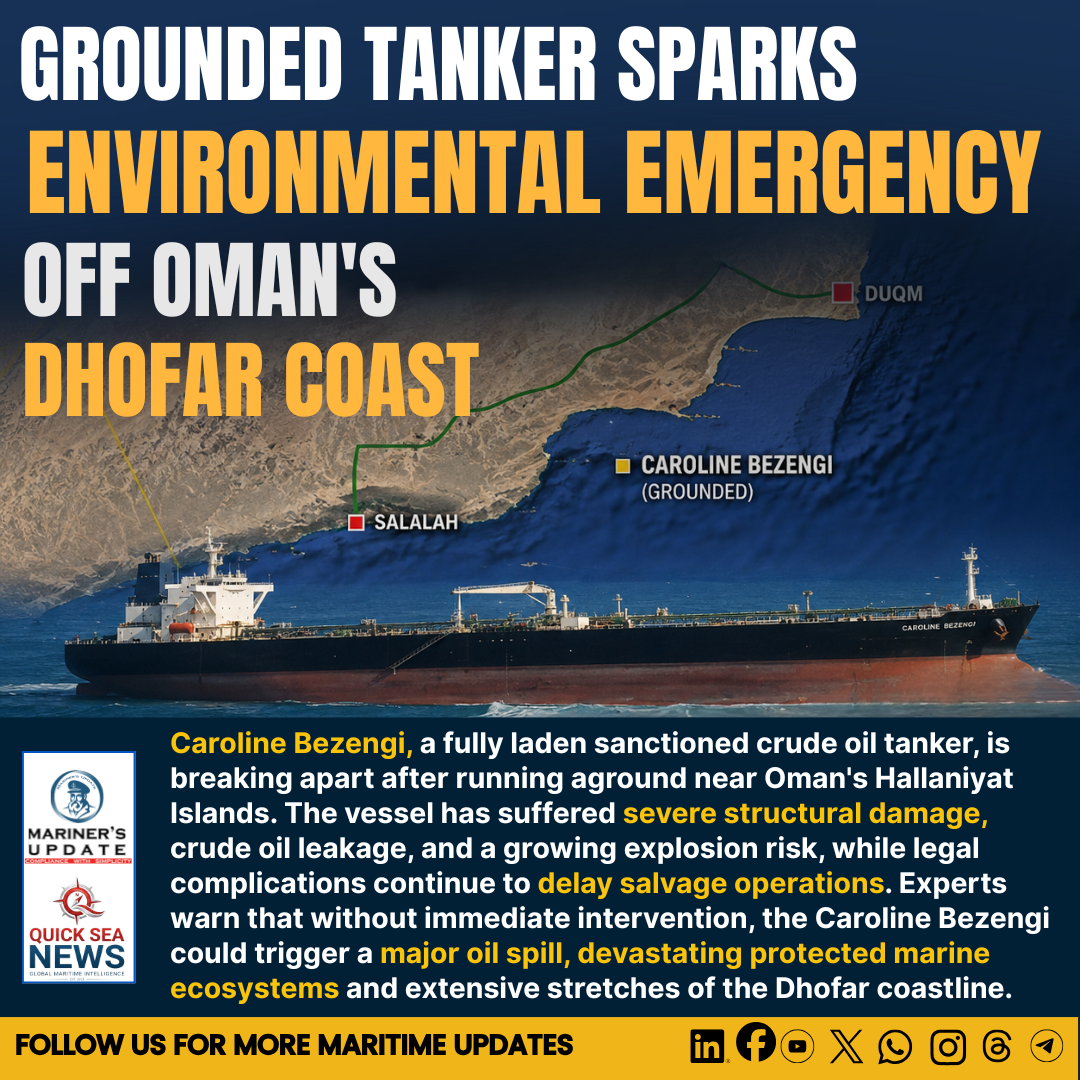
Oman is racing against time to prevent a major environmental disaster after the sanctioned tanker Caroline Bezengi (IMO 9224439) began breaking apart while stranded on rocks near the Hallaniyat Islands, off the Dhofar coast in southwestern Oman. Authorities warn that unless urgent salvage efforts begin, the vessel could split apart completely, releasing a massive quantity of crude oil into one of the country’s most environmentally sensitive marine ecosystems.
The 274-metre Supermax crude tanker, built in 2001 with a deadweight of 159,168 DWT, has been operating under the name Caroline Bezengi since 2023. The vessel has been reporting under the Cameroon flag, although that registration is widely believed to be invalid after Cameroon removed several sanctioned vessels from its registry during a crackdown earlier this year.
The crisis began on 8 June, when the crew reported an explosion onboard while the tanker was sailing off the Dhofar coast. Video footage later showed signs of leakage from the vessel. The tanker had loaded crude oil at Novorossiysk, Russia, and was bound for India before the incident occurred.
The ship is currently aground on rocks at the southwestern tip of Jazirat Al Qibliyyah, one of the Hallaniyat Islands. Its location has made salvage operations extremely challenging. The bow remains firmly wedged on rocky outcrops, while additional rocks lie alongside the port side and approximately 500 yards astern, leaving little room for movement. Strong monsoon-driven seas continue to batter the stranded tanker, accelerating structural damage.
The crew is believed to have abandoned the vessel several days after the explosion. Although their current whereabouts remain unknown, former officers from the ship have reportedly been assisting Omani authorities in evaluating the vessel’s deteriorating condition.
An onboard inspection conducted by Omani maritime authorities on 12 July revealed alarming deterioration compared with aerial assessments carried out just one week earlier. Investigators found that the tanker was fully loaded with crude oil except for a single cargo tank, which was the only compartment not showing signs of damage. The remaining cargo tanks have reportedly been breached and contaminated with seawater.
Authorities also confirmed that the vessel is settling deeper into the water while developing an increasing list. Of particular concern is that crude oil has leaked into ballast spaces and the double-hull compartments, creating a build-up of flammable vapours that significantly increases the risk of another explosion.
The tanker is subject to sanctions imposed by the European Union, the United Kingdom, and the United States (OFAC) due to its association with Russia’s shadow fleet and previous links to Russian state-owned shipping company Sovcomflot.
Efforts to launch salvage operations have been complicated by legal and ownership issues. Omani authorities have reportedly received no response from the vessel’s listed owner and manager, Rentoor Shipmanagement, based in Shanghai, whose approval would typically be required before major recovery work could begin.
To assess available options, Oman commissioned an independent evaluation by an internationally recognised salvage company. The assessment concluded that the vessel’s condition is rapidly worsening but identified a possible recovery strategy. The proposed operation would involve installing a 1,000-yard pipeline to transfer the crude oil to a receiving tanker anchored in sheltered waters before attempting to refloat the damaged vessel as its weight decreases.
However, the salvage company warned that the operation itself carries considerable risks, including additional explosions, structural failure, and the possibility of the vessel breaking apart during cargo transfer.
Time is now the most critical factor. Without immediate intervention, experts fear the Caroline Bezengi could fracture completely, releasing its cargo into the surrounding waters.
Such a spill would threaten the internationally significant Hallaniyat Islands Marine Buffer Zone, an area with restricted access established to protect endangered marine wildlife, including the Arabian humpback whale, nesting sea turtles, and numerous seabird species. Oil contamination could also spread across extensive sections of the Dhofar coastline, causing long-term ecological and economic damage.
As legal complications continue to delay decisive action, the deteriorating tanker has become one of the region’s most serious maritime pollution threats, highlighting the growing risks posed by aging sanctioned vessels operating within the global shadow fleet.