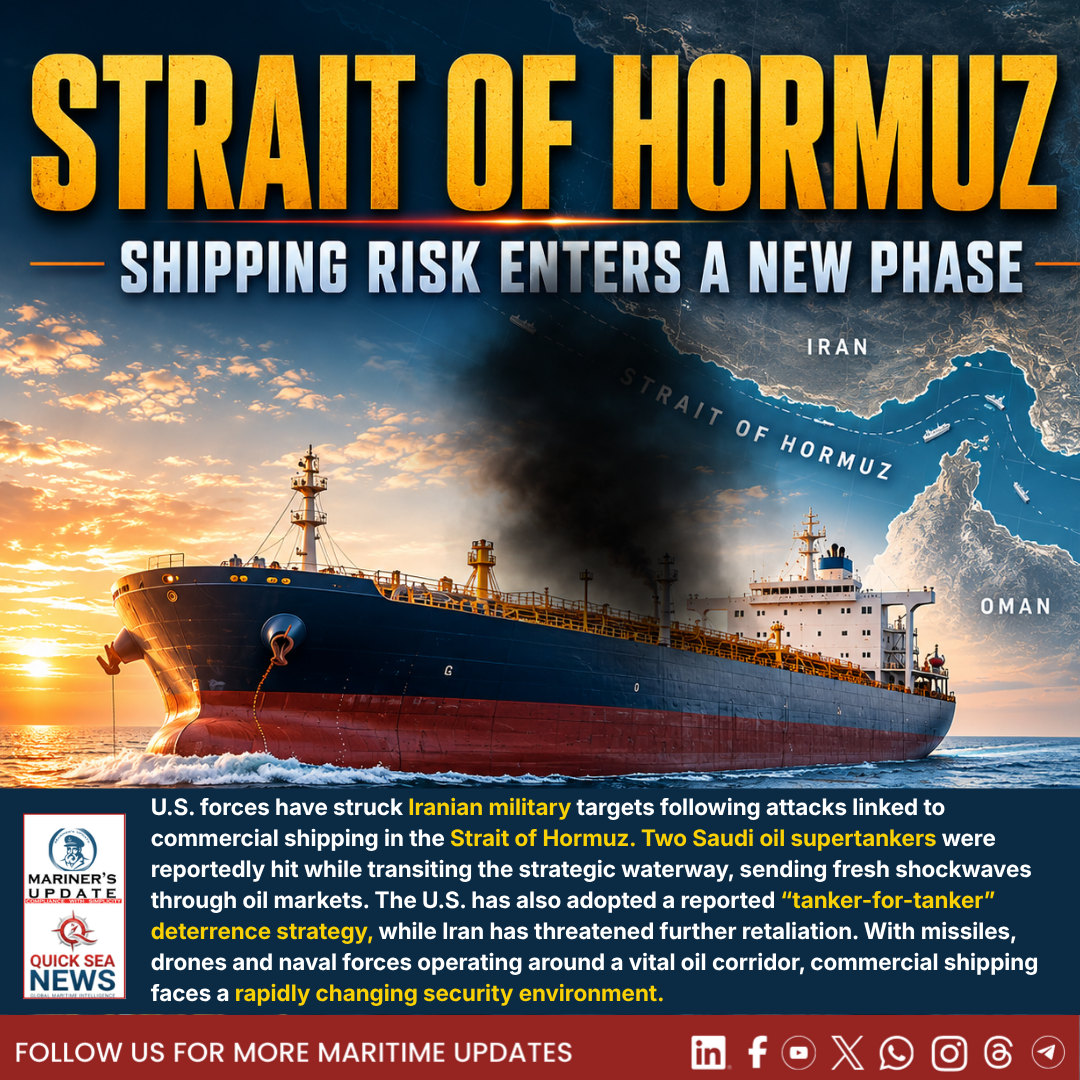
Military escalation, attacks on oil tankers and a new “tanker-for-tanker” strategy put commercial shipping at the centre of the U.S.–Iran confrontation.
The security situation around the Strait of Hormuz has entered a more dangerous phase after the United States launched a new wave of strikes against Iranian targets, following a series of attacks involving commercial shipping and military assets in the region.
The latest escalation has raised fresh concerns for shipowners, operators, seafarers, insurers and energy markets, as the waterway remains effectively closed to normal commercial shipping activity amid the confrontation.
The U.S. Central Command said its forces began striking Islamic Revolutionary Guard Corps (IRGC) targets in Iran at 12 p.m. ET on Tuesday, stating that the operation followed attempted IRGC attacks against commercial vessels transiting the Strait of Hormuz and against U.S. personnel stationed in the region.
Tankers attacked while transiting Hormuz
The escalation follows reports that two supertankers carrying Saudi crude were struck by unknown projectiles within minutes of each other late Monday while sailing outbound through the Strait of Hormuz.
The incidents were reported by shipping intelligence and vessel-tracking firms and immediately heightened concerns over the safety of commercial vessels using the strategically important waterway.
The Strait of Hormuz is one of the world’s most important energy corridors, making any disruption there capable of creating consequences well beyond the immediate conflict zone.
Oil markets reacted quickly. Brent crude futures, which were already around 2% higher, gained almost another 2% following reports of the tanker attacks, reflecting renewed fears of disruption to crude supplies from the Gulf.
U.S. expands military response
According to U.S. officials, Tuesday’s operation involved approximately 100 targets across Iranian military infrastructure.
The reported targets included:
- IRGC air-defence installations
- Radar systems
- Communications infrastructure
- Mine-laying capabilities
- Anti-ship cruise missile launchers
- Attack-drone launch facilities
The strikes were intended not only as retaliation but also to reduce Iran’s ability to threaten commercial shipping, U.S. naval vessels and aircraft operating in and around the Strait.
U.S. officials said the operation was designed to degrade Iran’s radar and missile capabilities and could reduce the immediate threat to commercial shipping for at least a period of time.
A new “tanker-for-tanker” strategy
One of the most significant developments is the reported decision by the Trump administration to adopt a new “tanker-for-tanker” policy.
U.S. officials said the strategy was approved by President Donald Trump as an additional deterrent against Iranian attacks on tankers moving through the Strait.
During Tuesday’s operation, two Iranian government tankers were also struck, according to U.S. officials. The vessels were reportedly anchored north of the U.S. naval blockade line, with U.S. drones striking their engine rooms.
This marks a significant development because the vessels were reportedly targeted in retaliation for attacks on shipping, rather than simply as part of efforts to prevent them from breaching the naval blockade.
Iran retaliates
Iran responded with missile and drone attacks against U.S. positions across the region.
U.S. officials said Iran launched approximately 25 ballistic missiles, with around half reaching Jordanian airspace. Ten were reportedly intercepted, while three landed without causing casualties.
Iran also launched approximately two dozen drones toward U.S. bases in Bahrain, most of which were intercepted.
Additional ballistic missiles and drones were reportedly directed toward U.S. installations in Kuwait, while two drones launched toward a U.S. facility in Erbil, in Iraq’s Kurdistan region, were also intercepted.
Iranian officials warned that Washington would regret the latest attacks, signalling that the possibility of another round of retaliation remains high.
Commercial vessels continue moving under military protection
Despite the rapidly deteriorating security environment, commercial shipping did not completely stop.
U.S. officials said American forces continued guiding vessels through the Strait of Hormuz, with approximately 40 ships transiting in and out of the waterway on Tuesday, collectively carrying millions of barrels of oil.
U.S. forces also reportedly intercepted several anti-ship cruise missiles and drones launched by the IRGC toward ships operating in the area. According to U.S. officials, none of the commercial vessels were hit during these incidents.
For the shipping industry, however, the continued movement of vessels does not eliminate the risk.
The presence of active missiles, drones, naval forces and military interception operations means that even vessels which successfully transit the Strait may face significantly elevated operational and insurance risks.
Iran warns of wider oil disruption
Iranian officials have continued to issue strong warnings regarding Gulf oil exports.
Iranian Parliament Speaker Mohammad Baqer Qalibaf was quoted as saying that if Iran is prevented from exporting oil from the Persian Gulf, no one would be able to export oil.
Iranian Foreign Ministry spokesman Esmaeil Baghaei also accused Washington of making excessive demands and warned that Tehran would use its available capabilities both on the battlefield and through diplomatic channels.
Such statements have intensified concerns that the conflict could move beyond isolated attacks and develop into a broader disruption of energy shipments from the Gulf.
Economic pressure adds another layer of tension
Military action is being accompanied by renewed U.S. economic pressure.
U.S. Treasury Secretary Scott Bessent had indicated that Washington was preparing additional sanctions against Iran, including potential measures targeting banks, airline-leasing companies and other entities linked to the IRGC.
He also warned that companies and countries conducting business with Iran could face U.S. sanctions.
The objective, according to Bessent, is to place further economic pressure on Iran’s leadership by restricting access to financial resources and oil-related revenues.
Iran has faced extensive U.S. sanctions for decades, particularly measures designed to restrict its oil income and access to components and technologies associated with military capabilities.
Conflict risks spilling back into full-scale confrontation
The latest developments come after months in which the conflict had increasingly shifted from direct military confrontation toward sanctions, blockades and economic pressure.
A June Memorandum of Understanding had been intended to halt fighting and create a 60-day period for negotiations. However, the negotiation period passed without a broader agreement, while thousands of people in Iran and Lebanon have reportedly been killed since U.S. and Israeli strikes began on February 28.
The weekend’s exchange of attacks had initially raised hopes that the confrontation might remain limited.
Those expectations have now been challenged.
Although President Trump had said the Iranian strikes did not necessarily represent a return to full-scale war, both sides have continued to threaten further retaliation.
That creates a particularly uncertain environment for maritime operators because the Strait of Hormuz sits directly at the intersection of military activity and global energy transportation.
Shipping industry faces renewed uncertainty
For shipowners and operators, the latest escalation introduces several immediate concerns.
The reported attacks on Saudi crude tankers demonstrate that commercial vessels can become directly exposed even when they are not military targets.
Potential consequences include:
- Increased risk to tankers transiting the Strait
- Higher war-risk insurance exposure
- Possible delays and rerouting decisions
- Greater requirements for voyage-risk assessments
- Increased naval and military activity around commercial traffic
- Potential disruption to crude and petroleum-product movements
- Higher volatility in global oil prices
- Additional sanctions-compliance challenges for operators dealing with Gulf trade
The U.S. Embassy in Qatar has also urged Americans in the region to maintain heightened vigilance, warning of possible flight cancellations, airspace closures and travel disruption.
For maritime stakeholders, the situation reinforces the importance of continuously monitoring navigational warnings, naval advisories, security alerts, charter-party requirements, insurance guidance and company security procedures before and during voyages through the region.
What happens next?
The immediate question is whether Tuesday’s strikes will act as a deterrent or trigger another cycle of retaliation.
Iran has already indicated that it will respond to further attacks, while Washington has warned that any retaliation could result in an even stronger response.
Meanwhile, commercial vessels continue to navigate one of the world’s most strategically important waterways under an increasingly complex security environment.
The situation therefore remains fluid.
For the global shipping industry, the Strait of Hormuz is no longer simply a geopolitical flashpoint. It has become a direct operational risk for vessels, crews, cargo interests and global energy supply chains.
Any further attacks on tankers, additional military strikes or restrictions on Gulf oil exports could rapidly push oil prices higher and create wider disruption across international shipping markets.