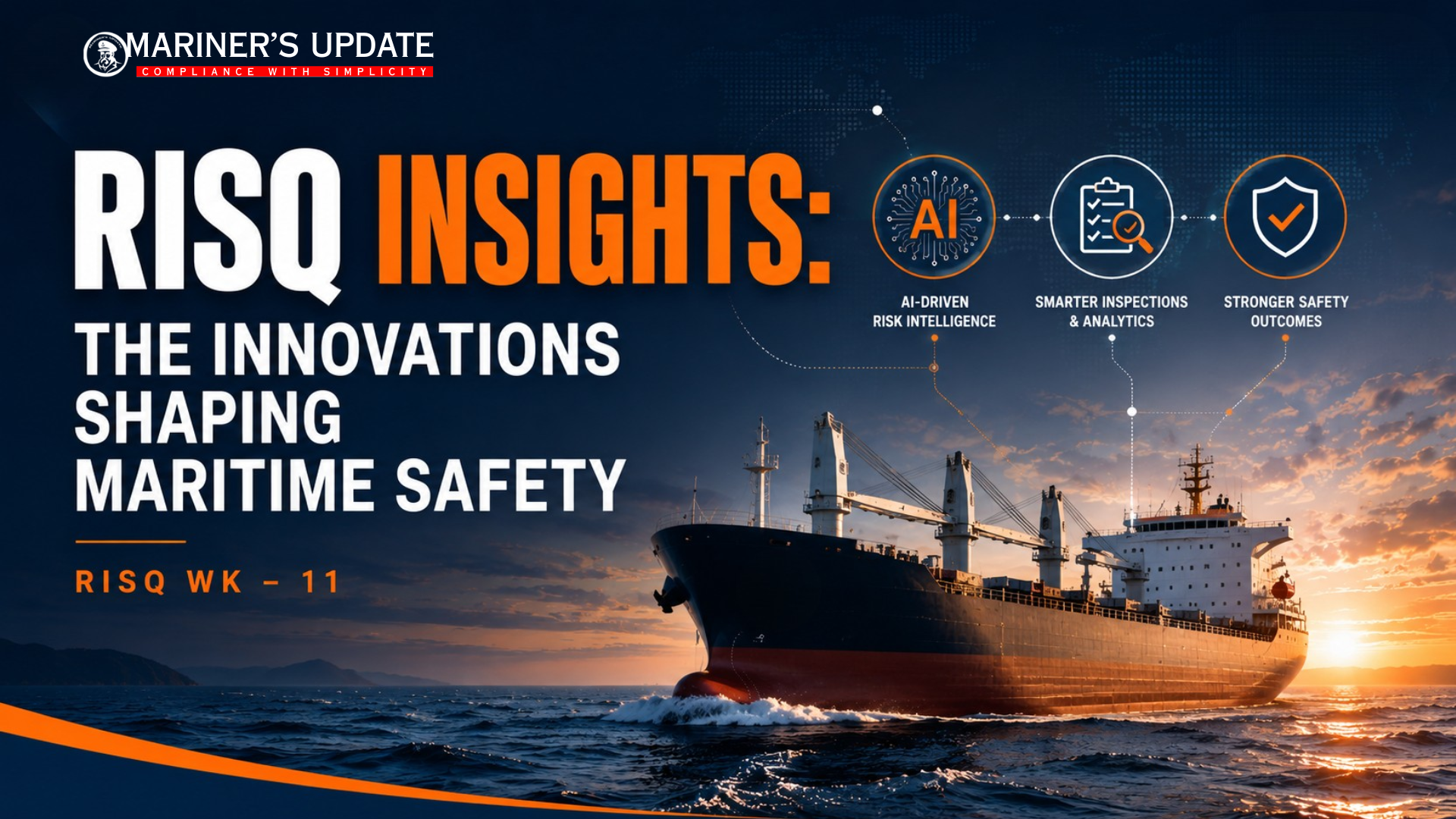
A data-led briefing on AI in risk management, operational efficiency drivers, and the direction of standardised vessel inspections.
This briefing summarises three key developments shaping maritime risk management today: the rise of AI-led inspection analysis, the operational factors driving efficiency gains, and the industry’s shift toward standardised inspection frameworks.
AI in Maritime Risk Management
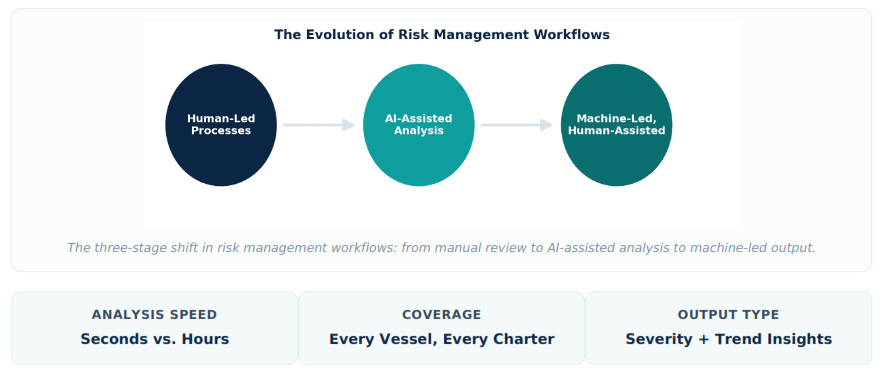
From Manual Review to Machine-Led, Human-Assisted Analysis
Artificial intelligence is fundamentally changing how maritime risk is assessed. Specialised AI agents can now interpret complex Port State Control closeouts and extract insights from Class Status Reports within seconds, replacing manual, human-led review with machine-led, human-assisted analysis.
Beyond counting deficiencies, AI systems evaluate severity, filter out noise, and identify recurring risk themes, enabling regional insights at scale across every vessel and every charter, a level of analysis not previously achievable through manual effort alone.
A significant portion of maritime data still exists in unstructured formats such as PDFs, designed for human reading rather than machine processing. AI directly addresses this gap by reading unstructured documents, interpreting context, and generating actionable output in real time, with human expertise retained for decisions that require judgement.
Summary Points:
- Workflow shift: AI now leads routine analysis; human judgement is applied where it adds the most value.
- Data conversion at scale: Unstructured PDFs are turned into actionable, industry-scale insight in seconds.
- Beyond deficiency counts: AI output includes severity rating, risk themes, and regional trend data.
- Built-in oversight: Transparent methods and human review keep the model accountable and trustworthy.
Operational Efficiency: What’s Driving Risk Today
Data Access and Workflow Design, Not Just Technology
Operational risk in shipping is closely tied to timeline pressure and fragmented data access. Across chartering and cargo operations, the primary source of risk is often not an unknown hazard, but time lost retrieving documents, checking disconnected platforms, and consolidating information under pressure.
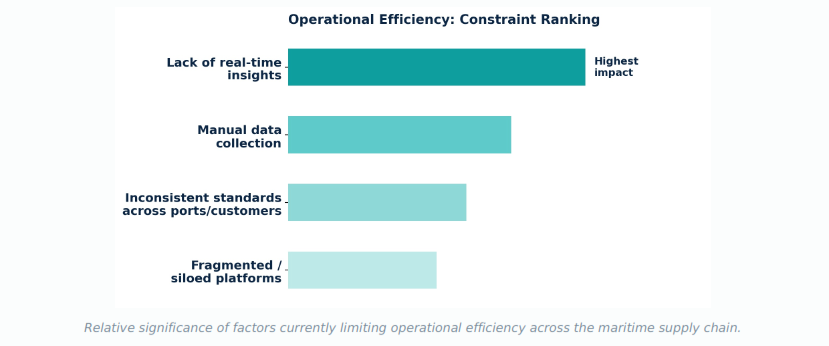
Four recurring factors currently limit operational efficiency across the industry: limited real-time visibility, manual data collection, inconsistent standards across ports and customers, and fragmented, siloed platforms. Of these, limited real-time visibility is the most significant constraint, directly affecting how quickly decisions can be made and verified.
Addressing this requires transparency and orchestration, ensuring information flows proactively between owners, managers, charterers, and terminals. Data completeness and verification remain more critical than platform capability alone: incomplete or unverified data limits the value of any system, regardless of its sophistication.
Summary Points:
- Real-time data access is the top constraint: Decision speed depends on data being collected, verified, and accessible across all parties.
- Manual and siloed systems create delay: Continued reliance on email and disconnected platforms adds duplication and lag time.
- Risk profiles are not uniform: Shared frameworks, rather than single fixed solutions, allow risk management to scale across varied supply chains.
- Advance data sharing supports readiness: Vessels stay inspection- and audit-ready when requirements and data are shared ahead of time.
- Adoption matters as much as tooling: Efficiency gains depend on trust and collaboration across the value chain, not technology alone.
Standardised Inspections: Current State and Direction
Toward Consistency, Context, and Comparable Outcomes
Inspection standardisation is well established in the tanker sector through frameworks such as SIRE, while the dry bulk sector continues to operate under varied expectations, multiple inspection formats, and inconsistent standards across stakeholders. This variation adds complexity for owners, managers, and charterers assessing vessel condition and inspection outcomes.
The direction of travel is toward a risk-based inspection model, one that accounts for corrective action history, improves how inspection data is shared and interpreted, and factors in the seafarer’s operating experience. Inspection outcomes are increasingly viewed as most useful when they measure resilience and responsiveness, not only the presence or absence of deficiencies.
Summary Points:
- Standardisation drives consistency: A common inspection framework enables owners, charterers, and operators to work from a shared performance baseline.
- Risk-based inspection is more efficient: Tailoring inspection scope to vessel history focuses effort where it is most needed.
- Response quality is a meaningful metric: How operators address findings is as informative as the findings themselves.
- Shared data reduces duplication: Streamlined access to inspection records can reduce repeat inspections and improve fleet-wide planning.