
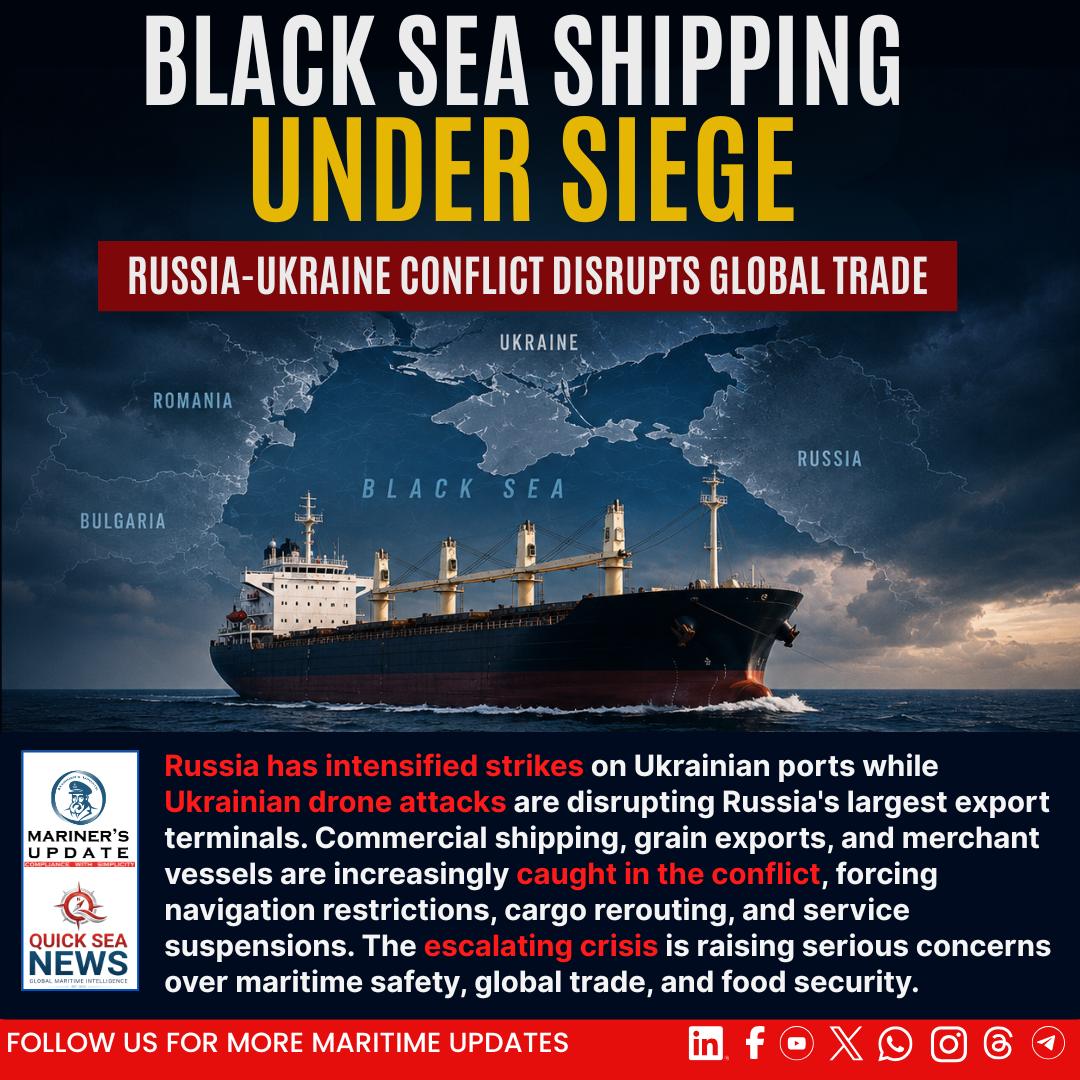
The Black Sea shipping industry is facing one of its most challenging periods since the outbreak of the Russia-Ukraine conflict, with escalating military actions by both nations increasingly disrupting commercial maritime operations, threatening global food supplies, and forcing shipping companies to alter established trade routes.
Russia has intensified attacks on Ukraine’s maritime infrastructure, targeting key commercial ports, merchant vessels, warehouses, and fuel storage facilities, while Ukraine’s expanding drone campaign is simultaneously disrupting Russia’s own export gateways. The latest developments demonstrate how merchant shipping and civilian port infrastructure have become central elements of the ongoing conflict.
According to Russia’s Ministry of Defence, Russian forces carried out strikes against port infrastructure in Odesa and Chornomorsk. Russian officials claimed that a dry cargo vessel unloading cargo at Chornomorsk was struck alongside a military cargo depot and nearby fuel storage tanks. Additional attacks reportedly targeted loading facilities, warehouses, and two bulk carriers operating in Odesa.
Nearly four and a half years into the war, commercial shipping has become increasingly exposed to military operations. Tankers, bulk carriers, and general cargo vessels operating throughout the Black Sea and the Sea of Azov have repeatedly faced missile and drone attacks, making it increasingly difficult for shipowners, operators, and crews to distinguish between civilian trade and military logistics.
The situation has become severe enough for Ukraine to request an urgent meeting of the United Nations Security Council after maritime traffic through Ukraine’s Black Sea humanitarian shipping corridor came to a complete standstill during one of the country’s most critical agricultural export periods.
Ukraine’s Acting Foreign Minister Andrii Sybiha stated that no commercial vessels transited the corridor during the latest reporting period. He further accused Russia of attacking at least three civilian cargo vessels in recent days, resulting in multiple crew members being killed or injured.
Ukraine also warned that continued attacks on merchant shipping could have significant global consequences. As one of the world’s largest agricultural exporters, prolonged disruption of Ukrainian grain exports could increase food prices across Africa, Asia, the Middle East, and Latin America, placing additional pressure on already fragile global food supply chains.
While Ukraine’s ports remain under attack, Russia is also experiencing growing disruption to its maritime exports.
Following repeated Ukrainian drone attacks, Russian authorities have imposed temporary navigation restrictions at Novorossiysk, the country’s largest commercial port by cargo throughput. Ships are reportedly prohibited from entering or departing the port between midnight and 5:00 a.m., although normal commercial operations continue outside those restricted hours.
Novorossiysk is strategically important to Russia’s economy, handling approximately one-third of the nation’s grain exports in addition to significant volumes of crude oil, petroleum products, metals, and containerized cargo.
Russia has also introduced additional security measures around the ports of Azov and Kavkaz, prohibiting vessels from anchoring in areas lacking adequate air-defence protection following recent drone attacks.
These restrictions were introduced shortly after Ukrainian drones struck the offshore terminal of the Caspian Pipeline Consortium near Novorossiysk. During the attack, the tankers Asia and Nissos were affected while loading crude oil. A fire broke out aboard Asia, forcing a temporary suspension of loading operations. Fortunately, no casualties or marine pollution were reported.
The worsening security situation is already reshaping commercial shipping networks.
Global container carrier Maersk has suspended feeder services through Chornomorsk Fishing Port until further notice. Import containers, including cargo carried aboard Medkon Mira, are now being redirected to Romania’s Port of Constanța, where alternative transport arrangements into Ukraine are being offered. Export cargoes are also being shifted to Romanian facilities as shipping companies continue adjusting operations to minimize security risks.
Beyond the Black Sea, European authorities are expanding enforcement actions against Russia-linked shipping.
European Union member states have authorised Operation Atalanta operating in the Indian Ocean to board vessels suspected of belonging to Russia’s so-called “shadow fleet.” The decision follows another successful inspection conducted under Operation Irini in the Mediterranean, reflecting the EU’s broader strategy of combining maritime sanctions with active enforcement at sea.
The continued escalation highlights how maritime security has become a critical dimension of the Russia-Ukraine conflict. With commercial vessels, export terminals, and strategic ports increasingly caught between military operations, global shipping faces heightened operational risks, insurance costs, voyage disruptions, and continued uncertainty across one of the world’s most strategically important trade corridors.