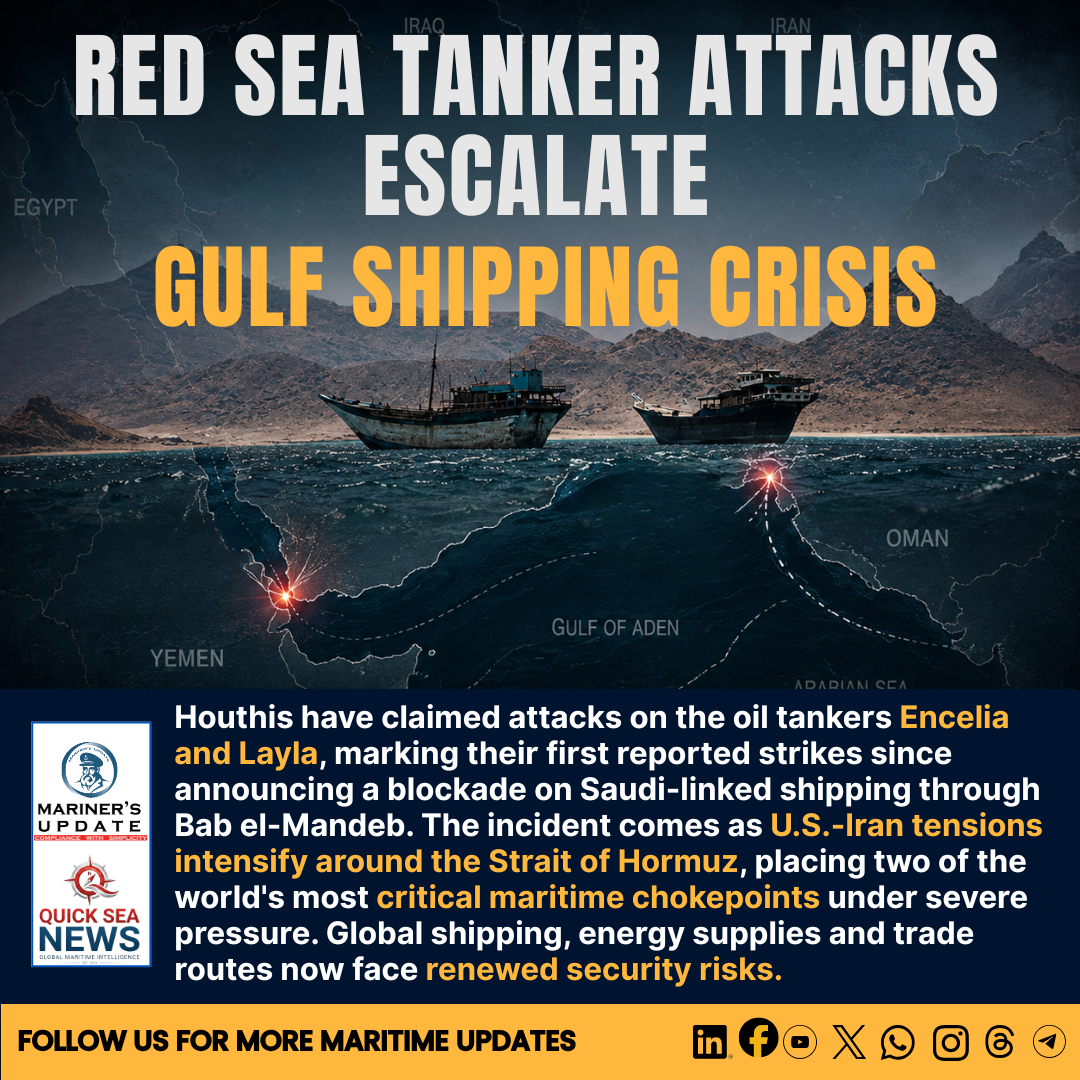
The maritime security situation in the Middle East has deteriorated further after Yemen’s Iran-backed Houthi movement claimed responsibility for attacks on two oil tankers in the Red Sea, marking a significant escalation in the ongoing regional conflict. The attacks come amid an expanding confrontation involving the United States, Iran, and strategic maritime chokepoints that are vital to global trade and energy supplies.
According to Houthi statements, the crude oil tankers Encelia and Layla were targeted in the Red Sea, with both vessels reportedly catching fire following the strikes. The group described the attacks as retaliation against Saudi Arabia’s continued blockade of Yemen and recent military actions targeting Sanaa. This is the first reported strike on commercial vessels since the Houthis announced a blockade on Saudi-linked shipping transiting the Bab el-Mandeb Strait, one of the world’s most strategically important maritime corridors.
Saudi authorities confirmed that Encelia sustained fire damage at the vessel’s bow after being struck while transiting the Red Sea. Fortunately, no casualties were reported. The United Kingdom Maritime Trade Operations (UKMTO) also confirmed receiving reports of a tanker hit by an unidentified projectile approximately 70 nautical miles southwest of Al Shuqaiq, Saudi Arabia, with no injuries among the crew.
The latest attacks have significantly heightened concerns over the security of the Bab el-Mandeb Strait, a critical gateway connecting the Red Sea with the Gulf of Aden. Approximately 12% of global trade and nearly 25% of the world’s container traffic passes through this narrow waterway on routes linking Europe and Asia via the Suez Canal. Any sustained disruption in this corridor could have serious implications for global supply chains, freight costs, energy markets, and insurance premiums.
The escalation also coincides with continuing tensions surrounding the Strait of Hormuz, another globally significant maritime chokepoint. While Bab el-Mandeb faces renewed attacks from the Houthis, the Strait of Hormuz remains under severe strain due to the ongoing confrontation between the United States and Iran. The waterway, which normally carries around 20% of the world’s traded oil and gas, continues to experience major operational disruptions, placing additional pressure on international shipping and energy markets.
Meanwhile, the United States has continued its military campaign against Iran, carrying out another night of strikes aimed at degrading Tehran’s military capabilities and protecting commercial shipping. U.S. Central Command stated that the operations are intended to reduce threats against civilian mariners and merchant vessels operating in regional waters.
Adding to tensions, U.S. President Donald Trump warned that the United States would respond forcefully to any future Iranian attack on commercial shipping in the Strait of Hormuz, declaring that every attack on a vessel would trigger strikes against selected Iranian infrastructure. The statement signals an increasingly aggressive posture as both nations continue to exchange threats.
Iran, however, has maintained that the strategic waterway will not return to pre-war operating conditions. Iranian officials continue to insist they have the authority to regulate maritime traffic through the Strait of Hormuz, while warning that any attacks on Iranian infrastructure will be met with what they described as a “powerful and decisive response.”
The wider conflict continues to expand beyond maritime operations. Reports indicate ongoing U.S. missile strikes on military targets inside Iran, while Iranian retaliatory actions have reportedly targeted energy infrastructure and desalination facilities across the Gulf region. Kuwait also confirmed its air defence systems intercepted hostile drones during the latest round of regional hostilities.
Despite continued diplomatic engagement involving Pakistan, Gulf nations and other regional mediators, there are currently few signs of meaningful progress toward de-escalation. Senior U.S. officials have stated that while diplomatic channels remain open, the immediate priority remains ensuring the safety of international shipping and restoring freedom of navigation.
For the maritime industry, the simultaneous instability at both the Bab el-Mandeb Strait and the Strait of Hormuz represents one of the most serious security challenges in recent years. Shipowners, operators, charterers and insurers are closely monitoring developments as voyage planning, routing decisions, risk assessments and freight costs continue to be heavily influenced by the evolving geopolitical situation.