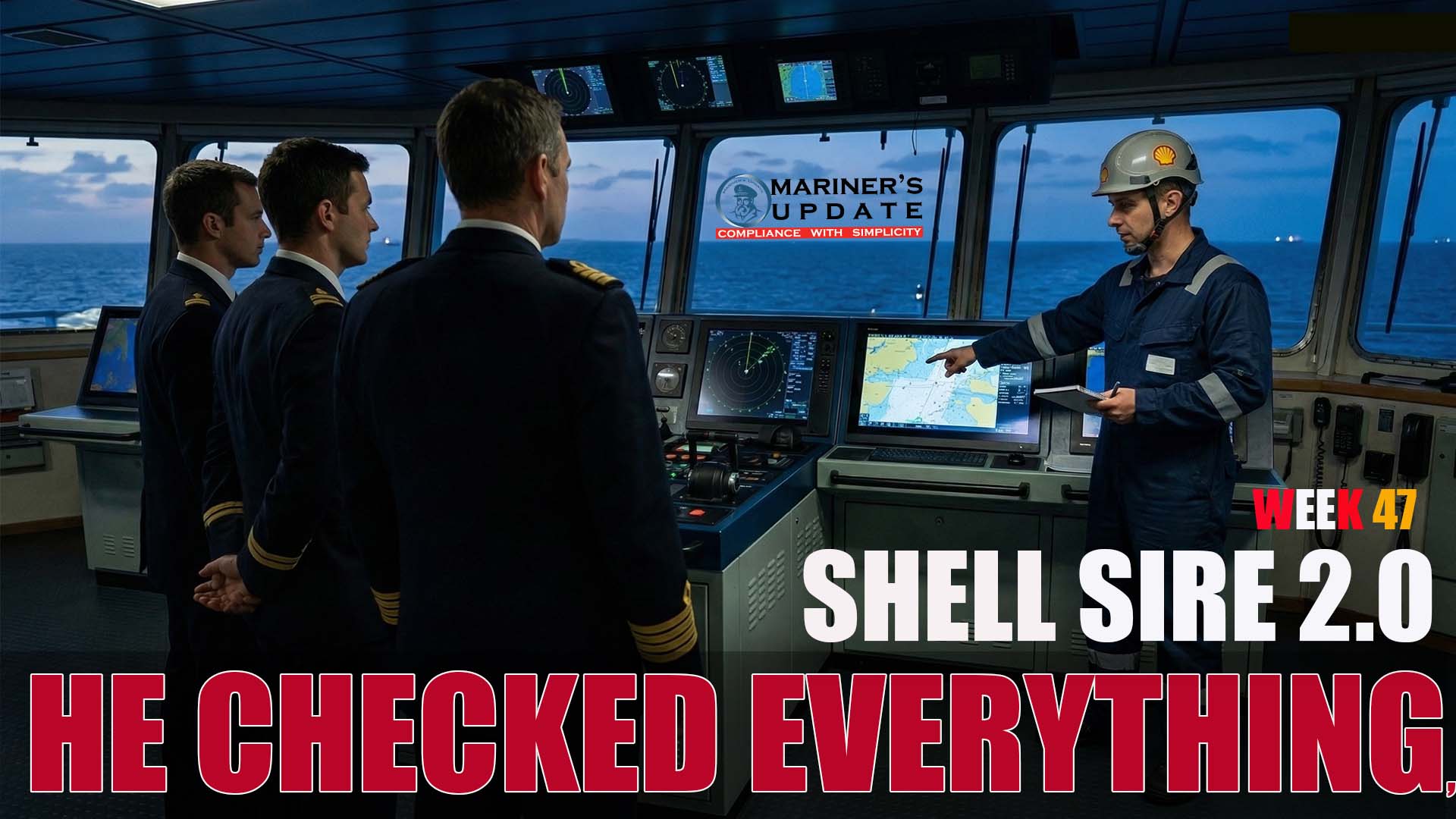
SIRE 2.0 Inspection Experience – February 2026
Inspector: Ma###or #a#d#
Oil Major: Shell
Inspection Flow – As Experienced Onboard
The inspector, boarded the vessel and after the initial gangway formalities, proceeded directly to the Master’s office.
Opening Meeting
He started with a brief opening meeting with the ship’s management team.
He explained the scope of inspection, the areas he would be covering, and how he would be using his tablet for SIRE 2.0.
He also mentioned that apart from the standard questionnaire, he carries his own set of additional questions, as according to him, some practical aspects are not fully covered in SIRE.
Chief Officer / CCR & Deck Inspection
He then moved to the cargo control room and started with the cargo plan.
- He carefully checked the plan and appreciated the presence of the Loading Master’s signature and stamp, stating that it confirms proper discussion with the terminal.
Next, he went into cargo operations in detail:
- He asked about cargo tank valve timings, how they are verified, and how they compare with yard timings.
- He checked the Ship/Shore Safety Checklist and asked how insulation between ship and terminal was verified.
- He questioned the wind limits for stopping cargo operations and what actions are taken if terminal requirements differ from company SMS.
He then moved to documentation and pre-arrival checks:
- He checked pre-arrival entries in the port log
- Asked about ODME operations and understanding
Equipment & System Checks
He then started verifying equipment practically:
- He checked the BWTS room, including:
- Fixed gas detection system
- Calibration procedure
- Span gas availability and expiry
- He checked personal gas meters, including calibration and expiry dates
Next, he conducted a live test:
- He asked a crew member to go to the pump room and activate the bilge alarm, and he verified both audio and visual alarms in CCR
Procedures & Operational Knowledge
He continued with detailed questioning:
- Procedures for inerting ballast tanks and void spaces
- Location of equipment used for the same
- Dump valve operation and PMS records, specifically asking whether liquid level checks are recorded
He then cross-checked multiple operational entries:
- High-level alarm testing during pre-arrival
- O₂ checks before arrival and cargo operations
- Comparison of CCR ullages with UTI readings
- Draft verification (visual vs recorded), as vessel was alongside
Further Checks
- He checked WBT inert gas hoses, including condition and records
- Verified MSDS of cargo, focusing on toxic gases and availability of gas detection tubes
- Reviewed last:
- Enclosed space entry permit
- Hot work permit
- Pump room entry permit
- He asked about maximum venting rates in ballast tanks
- Checked loadicator test records and compared with class condition
- Verified mooring equipment inventory
Additional Questions (From His Own Set)
After routine checks, he started asking deeper questions:
- Before starting COW, at what level should O₂ be checked?
→ He clarified it should be 3 LEVELS - Corrections required when using gas detection tubes
- Corrections in float gauge readings when UTI is not available (density correction)
- How to check tank pressure via PV breaker when readings are unclear
- Safety trips of Cargo Oil Pumps
Deck Round
He then proceeded on deck:
- Checked dump valve movement
- Personally verified O₂ levels in two tanks
- Took photographs of:
- Mooring winches
- Hose handling crane
- PV breaker
- Manifold
- Checked inert gas hoses in store
- Inspected gangway sheaves
Crew Interaction
He spoke to the Bosun:
- Asked him to demonstrate a lifebuoy light
- Asked about pilot ladder rigging procedure and safety precautions
Engine Room Inspection
He then moved to the engine room and started from the bottom platform upwards.
- Tested bilge well alarms
- Checked OWS operation, including 15 ppm alarm and 3-way valve
- Verified ME & AE leak-off alarms
- Checked Oil Mist Detector alarms
He then asked for a practical demonstration:
- Emergency steering was tested with assistance from the ETO
Engine Room Interaction
He spent time with the 3rd Engineer and duty Oiler:
- Asked about:
- Dead ship recovery procedure
- Enclosed space entry
- Engine room watchkeeping standards
Observation Raised
- Suggested that engine room garbage bins should have self-closing lids
Bridge Inspection (Approx. 2 Hours)
He then proceeded to the bridge.
Initial Checks
- First, he checked all bridge equipment
- Asked if there were any defects
Passage Plan Review (Detailed – ~40 mins)
He then went into the passage plan in detail:
- Checked route from last port to berth, leg by leg
- Verified ECDIS settings and change records
- Asked about publications used
He was very strict on UKC calculations:
- Compared with company policy
- Asked how squat/sinkage values are verified
- Discussed density and other influencing factors
Navigation & System Questions
- How safety settings on ECDIS are calculated
- Basis and references used
- No-go areas and PI settings
He then tested:
- Steering gear (single and both motors)
- Asked procedure and requirements for steering gear testing
GMDSS & Emergency Systems
- Checked test records (daily, weekly, monthly)
- Asked:
- How to send distress message
- How EPIRB works
- How SART works
- Asked whether AIS can be used for collision avoidance and why not
Additional Bridge Checks
- Verified ECDIS updates
- Route filters and chart display settings
- Nav warnings and Navtex handling
- Compass error log (including leading lights)
- ALDIS lamp and spares
- Sound-powered telephone
- Tested echo sounder depth alarm and checked records
- Verified:
- Master-Pilot information
- Pilot card
Inspector’s Behaviour
Throughout the inspection:
- He remained calm, composed, and professional
- He gave time to think before answering
- He focused on understanding rather than fault-finding
Key Learning
This inspection clearly showed that:
- Inspectors are focusing on practical knowledge and understanding
- Questions are scenario-based, not checklist-based
- Cross-verification of entries is common
- Crew confidence and clarity play a major role
#MarinersUpdate #SIRE #SIRE2 #OCIMF #VettingInspection #OilMajor #ShipInspection #MaritimeIndustry #SeafarersLife #DeckOfficer #MarineEngineering #ShipManagement #TankerOperations #BridgeTeam #ECDIS #Navigation #MarineSafety #ShippingIndustry #PortOperations #MarineTraining #Competency #HumanElement #SafetyAtSea #MaritimeLeadership #NauticalScience #StaySafe