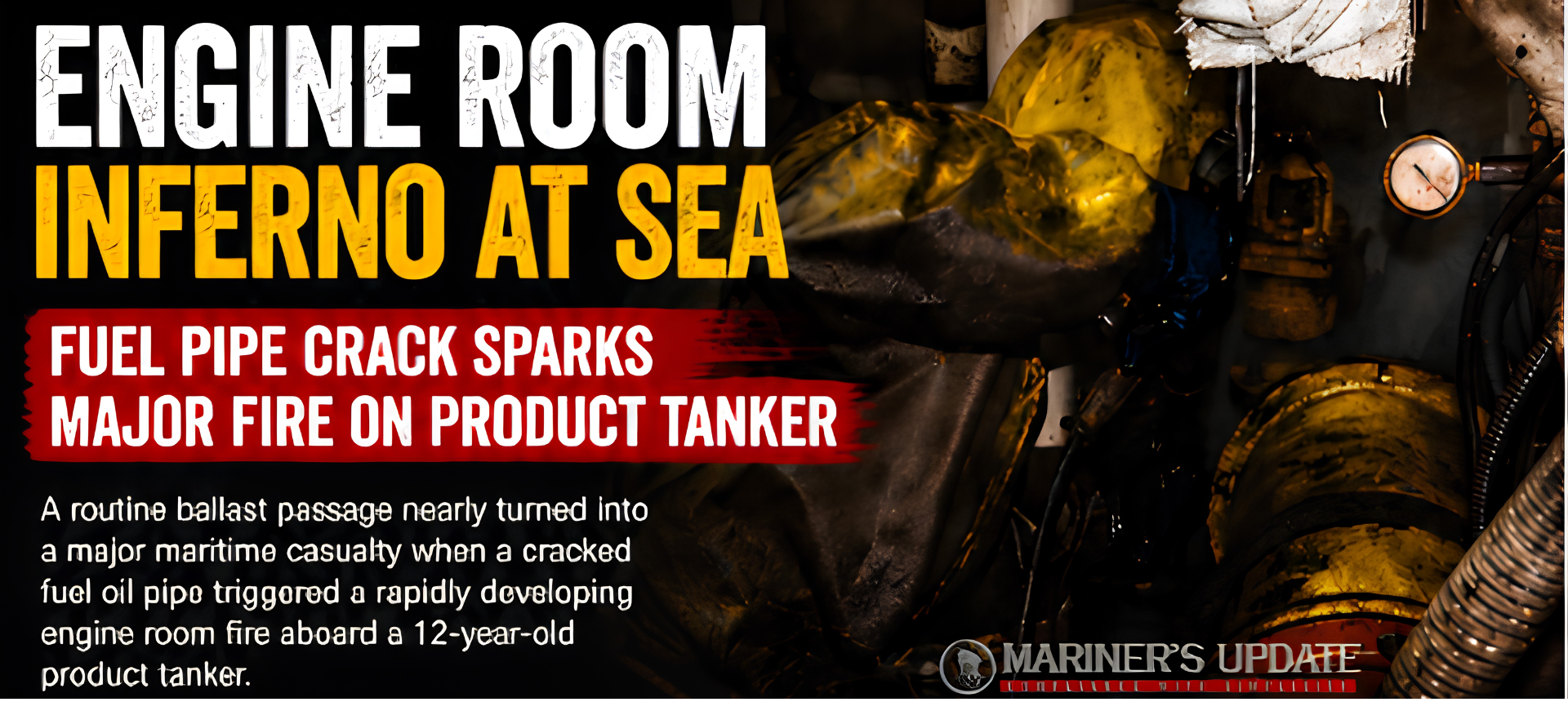
A routine ballast voyage nearly turned into a major maritime casualty after a fire broke out in the engine room of a 12-year-old product tanker, highlighting the critical dangers posed by aging fuel systems and vibration-induced machinery failures.
The vessel was operating normally in open waters with both main engines running and no indications of machinery abnormalities, alarms, or operational restrictions. During the early afternoon, the engine room fire detection system activated simultaneously on the bridge and in the Engine Control Room, indicating a fire near the starboard main engine.
Engine room personnel immediately investigated and confirmed dense smoke and active fire in the vicinity of the engine room stairway adjacent to the starboard main engine.
The bridge team promptly stopped both main engines and activated emergency response procedures in accordance with the vessel’s Safety Management System (SMS). Fire teams were mustered, boundary cooling commenced, and local firefighting efforts were initiated using portable firefighting equipment. Access to the affected area was restricted to reduce oxygen supply and limit fire growth.
Despite the crew’s rapid response, the fire intensified quickly. Given the proximity of the fire to fuel oil systems, hot exhaust surfaces, and critical machinery spaces, the risk of escalation was assessed as severe.
The Master subsequently ordered the release of the fixed CO₂ firefighting system protecting the engine room. The system was deployed shortly after the initial alarm and successfully extinguished the fire. The engine room remained sealed until conditions were verified safe for re-entry.
No injuries were reported, and no reignition occurred.
Following extinguishment, the crew focused on restoring essential vessel functions. Electrical power was progressively re-established, critical navigation systems were returned to service, and limited propulsion capability was restored within a relatively short period. As a result, the tanker was able to continue under its own power, avoiding the need for external towage assistance.
Subsequent investigation determined that the fire originated from a crack in a pressurized fuel oil pipe located near the starboard main engine. The defect allowed fuel oil to escape as a fine spray, which came into contact with a hot surface and ignited.
Investigators concluded that the pipe failure resulted from long-term fatigue cracking caused by continuous vibration and cyclic stress — a risk that becomes increasingly significant as vessels age beyond a decade in service.
The incident demonstrates how a seemingly minor machinery defect can rapidly escalate into a serious engine room fire. It also highlights the importance of rigorous inspection programs, effective insulation management, vibration monitoring, and crew preparedness in preventing and responding to machinery-space emergencies.
Throughout the emergency, the crew displayed strong technical competence, effective communication, and disciplined emergency response, preventing what could have become a far more serious casualty.
Engine Room Fire Prevention & Preparedness Checklist
□ Verify SMS procedures adequately address fuel oil leakage and engine room fire risks.
□ Review whether any SMS requirements would have been breached under similar circumstances.
□ Inspect engine room insulation regularly for damage, deterioration, or contamination.
□ Confirm insulation around hot surfaces remains effective and properly secured.
□ Verify insulation is reinstated correctly following maintenance activities.
□ Check fuel oil pipes for signs of vibration, fatigue cracking, loose supports, or abnormal movement.
□ Ensure pipe clamps, supports, and vibration dampening arrangements remain effective.
□ Use thermographic inspections where available to identify hot spots and verify surface temperatures remain below 220°C.
□ Increase inspection frequency on older vessels, particularly for fuel systems exposed to long-term vibration.
□ Review maintenance records for recurring vibration-related defects.
□ Conduct realistic engine room fire drills involving loss of propulsion and emergency response scenarios.
□ Verify crew familiarity with fixed CO₂ release procedures and engine room isolation requirements.
□ Assess whether additional crew training is required on machinery fire prevention and response.
□ Identify any additional resources, equipment, or procedural improvements needed from shore management.
□ Establish immediate corrective actions and preventive measures following safety discussions.