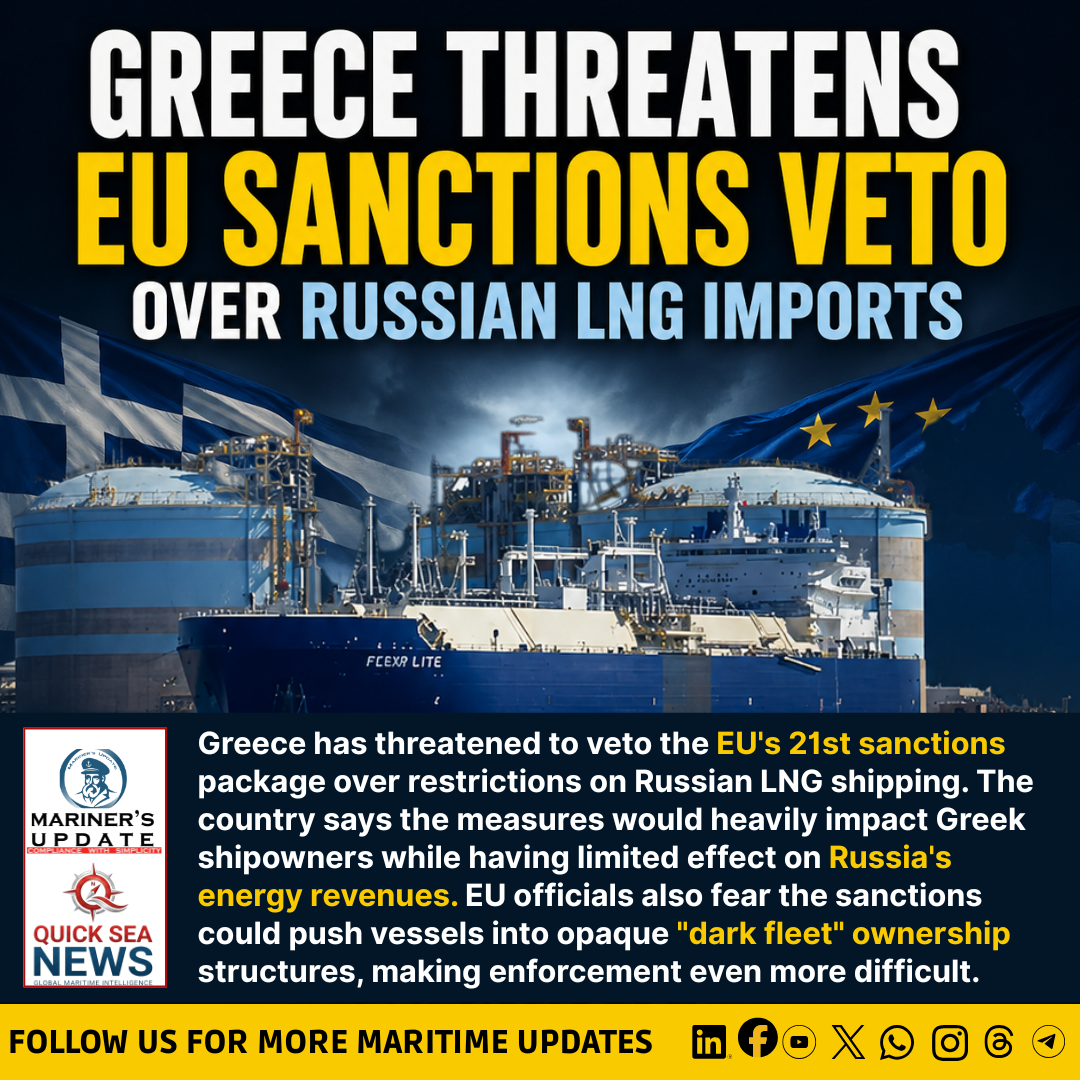
The European Union’s latest efforts to tighten sanctions against Russia have encountered fresh resistance as Greece threatens to veto the proposed 21st sanctions package over measures targeting Russian liquefied natural gas (LNG) exports.
The dispute highlights growing divisions within the EU as Brussels seeks to further restrict Russia’s energy revenues while balancing the economic interests of member states that remain deeply connected to the maritime transport sector.
The European Union’s sanctions process is widely regarded as one of the most complex policymaking systems in the world. Any new sanctions package requires extensive coordination and consensus among the European Council, the European Parliament, and the European Commission before implementation.
Despite the lengthy process, the EU has steadily expanded sanctions since the beginning of the Russia-Ukraine conflict. Once one package is adopted, preparations for the next begin almost immediately. The upcoming 21st sanctions package continues this long-term strategy of increasing economic pressure on Moscow.
Previous sanctions have already delivered significant changes across Europe’s energy market. One of the most notable achievements has been Germany’s successful reduction of its dependence on Russian pipeline gas, which had previously formed a major part of its energy supply.
However, the current sanctions package shifts its focus from pipeline gas to seaborne LNG imports.
This change has become a major concern for Greece, whose shipping industry plays a significant role in transporting Russian LNG cargoes worldwide. Greek shipowners control one of the world’s largest merchant fleets and account for a substantial share of vessels involved in Russian LNG transportation.
Greek authorities argue that restricting LNG shipping would have a disproportionate impact on Greek shipping companies while doing relatively little to reduce Russia’s LNG export revenues. From Athens’ perspective, the proposed measures could damage the competitiveness of its maritime sector without delivering equivalent strategic benefits.
As a result, Greece has warned that it may block the sanctions package unless its concerns are addressed.
The standoff has created a difficult challenge for European policymakers.
Granting Greece an exemption could weaken the credibility and effectiveness of the sanctions regime while encouraging other member states to seek similar exceptions in future packages. Such a precedent could undermine the EU’s broader objective of steadily closing remaining loopholes in Russian energy exports.
At the same time, officials are also concerned about the potential market response if the sanctions proceed without compromise.
Industry observers suggest that Greek shipowners could choose to sell affected vessels to operators outside the EU or restructure ownership through complex offshore arrangements similar to the “dark fleet” networks that have emerged to transport sanctioned Russian oil.
These opaque ownership structures often obscure the true beneficial owners of vessels, making sanctions enforcement significantly more difficult. Experts with experience in managing such networks, including individuals formerly associated with Russian shipping operations, are believed to possess extensive knowledge of creating these alternative ownership models.
If such restructuring accelerates, the intended impact of the sanctions could be reduced, while vessel ownership shifts beyond European regulatory oversight.
The disagreement illustrates the increasingly difficult balance facing the European Union as it attempts to tighten sanctions against Russia while protecting the commercial interests of member states with globally significant maritime industries.
Whether Greece ultimately exercises its veto or reaches a compromise with Brussels could determine not only the fate of the 21st sanctions package but also shape the future direction of EU energy sanctions and global LNG shipping.