
Understanding How the Sun Influences Weather and Temperature
The Sun is the driving force behind Earth’s weather system. Nearly all atmospheric processes, from cloud formation and wind circulation to rainfall and ocean currents, are powered by solar energy. Understanding how solar radiation interacts with the Earth’s surface and atmosphere is fundamental to understanding meteorology.
Although the Sun is approximately 150 million kilometres away from Earth, the energy it emits continuously reaches our planet in the form of electromagnetic radiation. This incoming energy provides the heat necessary to sustain life and drive weather patterns across the globe.
How Solar Radiation Reaches the Earth
Heat can be transferred in three ways: conduction, convection, and radiation. Unlike conduction and convection, radiation does not require a medium through which to travel. This allows solar energy to pass through the vacuum of space and reach the Earth.
The Sun emits enormous amounts of energy in the form of short-wave radiation. Because the Sun’s surface temperature is extremely high, approximately 6,000°C, the radiation emitted is both intense and capable of travelling vast distances.
When this solar radiation reaches Earth, part of it is absorbed by the land and oceans, causing the surface to warm. This absorbed energy becomes the primary source of heat for the lower atmosphere.
What Happens to Incoming Solar Energy?
Not all of the Sun’s energy reaches the Earth’s surface.
As solar radiation passes through the atmosphere:
- Some is reflected back into space by clouds.
- Some is scattered by atmospheric particles.
- Some is absorbed by gases and water vapour.
- The remaining portion reaches the Earth’s surface and is absorbed.
Clouds play a particularly important role in this process. Thick cloud layers can reflect a large proportion of incoming solar radiation, reducing the amount of heat that reaches the surface below.
The balance between absorbed and reflected solar energy has a major influence on local weather conditions and temperature.
The Earth’s Response: Outgoing Long-Wave Radiation
After absorbing solar energy, the Earth’s surface begins to release heat back toward the atmosphere and space.
Unlike the Sun, which emits short-wave radiation, the Earth emits energy in the form of long-wave radiation because its surface temperature is much lower.
This continuous exchange of incoming and outgoing energy helps regulate the planet’s temperature.
If all outgoing heat escaped directly into space, Earth’s surface would become significantly colder, especially during the night.
Understanding the Greenhouse Effect
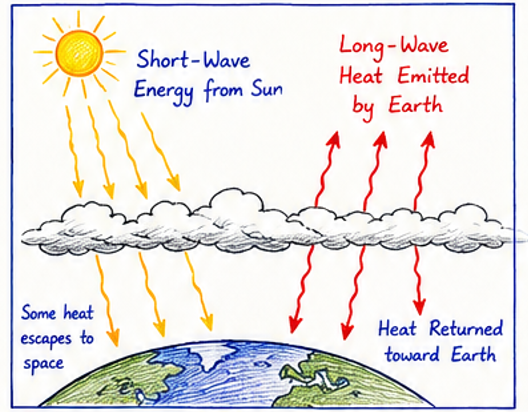
Fortunately, the atmosphere contains gases and water vapour that absorb part of the outgoing long-wave radiation.
Clouds and water vapour act like a thermal blanket, trapping a portion of this heat and re-radiating some of it back toward the Earth’s surface.
This process is known as the Greenhouse Effect.
The Greenhouse Effect helps maintain temperatures suitable for life and prevents excessive cooling of the Earth’s surface.
A common example can be observed during the night:
- On clear nights, heat escapes more freely into space, resulting in greater cooling.
- On cloudy nights, clouds trap some of the outgoing heat, reducing the fall in temperature.
This is why cloudy nights are often noticeably warmer than clear nights.
Daily Temperature Changes
The amount of solar energy received at the Earth’s surface changes continuously throughout the day.
Morning
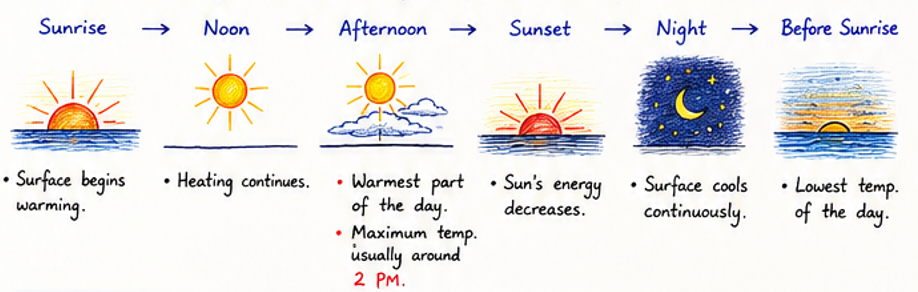
Shortly after sunrise, incoming solar radiation begins to exceed the amount of heat being lost by the surface. As a result, temperatures start to rise.
Afternoon
The Earth’s surface continues absorbing energy throughout the morning and early afternoon. Maximum temperatures are usually reached during mid-afternoon, often around 1400 Local Time.
Evening
After the Sun begins to lower in the sky, incoming solar radiation decreases while heat loss continues. Surface temperatures gradually begin to fall.
Night
Once darkness arrives, incoming solar radiation ceases entirely. The Earth’s surface continues losing heat throughout the night until sunrise, when the cycle begins again.
Why Land and Sea Heat Differently
Land and water do not respond to solar heating in the same way.
Land Surfaces
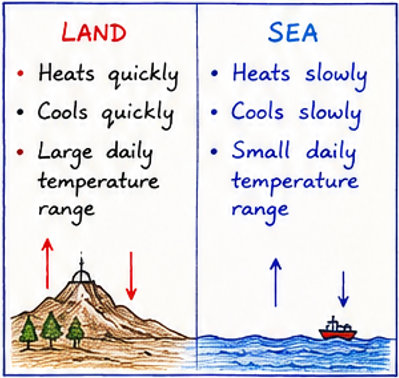
Land heats up rapidly during the day and cools quickly at night. As a result, land areas often experience large daily temperature variations.
Ocean Surfaces
Water absorbs and stores heat much more effectively than land. Oceans warm and cool more slowly, resulting in relatively small daily temperature changes.
This difference is one of the reasons coastal areas generally experience more moderate temperatures than inland regions.
The contrast between land and sea heating also contributes to the development of local wind systems such as sea breezes and land breezes.
Why This Matters to Mariners
For seafarers, understanding solar radiation and temperature variation is essential because these processes influence many weather phenomena encountered at sea.
Solar heating affects:
- Atmospheric stability
- Wind development
- Sea breeze circulation
- Cloud formation
- Fog development
- Local and regional weather patterns
A clear understanding of how the Earth gains and loses heat helps mariners interpret weather conditions more effectively and make better-informed operational decisions.
Key Takeaways
• The Sun is the primary source of energy for Earth’s weather system.
• Solar energy reaches Earth as short-wave radiation.
• Part of the incoming radiation is absorbed, reflected, or scattered.
• The Earth releases absorbed heat as long-wave radiation.
• Clouds and water vapour trap some outgoing heat through the Greenhouse Effect.
• Cloudy nights are generally warmer than clear nights because less heat escapes.
• Land heats and cools faster than water.
• Daily temperature changes are controlled by the balance between incoming and outgoing radiation.
• Solar heating plays a major role in weather formation and maritime meteorology.