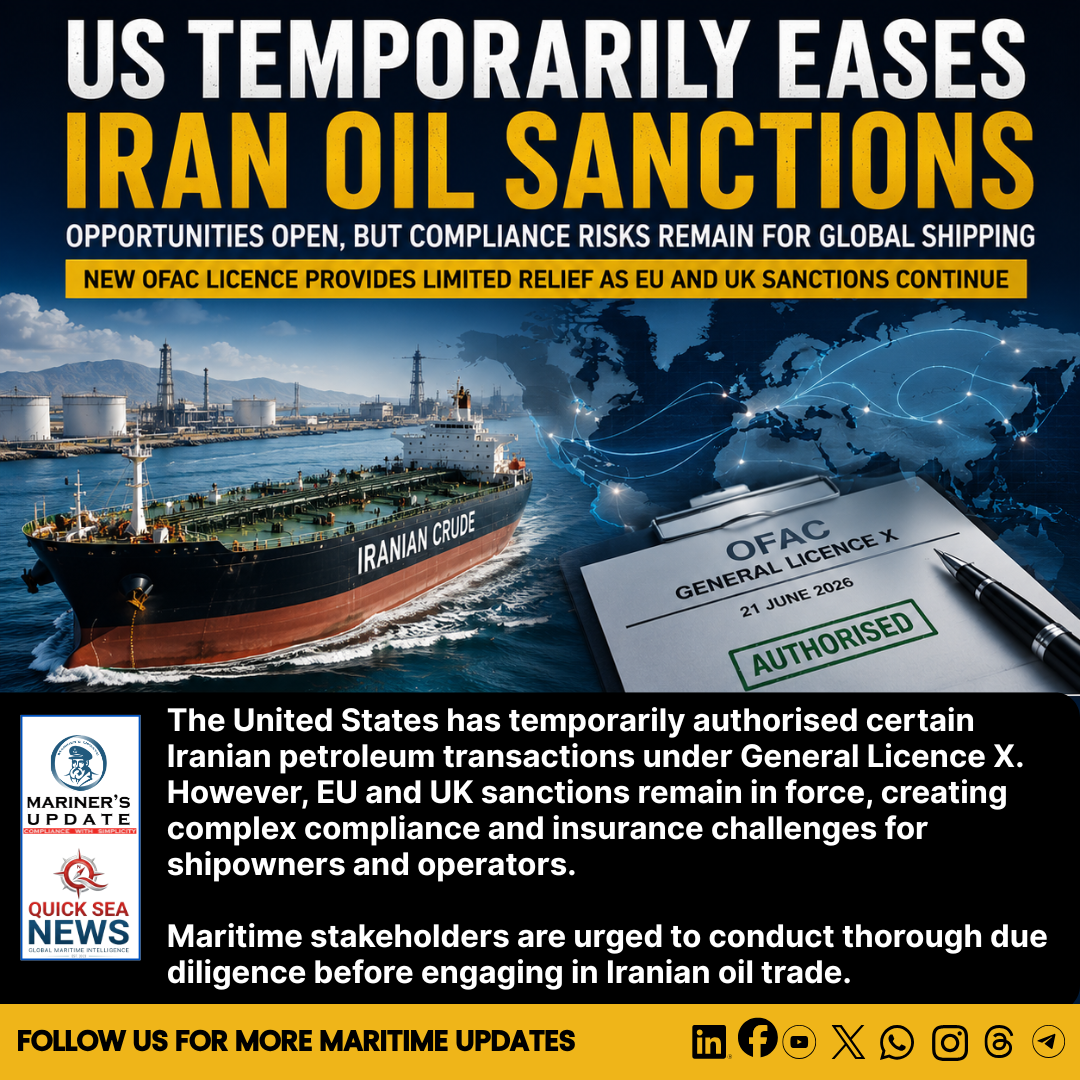
The United States has introduced a temporary easing of certain sanctions on Iranian petroleum trade, offering limited relief for companies involved in the transportation of Iranian crude oil, petroleum products, and petrochemicals. However, maritime stakeholders are being warned that significant legal, insurance, and compliance risks remain due to the continued differences between U.S., European Union, and United Kingdom sanctions regimes.
On 21 June 2026, the U.S. Office of Foreign Assets Control (OFAC) issued General Licence X (GL X), authorising specific transactions related to the production, sale, transport, and discharge of Iranian-origin petroleum products. The licence also permits associated maritime services, including shipping and insurance activities that are ordinarily necessary for these transactions.
While the announcement marks a notable shift in U.S. policy, the authorisation is temporary and may be amended, extended, or withdrawn at any time. Companies intending to rely on the licence are advised to closely monitor further regulatory developments.
Temporary Relief with Important Restrictions
Despite the relaxation, GL X does not remove all sanctions related to Iran.
The licence applies only to the petroleum sector and excludes certain jurisdictions and transactions involving individuals or entities that remain designated under separate U.S. Executive Orders. As a result, companies must continue conducting detailed due diligence before entering into any transaction involving Iranian cargoes.
EU and UK Sanctions Continue to Differ
One of the biggest challenges for the shipping industry is the continued lack of alignment between U.S., EU, and UK sanctions.
The European Union continues to prohibit the purchase, transportation, and insurance of Iranian-origin oil regardless of its destination.
Meanwhile, the United Kingdom maintains a designation-based sanctions regime. Although it does not currently impose a blanket prohibition on Iranian oil trade, asset freezes remain in place against designated Iranian individuals and entities.
This regulatory divergence means that a transaction permitted under U.S. law may still violate EU sanctions or create legal complications under UK regulations.
Insurance Risks Remain Significant
Maritime insurers are also warning that lawful trade under one sanctions regime does not automatically guarantee insurance protection.
Even where a voyage complies with applicable UK regulations, restrictions affecting International Group P&I Pool arrangements, EU-based reinsurers, or financial partners could limit or prevent the recovery of claims following a major incident.
Consequently, shipowners and operators could remain financially exposed despite believing their trade is legally permissible.
Due Diligence More Important Than Ever
Shipowners, charterers, operators, insurers, brokers, and financial institutions are encouraged to conduct enhanced due diligence before engaging in any Iranian petroleum trade.
This includes verifying counterparties, cargo ownership, vessel histories, financing arrangements, insurance coverage, and the potential application of multiple sanctions regimes.
Maintaining comprehensive records and obtaining specialist legal advice where necessary will be essential to managing compliance risks.
Industry Impact
Although General Licence X provides temporary flexibility under U.S. law, it does not eliminate the complex sanctions landscape facing international shipping.
The differing requirements across the United States, European Union, and United Kingdom mean that maritime companies must carefully evaluate every transaction from both a legal and commercial perspective before proceeding.
As geopolitical developments continue to evolve, compliance, insurance protection, and sanctions due diligence remain critical priorities for the global maritime industry.