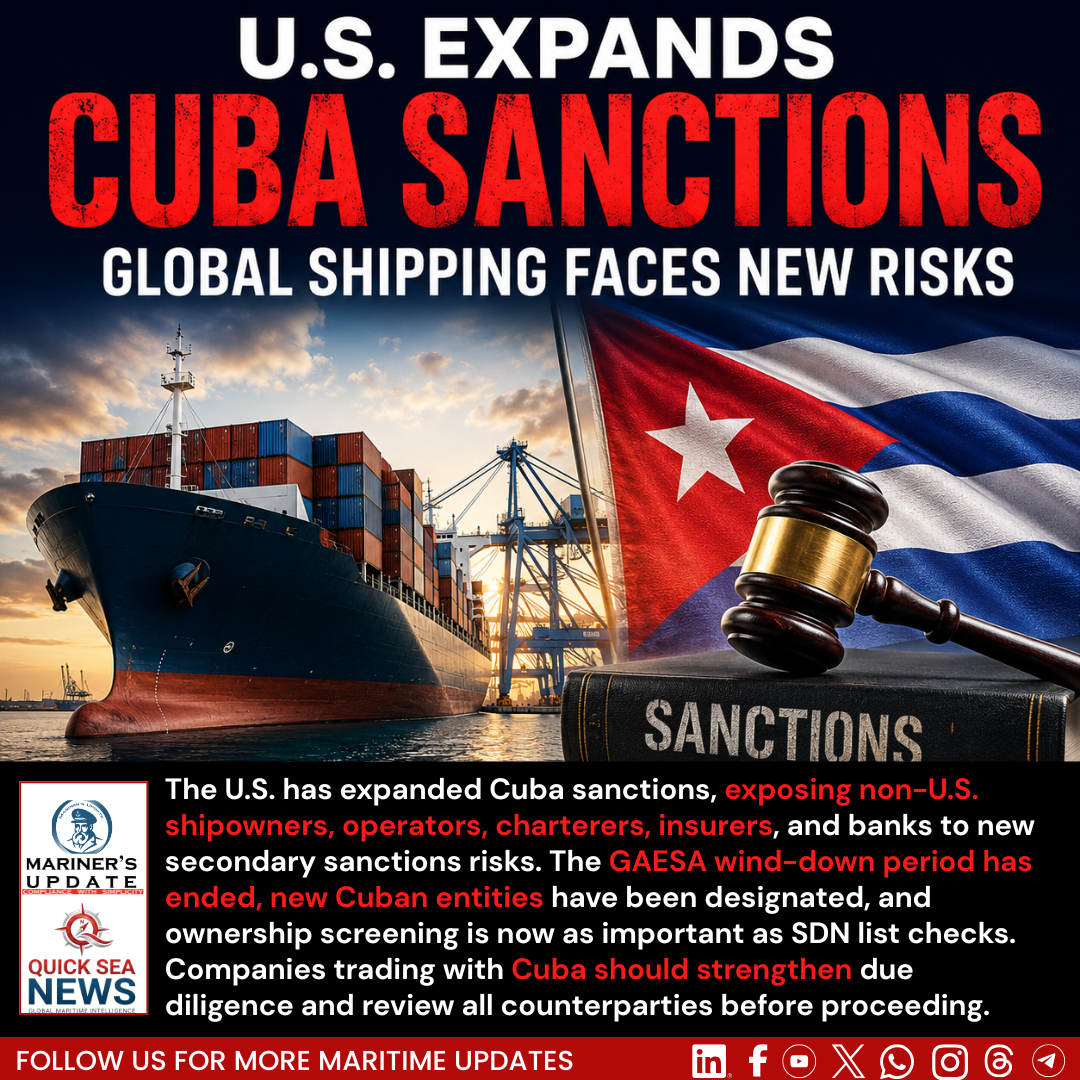
The United States has significantly expanded its Cuba sanctions framework, creating a new level of compliance risk for shipowners, operators, charterers, insurers, banks, and other maritime stakeholders worldwide.
With the introduction of Executive Order (EO) 14404, signed on 1 May 2026, the U.S. has, for the first time, established a sanctions regime that allows non-U.S. persons to be designated for certain Cuba-related activities—even where there is no direct U.S. connection. This marks a major shift in the enforcement landscape for the global shipping industry.
Unlike the long-standing Cuban Assets Control Regulations (CACR), EO 14404 introduces secondary sanctions, meaning foreign shipping companies, financial institutions, cargo interests, and commercial partners can face U.S. sanctions simply for engaging with designated Cuban entities.
Major Development: GAESA Wind-Down Period Has Ended
One of the most important deadlines has now passed.
The temporary wind-down authorization provided through OFAC General License No. 1 expired on 5 June 2026.
Until that date, foreign companies were allowed to complete transactions that were necessary to wind down existing dealings involving GAESA (Grupo de Administración Empresarial S.A.) and its majority-owned subsidiaries.
From 5 June 2026 onwards, any continued dealings with GAESA or entities in which GAESA owns 50% or more may expose non-U.S. persons to designation under EO 14404.
Companies that failed to complete the wind-down before the deadline are advised to obtain immediate legal guidance.
Wave of New Cuban Sanctions
Between 18 May and 23 June 2026, the U.S. Office of Foreign Assets Control (OFAC) announced four additional rounds of designations, considerably expanding the sanctions list.
The newly designated organizations include:
Government, Military & Security
✔ Ministry of the Interior (MININT)
✔ Policía Nacional Revolucionaria (PNR)
✔ Directorate of Intelligence (DGI)
✔ Ministry of the Revolutionary Armed Forces (MINFAR)
Energy
✔ Unión Cuba Petróleo (CUPET)
Financial Institutions
✔ RAFIN S.A.
✔ Banco Financiero Internacional (BFI)
Ports & Logistics
✔ Almacenes Universales S.A. (AUSA)
Mining & Steel
✔ Minera la Victoria S.A.
✔ GeoMinera S.A.
✔ Empresa Siderúrgica José Martí (Antillana de Acero)
Tourism & Political Organisations
✔ Cuban Institute of Friendship with the Peoples (ICAP)
✔ Amistur Cuba S.A.
✔ Committees for the Defense of the Revolution (CDR)
Several senior Cuban government officials and regime-linked individuals were also added to the sanctions list during this period.
OFAC FAQ 1258 Expands the Compliance Burden
Perhaps the most significant clarification came on 4 June 2026, when OFAC issued FAQ 1258.
The guidance confirms that sanctions exposure extends beyond entities appearing on the SDN List.
Any company that is 50% or more owned, directly or indirectly, by:
- GAESA
- MININT
- MINFAR
is considered subject to the same sanctions risk—even if it is not individually listed.
This means relying solely on SDN screening is no longer sufficient.
Shipping companies must now investigate:
- Ultimate ownership
- Corporate control structures
- Parent companies
- Subsidiaries
- Affiliates
before entering into Cuba-related business.
What This Means for Shipowners and Operators
The expanded sanctions significantly increase operational and commercial risks.
Port Calls
The Port of Mariel now presents heightened compliance concerns because container operations involve AUSA, a designated GAESA subsidiary.
Operators must carefully assess whether any terminal, port service, or logistics provider is linked to sanctioned entities.
Fuel Supply Risks
Following the designation of CUPET, bunkering operations, petroleum cargoes, fuel terminals, and related energy services connected with the company now present direct sanctions exposure.
Financial Transactions
Payments routed through:
- RAFIN
- Banco Financiero Internacional (BFI)
- Other GAESA-linked financial institutions
may expose shipowners, charterers, insurers, banks, and financial intermediaries to sanctions risk.
Ownership Screening
The new 50% ownership rule means even non-listed subsidiaries of GAESA, MININT, and MINFAR carry the same sanctions exposure.
Ownership due diligence has become as important as sanctions list screening.
More Designations Expected
Since May 2026, OFAC has already issued four rounds of sanctions and has indicated that additional Cuban state-owned entities—particularly within transport, logistics, and infrastructure—may be designated in future.
Companies trading with Cuba should therefore expect the sanctions landscape to continue evolving.
Insurance and P&I Cover Considerations
Shipowners should remember that P&I Clubs may be unable to provide cover where a voyage, cargo, trade, or contractual arrangement could place the Club in breach of sanctions.
In addition, existing U.S. sanctions may prevent U.S. insurers and reinsurers from paying claims involving Cuba or Cuban entities.
Where reinsurers cannot reimburse claims due to sanctions restrictions, Members may also be unable to recover those losses under Club Rules.
Recommended Actions
✔ Confirm all GAESA-related wind-down activities were completed before 5 June 2026.
✔ Immediately re-screen every Cuba-related counterparty.
✔ Verify ownership and control—not just SDN List status.
✔ Conduct enhanced due diligence on ports, terminals, agents, charterers, cargo interests, banks, and logistics providers.
✔ Review any exposure involving Mariel Port, CUPET, RAFIN, BFI, or other Cuban state-linked entities.
✔ Seek specialist legal advice before accepting Cuba-related fixtures or contracts.
✔ Consult your P&I Club whenever sanctions implications are uncertain.
Conclusion
EO 14404 represents one of the most significant changes to U.S. Cuba sanctions affecting international shipping in recent years. The combination of secondary sanctions, expanded ownership rules, and rapid additions to the sanctions list means maritime companies must move beyond basic sanctions screening and adopt enhanced ownership verification and risk assessment procedures.
For shipowners, operators, charterers, insurers, and financial institutions, robust sanctions compliance is now essential to protect commercial operations, insurance cover, and regulatory standing.