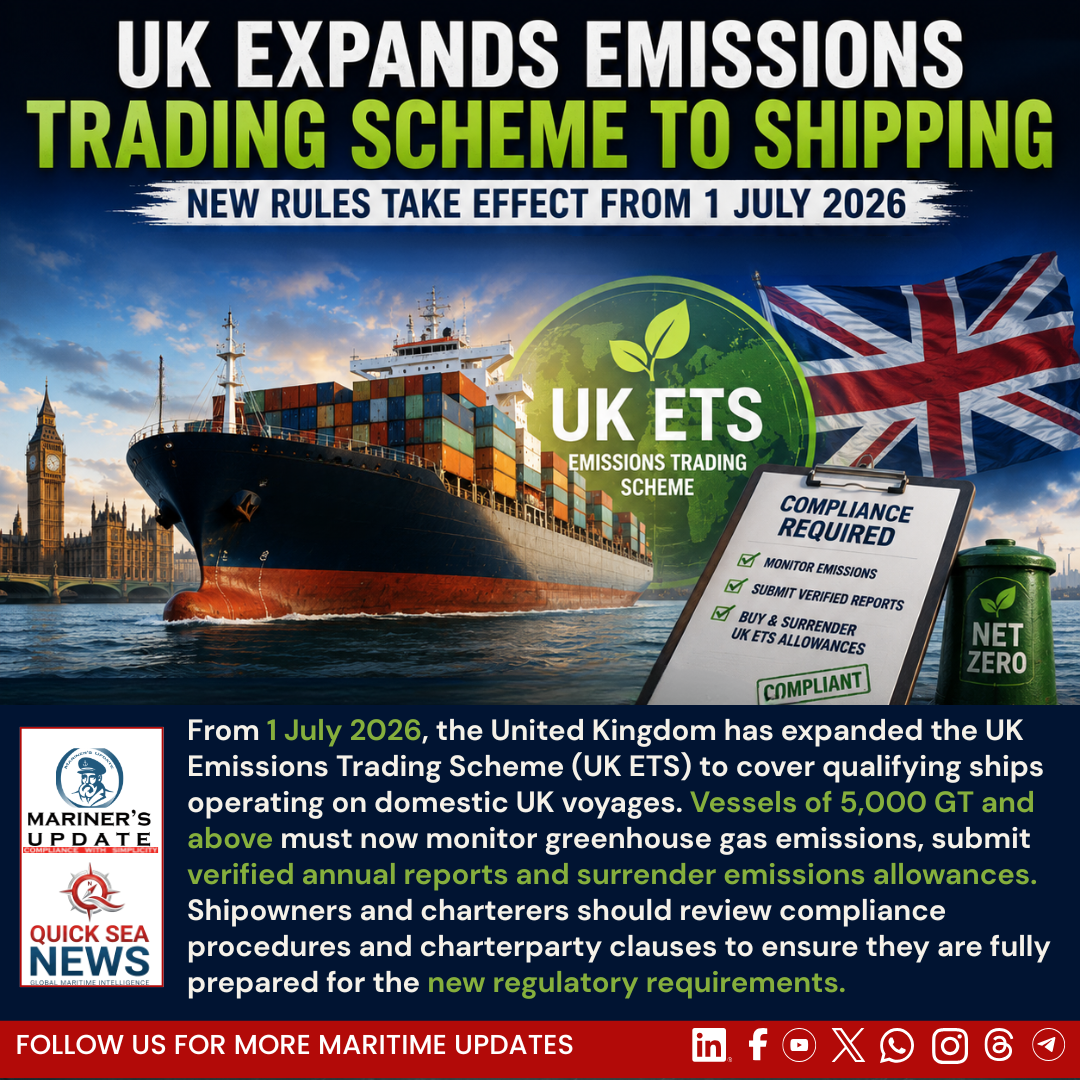
The United Kingdom has officially extended its Emissions Trading Scheme (UK ETS) to the maritime sector, introducing new carbon compliance requirements for qualifying vessels operating on domestic UK voyages. Effective 1 July 2026, shipowners and charterers must comply with mandatory emissions monitoring, reporting and carbon allowance obligations, marking another significant milestone in shipping’s transition towards decarbonisation.
The UK ETS is designed to reduce greenhouse gas emissions by requiring operators of eligible ships to account for their emissions through the purchase and surrender of carbon allowances. Similar to other emissions trading systems, the scheme places a financial value on greenhouse gas emissions, encouraging greater fuel efficiency and investment in cleaner technologies.
Key Highlights
✔️ The UK ETS now applies to greenhouse gas emissions from domestic voyages between UK ports.
✔️ Emissions generated while vessels are alongside at UK ports, including single-port calls, are also covered under the regulations.
✔️ The scheme regulates emissions of:
- Carbon Dioxide (CO₂)
- Methane (CH₄)
- Nitrous Oxide (N₂O)
✔️ The regulations currently apply to ships of 5,000 Gross Tonnage (GT) and above.
✔️ International voyages to and from UK ports remain outside the scheme for now, although emissions produced during a vessel’s stay in a UK port are included. Future expansion to international voyages is under consideration.
Compliance Requirements for Shipowners
Owners of qualifying vessels are required to:
- Develop and maintain an approved emissions monitoring plan.
- Continuously monitor greenhouse gas emissions.
- Submit independently verified annual emissions reports.
- Purchase and surrender UK ETS allowances equivalent to verified emissions.
These obligations make emissions management an integral part of vessel operations and regulatory compliance.
Charterparty Considerations
The introduction of the UK ETS will also affect commercial contracts.
Owners and charterers should review both existing and future charterparty agreements to ensure responsibilities relating to emissions reporting, carbon allowance costs and regulatory compliance are clearly allocated.
Where vessels are expected to trade between UK ports or call at UK ports, incorporating suitable ETS clauses—such as industry-standard BIMCO provisions—can help reduce the risk of contractual disputes and ensure both parties clearly understand their obligations.
Why This Matters
The extension of the UK ETS reflects the growing global focus on reducing shipping emissions and increasing environmental accountability across the maritime industry. Shipowners, managers, operators and charterers should ensure their emissions monitoring systems, compliance procedures and charterparty terms are fully aligned with the new regulations to avoid operational and financial risks.