Awareness brief on RISQ checkpoint 3.1 — navigation instructions & officer familiarity
This week’s inspection focus looks at how vessel managers translate navigational safety policy into practical, everyday guidance — and whether officers can actually show they know and use it. Inspectors assess this under checkpoint 3.1: is practical navigational safety guidance built into the company’s navigation instructions, and are officers genuinely familiar with those procedures.
WHY THIS CHECKPOINT MATTERS
A navigation policy that only states good intentions is not enough. Inspectors are looking for procedures detailed enough to guide real decisions on the bridge, and for masters, officers and engineers who can speak to them confidently. This includes understanding when and how the override function on engine power limiters may need to be used, particularly while navigating in pilotage waters — a detail inspectors specifically expect crew to be conversant with, not just aware of on paper.
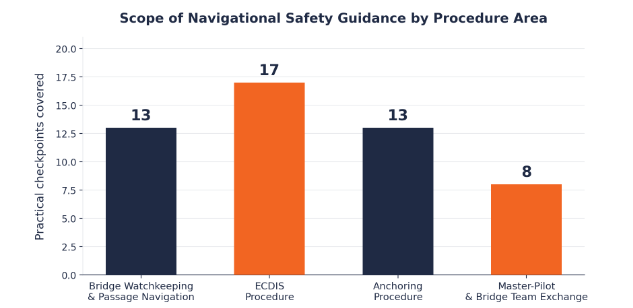
BRIDGE WATCHKEEPING & PASSAGE NAVIGATION
The foundation of safe navigation starts with clear, everyday bridge routines. Guidance should spell out:
- How bridge watchkeeping duties and responsibilities are allocated among the team
- Procedures for passage planning and navigation, including how any departure from the agreed passage plan is handled and authorised
- Routines for updating and correcting charts and nautical publications
- A dedicated ECDIS procedure, including how chart and software updates are managed (covered in depth in Section 2)
- Checks to ensure essential navigation equipment, and main and auxiliary machinery, are available and fully operational before and during passage
- Ship position reporting procedures
- Accident and near-miss reporting procedures, so lessons are captured and shared
- How relevant events are recorded, and the company’s Voyage Data Recorder (VDR) policy
- The correct operating modes for the Bridge Navigational Watch Alarm System (BNWAS) — automatic, manual, and off — and how correct operation is ensured
- Measures to prevent distraction and control unnecessary access to the bridge
- Requirements for familiarisation training and effective handover whenever crew changeover occurs
- A system for identifying specific, individual training needs rather than relying on generic refreshers
- A clear procedure defining exactly when the Master must be called to the bridge
ECDIS — THE DIGITAL BACKBONE OF NAVIGATION
Where ECDIS is used as the primary means of navigation, this must be clearly stated in the company’s SMS, backed by a robust procedure covering:
- Voyage planning and execution using ECDIS
- Watchkeeping practices that specifically guard against over-reliance on the system
- Chart maintenance routines
- Departure and arrival checks before getting underway and on approach
- ECDIS failure response and the backup system to fall back on
- Safety settings, and how they’re configured and checked
- The use and reliability of CATZOC (Category of Zone of Confidence) data when assessing chart accuracy
- Choice of depth contour shading — two-shade versus four-shade — appropriate to the area
- How ECDIS display layers are managed for different navigation conditions
- Managing manual layers, so current, important information is available and outdated material is archived or removed
- Displaying Temporary and Preliminary Notices to Mariners (T&Ps NMs), and correct use of the AIO (Admiralty Information Overlay) function
- Defining appropriate cross-track distance (XTD) limits for different sea areas — pilotage waters, confined waters, coastal waters, and open water — for each leg of the voyage
- Post-voyage review, so that any hazards or useful information discovered during the passage can be incorporated into future passage plans
- Route validation before it’s followed
- A protocol for naming and identifying saved routes, to avoid selecting an incorrect one
- An agreed, preferred method — and frequency — for verifying the vessel’s position while navigating on ECDIS
- Arrangements for regularly backing up ECDIS data, so any part of the passage record could be reviewed if needed
ANCHORING — READINESS AND VIGILANCE
Anchoring procedures need to go well beyond “drop and hold” and address the judgement calls that matter most:
- How to select a good anchorage location, including planning the anchoring position and approach in different weather and visibility conditions
- Bridge team management while anchoring, including traffic density and negotiating overcrowded anchorages, with the added risk of collision
- Safe swing room, and use of a safe anchor watch
- Position-keeping, and proper use of radar and GPS guard rings/alarms
- OOW use of the main engine while at anchor, where required
- The amount of cable and scope in use, holding ground and anchor holding power, proximity to shoreline, and the dangers of dragging anchor and grounding
- Special considerations when the vessel is in ballast condition, including the use of additional ballast
- The limitations on anchoring equipment under heavy stress
- The use of anchors in an emergency
- Considerations specific to deep-water anchoring
- Recognising when a dangerous situation is developing while at anchor, and knowing when to move
- Taking early and effective action once a risk is identified
- Factors affecting a vessel at anchor in heavy weather, including yawing and snatching loads on the cable
- Deciding when to put to sea ahead of adverse or severe weather
MASTER-PILOT & BRIDGE TEAM EXCHANGE
The SMS should also ensure the smooth integration of any specialist role joining the bridge team — a mooring master, lightering master, marine advisor, or deep sea pilot. This means documenting and discussing specific information before any transfer of the conn or responsibility takes place, covering:
- The vessel’s particulars and manoeuvring characteristics
- The planned passage
- A review of the ECDIS setup, including the status of safety depth alarms and layers in use
- The navigational aids available to the pilot
- Mooring and/or anchoring requirements
- Towage and/or tug assistance arrangements
- Under keel clearance
- Any relevant defects and/or operational constraints
This Master/Pilot exchange should always be documented, discussed and agreed before the transfer of conn or responsibility occurs — and it should be repeated in full whenever there is a change of pilot, not treated as a one-time formality for the voyage.
Navigation officers should also be clearly aware of the actions required in the event of single or multiple ECDIS failures. This awareness is best built through familiarisation checklists and routine drills — inspectors will record a finding if the bridge team appears unfamiliar with the company’s contingency plans for ECDIS failure.
KEY TAKEAWAY
A written procedure only satisfies checkpoint 3.1 if officers can demonstrate they actually apply it. Regular familiarisation, drills and bridge-team discussion turn policy on paper into safe practice at sea.
RISQ Inspection Focus is a weekly awareness series for masters, officers and DPAs, highlighting what RightShip inspectors look for and why it matters to safe operations.