
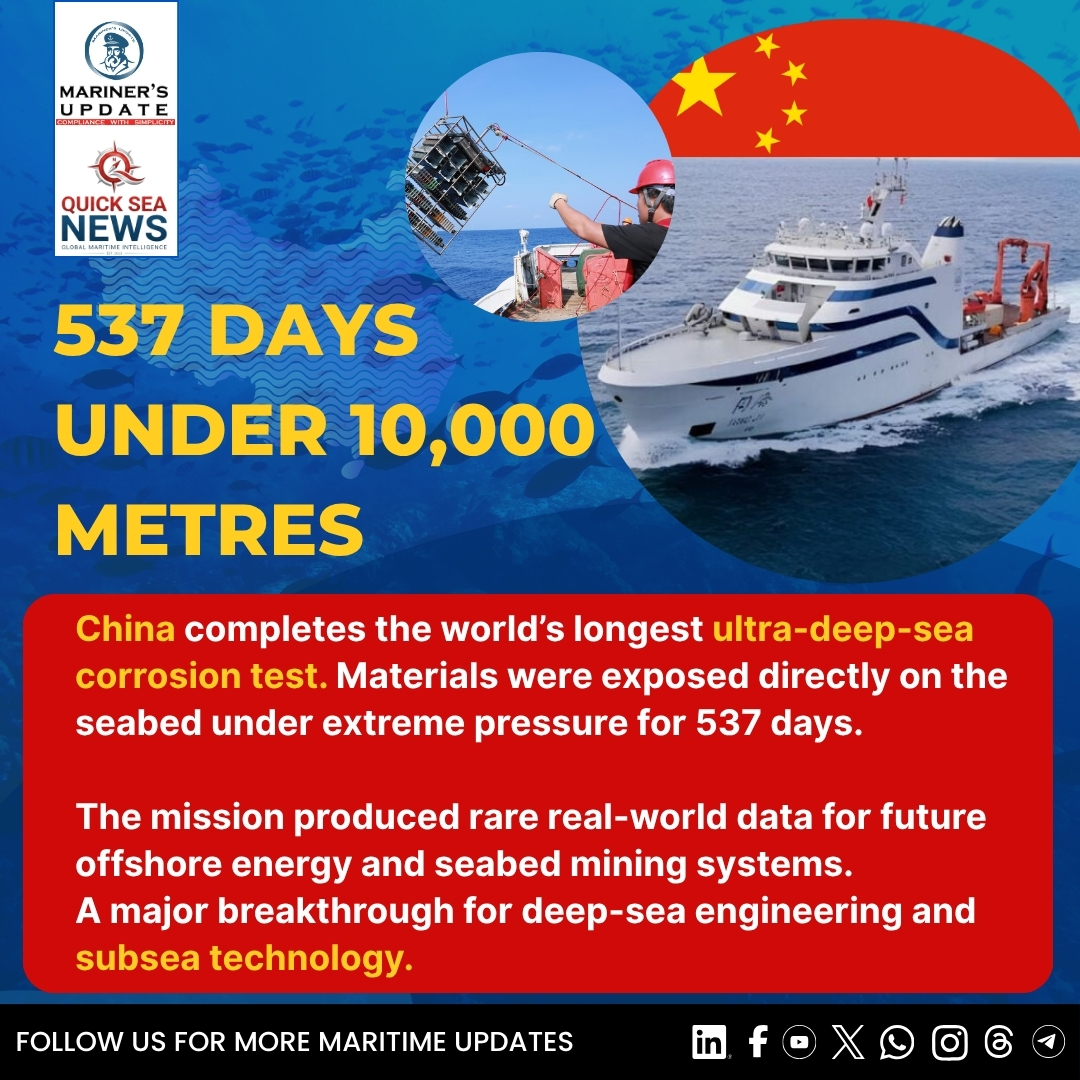
China has successfully completed the world’s first ultra-deep-sea material corrosion exposure test lasting 537 days at a staggering depth of 10,000 metres, marking a major milestone in subsea engineering and deep-ocean research.
The project was carried out by the China State Shipbuilding Corporation (CSSC), which deployed metals, protective coatings, buoyancy materials, and scientific instruments directly onto the seabed under some of the harshest environmental conditions found on Earth.
The mission aimed to understand how engineering materials behave during long-term exposure in ultra-deep waters where extreme pressure, low temperatures, high salinity, and minimal oxygen create highly aggressive corrosion conditions.
At depths beyond 10,000 metres, underwater pressure exceeds 1,000 times normal atmospheric pressure, making such real-world experiments extremely difficult, risky, and expensive. Unlike laboratory simulations, researchers left the materials on the ocean floor for the entire 537-day period without retrieval, allowing scientists to gather rare and highly accurate real-world degradation data.
According to the CSSC 725 Research Institute, the programme tested ferrous and non-ferrous metals, corrosion-resistant coatings, sacrificial anodes, and non-metallic buoyancy materials commonly used in offshore oil and gas systems, subsea mining equipment, and deep-sea exploration infrastructure.
Recovered samples revealed major differences in coating performance. Some protective coatings reportedly began peeling after prolonged exposure, while others remained intact despite the extreme underwater conditions. Researchers stated that the samples will now undergo additional laboratory analysis to better understand long-term material durability.
Scientists involved in the project highlighted that such real-world exposure data from 10,000-metre depths is globally rare and highly valuable for future subsea engineering projects. The findings are expected to improve lifecycle prediction models, corrosion-resistant designs, and safety standards for equipment operating in ultra-deep-sea environments.
The project also contributed to advancements in CSSC’s self-developed deep-sea simulation technology. Engineers upgraded high-pressure autoclave systems and environmental control mechanisms to better replicate actual deep-ocean conditions in laboratory settings.
Experts believe the successful completion of the 537-day mission could significantly support the future development of offshore energy projects, seabed mining operations, deep-sea oil extraction systems, and long-duration underwater infrastructure designed to operate under ultra-high-pressure environments.
As countries and energy companies continue expanding into offshore resource extraction and seabed mining, long-term reliability of subsea materials is becoming increasingly critical. This breakthrough offers valuable insights that may shape the next generation of deep-sea engineering technology.