Questions Covered:
2.4 – Is the vessel’s manning in compliance with the Safe Manning Certificate?
2.5 – Do all personnel maintain rest period/work hours and are the rest hours in compliance with STCW or MLC requirements?
2.4 – Safe Manning Certificate Compliance
Minimum safe manning is the level of manning that ensures a ship is sufficiently, effectively, and efficiently manned to provide safety and security of the ship, safe navigation and operations at sea, safe operations in port, prevention of human injury or loss of life, avoidance of damage to the marine environment and property, and the welfare and health of seafarers through avoidance of fatigue.
Except in ships of limited size or propulsion power, the determination of minimum safe manning should also consider the provision of qualified officers so that it is not necessary for the Master or Chief Engineer to keep regular watches by adopting a three-watch system.
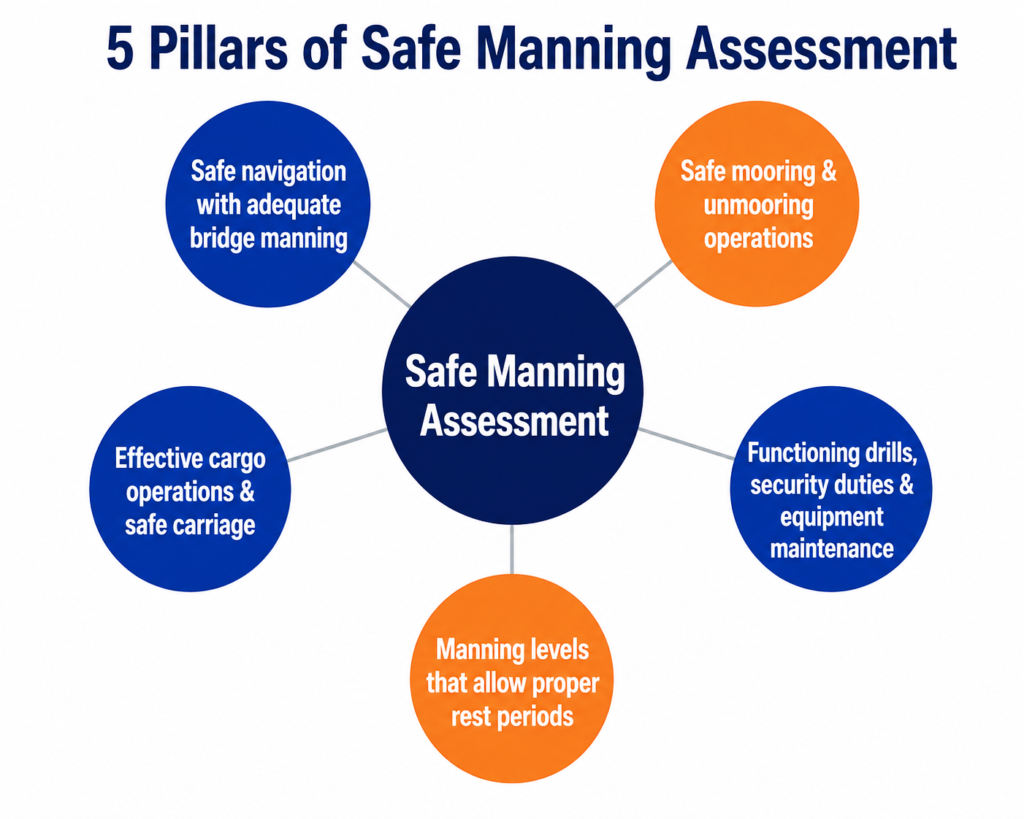
Inspectors should review the crew list and, considering the level of operation at sea and port, assess whether there are enough personnel onboard to fulfil the following principles of safe manning:
- Maintain safe navigation by adequate manning of the bridge throughout the passage.
- Mooring, tending mooring at port and unmooring the ship safely.
- Effective performance of cargo operations to ensure safe carriage of cargo during transit.
- Performance of on-board functions such as drills, ship security issues, and equipment maintenance.
- Manning levels should be such as to ensure that the time and place available for taking rest periods are appropriate for achieving a good quality of rest.
Note: Record in comments the actual and required manning of the vessel.
2.5 – Rest Hours & Work Hours Compliance
Each Administration shall, for the purpose of preventing fatigue:
- Establish and enforce rest periods for watchkeeping personnel and those whose duties involve designated safety, security and pollution prevention duties in accordance with Section A-VIII/1 of the STCW Code.
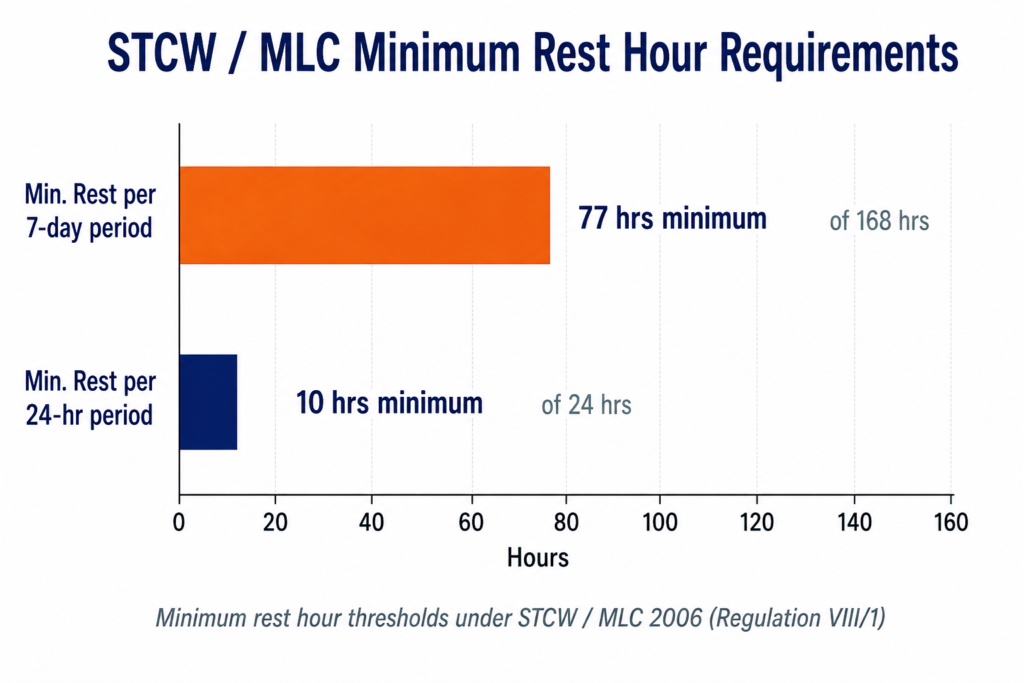
- Ensure all persons assigned duty as officer in charge of a watch, or as a rating forming part of a watch, and those whose duties involve designated safety, prevention of pollution and security duties, are provided a rest period of not less than:
- A minimum of 10 hours of rest in any 24-hour period; and
- 77 hours in any 7-day period.
- Hours of rest may be divided into no more than two periods, one of which shall be at least 6 hours in length, and the interval between consecutive periods of rest shall not exceed 14 hours.
Parties may allow exceptions from the required rest periods in points 2 and 3 above, provided the rest period is not less than 70 hours in any 7-day period.
Exceptions from the weekly rest period shall not be allowed for more than two consecutive weeks. The intervals between the two periods of exceptions onboard shall not be less than twice the duration of the exception.
The hours of rest provided for in point 1 may be divided into no more than three periods, one of which shall be at least 6 hours in length, and neither of the other two shall be less than one hour in length. Intervals between consecutive periods of rest shall not exceed 14 hours. Exceptions shall not extend beyond two 24-hour periods in any 7-day period, and shall, as far as possible, take into account the guidance regarding prevention of fatigue in Section B-VIII/1. (Regulation VIII/1 – Fitness for Duty, STCW 2017)
Record a Finding if:
- There are two or more consecutive violations by any seafarer onboard in any 30-day period.
- The vessel’s manager has not been informed at least monthly of compliance levels onboard.
- The work hour records are not in ILO format – Inspectors should refer to the IMO/ILO guideline “Guidelines for the Development of Tables of Seafarers’ Shipboard Working Arrangements and Formats of Records of Seafarers’ Hours of Rest.”
Rest hour records and manning levels are two sides of the same fatigue-prevention coin. Vessels that keep both genuinely aligned — not just on paper — consistently perform better at inspection.