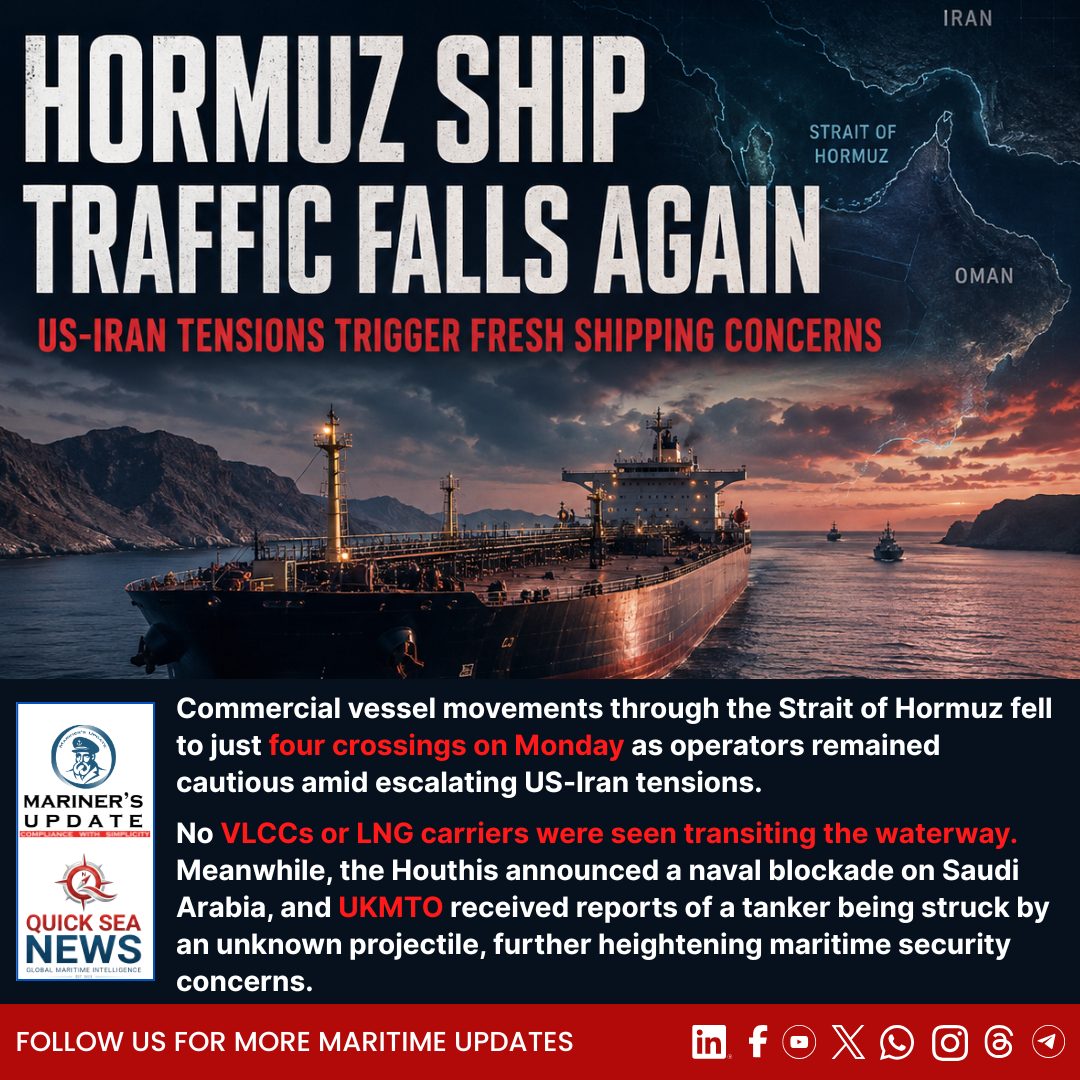
Commercial vessel traffic through the Strait of Hormuz continued to decline at the beginning of the week as heightened military tensions between the United States and Iran prompted ship operators to exercise greater caution while transiting one of the world’s most strategically important waterways.
According to shipping intelligence data from Kpler, only four commodity vessels transited the Strait of Hormuz on Monday, marking another decline from seven vessels recorded the previous day. The slowdown highlights growing concerns among shipowners, charterers, and operators over the deteriorating security environment in the region.
The four vessels recorded during Monday’s transit included:
- Two vessels exiting the Strait of Hormuz:
- One tanker transporting petrochemical cargo.
- One empty tanker departing the region.
- Two vessels entering the Strait:
- One bitumen tanker.
- One oil tanker.
Notably, no Very Large Crude Carriers (VLCCs) or Liquefied Natural Gas (LNG) carriers were observed transiting the strait during the day. The absence of these high-value energy carriers underscores the increasing reluctance of operators to expose large cargoes to the escalating security risks.
The regional maritime situation worsened further after Yemen’s Iran-aligned Houthi movement announced on Monday that it was imposing a naval blockade on Saudi Arabia. The declaration raises fresh concerns over the safety of commercial shipping and the potential disruption of global energy supply chains extending beyond the Persian Gulf.
Adding to the uncertainty, the United Kingdom Maritime Trade Operations (UKMTO) agency reported on Tuesday that it had received multiple reports indicating a tanker had transmitted a distress message stating it had been struck by an unknown projectile while transiting the Strait of Hormuz. The incident remains under investigation, but it further reinforces the increasingly volatile security environment confronting merchant shipping in the region.
The continued reduction in vessel movements, combined with reports of attacks and expanding regional threats, highlights the growing operational challenges for the global shipping industry. With the Strait of Hormuz serving as one of the world’s busiest energy corridors, any prolonged disruption could have significant implications for oil exports, freight markets, insurance costs, voyage planning, and international maritime trade.
As geopolitical tensions continue to escalate, shipping companies are expected to maintain enhanced risk assessments, closely monitor security advisories, and implement additional safety measures before transiting the region.