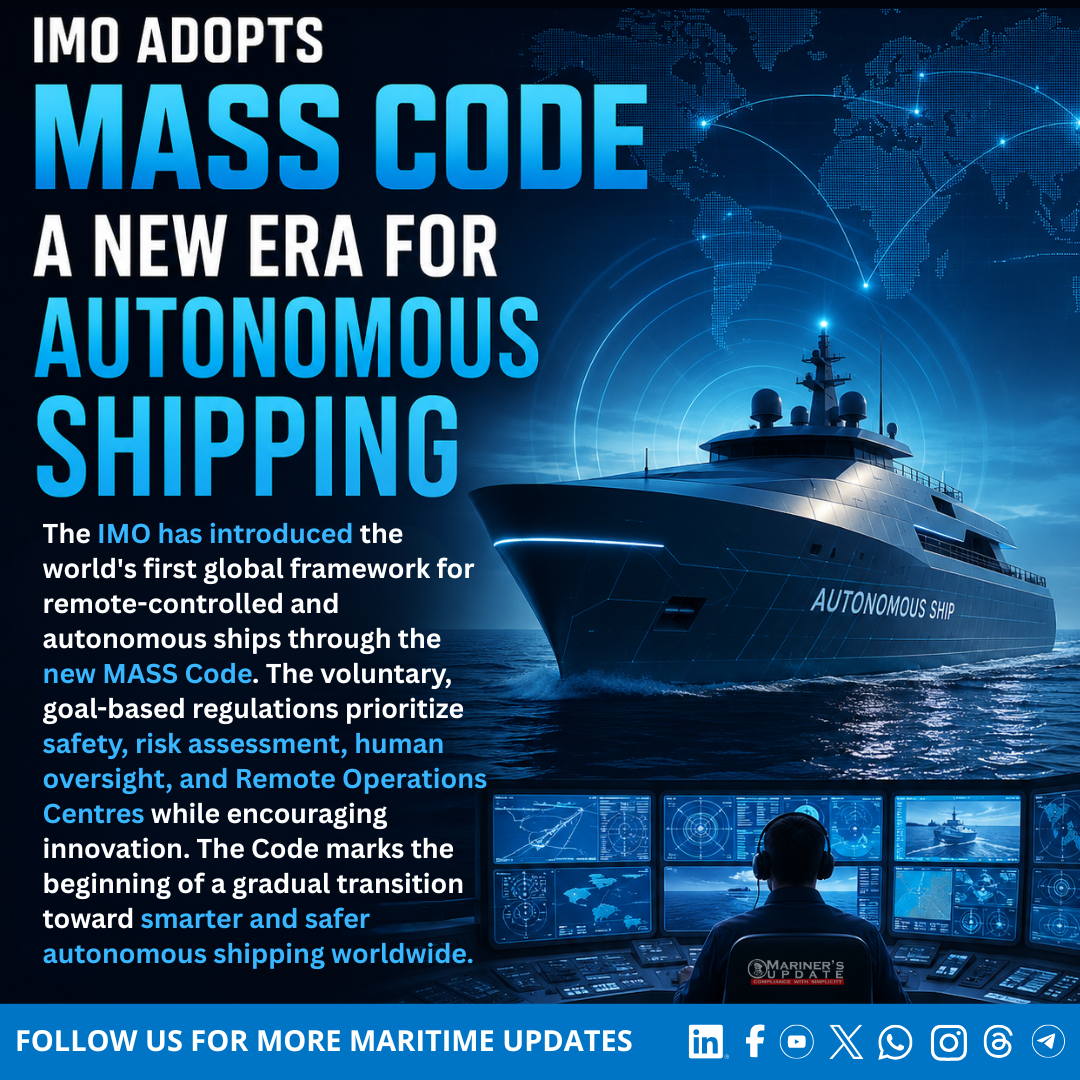
The International Maritime Organization (IMO) has taken a major step toward the future of digital shipping with the adoption of the Maritime Autonomous Surface Ships (MASS) Code. Rather than focusing solely on technology, the new Code establishes the world’s first global regulatory framework for ships operating with remote-control and autonomous capabilities, creating a clear path for the safe integration of automation into international shipping.
The adoption of the MASS Code represents a shift from isolated pilot projects to a structured, internationally recognized approach for designing, approving, and operating autonomous vessels. It provides a common regulatory foundation while allowing governments, classification societies, and the maritime industry to gain practical experience before mandatory implementation.
A Global Framework for Autonomous Shipping
For years, discussions surrounding autonomous shipping centered on technological capabilities—how much control could be transferred from onboard crews to digital systems and remote operators. The MASS Code changes that discussion by introducing internationally accepted safety principles that focus on operational outcomes instead of prescribing specific technologies.
The Code follows a goal-based and technology-neutral approach, meaning it specifies the safety outcomes that must be achieved without restricting how manufacturers or operators develop their systems. This flexible approach allows innovation while maintaining consistent safety standards across different technologies and operational concepts.
Importantly, the Code applies not only to fully autonomous vessels but also to individual autonomous functions, recognizing that automation will be introduced gradually through navigation support systems, remote monitoring, decision-support tools, and partially remote-controlled operations before fully autonomous ships become common.
Why the MASS Code Is Voluntary
One of the most notable aspects of the new framework is that it has been adopted as a non-mandatory (voluntary) instrument during its initial phase.
Rather than enforcing rigid compliance immediately, IMO has chosen an experience-building approach, allowing industry stakeholders to collect operational data, validate safety measures, and improve regulatory requirements through real-world implementation.
This strategy acknowledges the wide variety of autonomous technologies currently under development and provides flexibility for innovation while ensuring safety remains the highest priority.
During this phase:
- Every project will continue to undergo detailed risk assessments.
- Flag States remain responsible for approving autonomous operations.
- Classification societies will verify compliance and provide technical assurance.
- Each autonomous concept will require its own documented approval and safety validation.
The voluntary framework also lays the groundwork for a future mandatory international regulatory regime once sufficient operational experience has been gathered.
Expanding Regulation Beyond the Ship
One of the most significant changes introduced by the MASS Code is its expanded regulatory scope.
Traditional maritime regulations primarily focused on the vessel itself. The MASS Code recognizes that autonomous operations depend on an integrated system consisting of:
- The ship
- Remote Operations Centres (ROC)
- Digital communication links
- Shore-based operators
- Onboard systems
- Human decision-makers
The Code formally recognizes the Remote Operations Centre (ROC) as a critical component of safe vessel operation rather than simply a support facility.
As a result, operators must clearly define responsibilities, communication procedures, intervention capabilities, and operational interfaces between the ship and shore. These elements must be documented, verified, and certified as part of the overall safety assurance process.
Core Safety Principles of the MASS Code
The new Code establishes several key principles that will underpin autonomous shipping.
Risk Assessment Comes First
Every autonomous or remotely controlled operation must demonstrate safety through comprehensive risk assessments. Operators must identify hazards, define operational limits, establish fallback procedures, and provide evidence that risks are effectively managed before approval.
Human Responsibility Remains Essential
Despite increasing automation, the MASS Code makes it clear that responsibility does not disappear.
The ship’s Master remains legally responsible for the vessel and must retain the ability to intervene whenever necessary, even if operating remotely.
The Code also establishes requirements for operator competence, clearly defined roles, and effective human oversight throughout autonomous operations.
Goal-Based Rather Than Prescriptive
Instead of dictating specific hardware or software, the Code focuses on performance objectives. Systems responsible for navigation, connectivity, emergency response, and operational safety must demonstrate they can achieve required safety outcomes regardless of technology used.
Continuous Learning
The experience-building phase encourages industry-wide sharing of operational data and lessons learned. This collaborative approach will help refine future regulations while improving confidence in autonomous shipping technologies.
DNV’s Role in Supporting MASS Implementation
While the MASS Code establishes regulatory expectations, organizations such as DNV provide the practical assurance frameworks needed to demonstrate compliance.
Over the past decade, DNV has developed structured methodologies covering:
- Concept qualification
- System qualification
- Class notations
- Remote operation assurance
- Management systems
- Operator competence
- Project-specific verification
These frameworks complement the MASS Code by helping shipowners translate regulatory requirements into practical safety assurance for individual vessels and autonomous systems.
Challenges Still Ahead
Although the adoption of the MASS Code marks a major milestone, several important questions remain before autonomous shipping becomes widespread.
Industry stakeholders will continue working on:
- Allocation of responsibilities between ships, Masters, and Remote Operations Centres
- Human intervention during autonomous operations
- Communication reliability and connectivity
- Cybersecurity protection
- Search and rescue responsibilities
- Cross-border regulatory coordination
- Data sharing and operational experience
- System resilience and emergency fallback arrangements
Addressing these challenges will require close cooperation between IMO, Flag States, classification societies, technology developers, shipowners, and regulators.
The Future of Autonomous Shipping
The transition toward autonomous shipping is expected to be gradual rather than revolutionary.
Industry experts believe the next decade will likely see increasing use of:
- Decision-support systems
- Remote monitoring technologies
- Remote Operations Centres
- Partially autonomous vessel functions
- Bounded remote-control operations
Fully autonomous international commercial shipping will emerge only after years of operational experience, regulatory refinement, and demonstrated safety performance.
The adoption of the IMO MASS Code therefore represents not the final destination, but the beginning of a carefully managed global transition toward safer, smarter, and more digitally connected shipping.