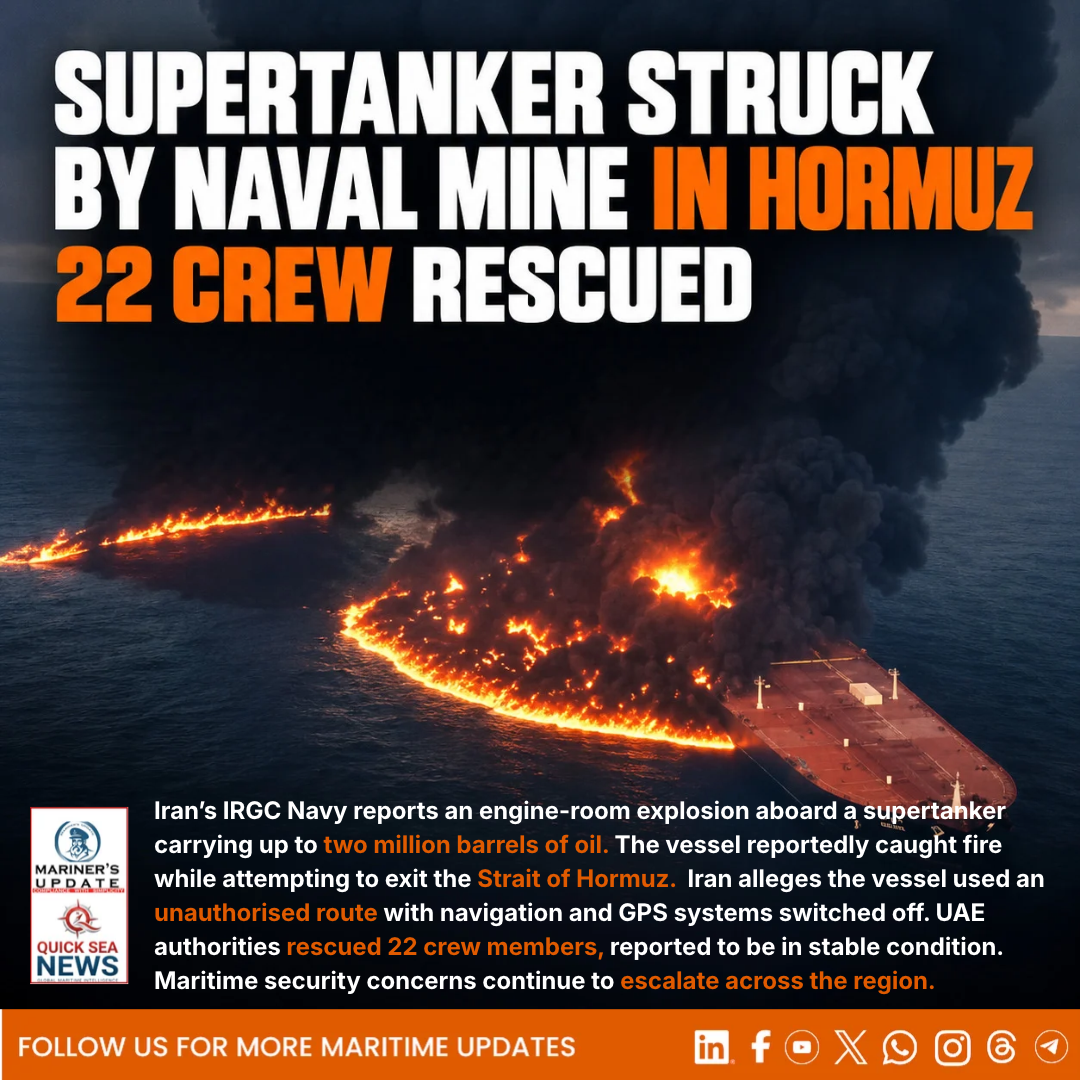
A crude oil supertanker reportedly struck a naval mine while attempting to exit the Strait of Hormuz, triggering an explosion in its engine room and a massive fire, according to a statement from Iran’s Islamic Revolutionary Guard Corps (IRGC) Navy, reported by Iranian state media Press TV.
The tanker was described as having the capacity to carry approximately two million barrels of crude oil. The incident comes amid heightened maritime security concerns in the region, where commercial shipping movements have reportedly fallen sharply amid ongoing hostilities.
Explosion Reported in Supertanker’s Engine Room
According to the IRGC Navy, the explosion occurred after the supertanker struck a naval mine while attempting to leave the Strait of Hormuz.
Iranian authorities alleged that the vessel was using an unauthorised and dangerous route and had switched off its navigation and Global Positioning System (GPS) equipment before the incident.
The explosion reportedly triggered a large fire, with the blaze said to have been visible to residents living along the coast some distance away.
The circumstances surrounding the incident have raised concerns about the risks facing oil tankers navigating the strategically important waterway. However, the reported cause of the explosion and the allegations concerning the vessel’s route and navigation systems have not been independently verified in the available information.
UAE Authorities Rescue 22 Crew Members
Following a distress call in the Arabian Gulf, the United Arab Emirates National Guard responded to the emergency and rescued 22 crew members, according to the available report.
The rescued seafarers were reported to be in stable condition.
The rescue operation highlights the importance of effective emergency communications and coordinated search-and-rescue arrangements when vessels experience serious incidents at sea.
Further details regarding the tanker’s identity, the extent of the damage, the status of the fire and any potential environmental impact were not established in the supplied information.
IRGC Warns Vessels Against Unauthorised Routes
Following the incident, the IRGC Navy issued a strong warning to vessels operating in the Strait of Hormuz.
The Iranian force stated that oil tankers disregarding its security measures and navigation requirements could face serious consequences. It further warned that action against vessels using unauthorised routes would not necessarily be confined to the strait, adding that such vessels could be pursued and punished across the wider region.
Iran maintains that its armed forces have exercised full control over the Strait of Hormuz since what Tehran describes as the beginning of the “US-Israeli aggression.” The warning reflects Iran’s stated position amid the ongoing conflict.
Strait of Hormuz Shipping Faces Continued Disruption
Commercial vessel movements through the Strait of Hormuz have reportedly declined sharply, with traffic falling to single-digit levels amid the ongoing conflict.
The disruption has increased uncertainty for shipowners, operators, charterers and seafarers navigating the region. Security threats, restrictions on vessel movements and uncertainty surrounding safe passage can complicate voyage planning and create additional operational challenges.
Iran has also stated that it will not reopen the waterway until the United States meets its demands and takes steps to restore Tehran’s trust.
Given the strait’s importance as a route for international oil shipments, continued disruption could affect energy transportation, shipping schedules and wider supply chains.
Implications for the Maritime Industry
The reported supertanker incident underscores the security risks associated with commercial shipping in and around the Strait of Hormuz.
Shipowners, operators and ship managers should closely monitor official maritime security advisories, relevant flag-state and coastal-state instructions, and verified updates when assessing operations in the region. Voyage risk assessments and operational decisions should reflect the latest applicable guidance from competent authorities.
The reported rescue of 22 crew members also highlights the critical role of emergency preparedness, effective distress communications and coordinated rescue capabilities in protecting seafarers during maritime emergencies.