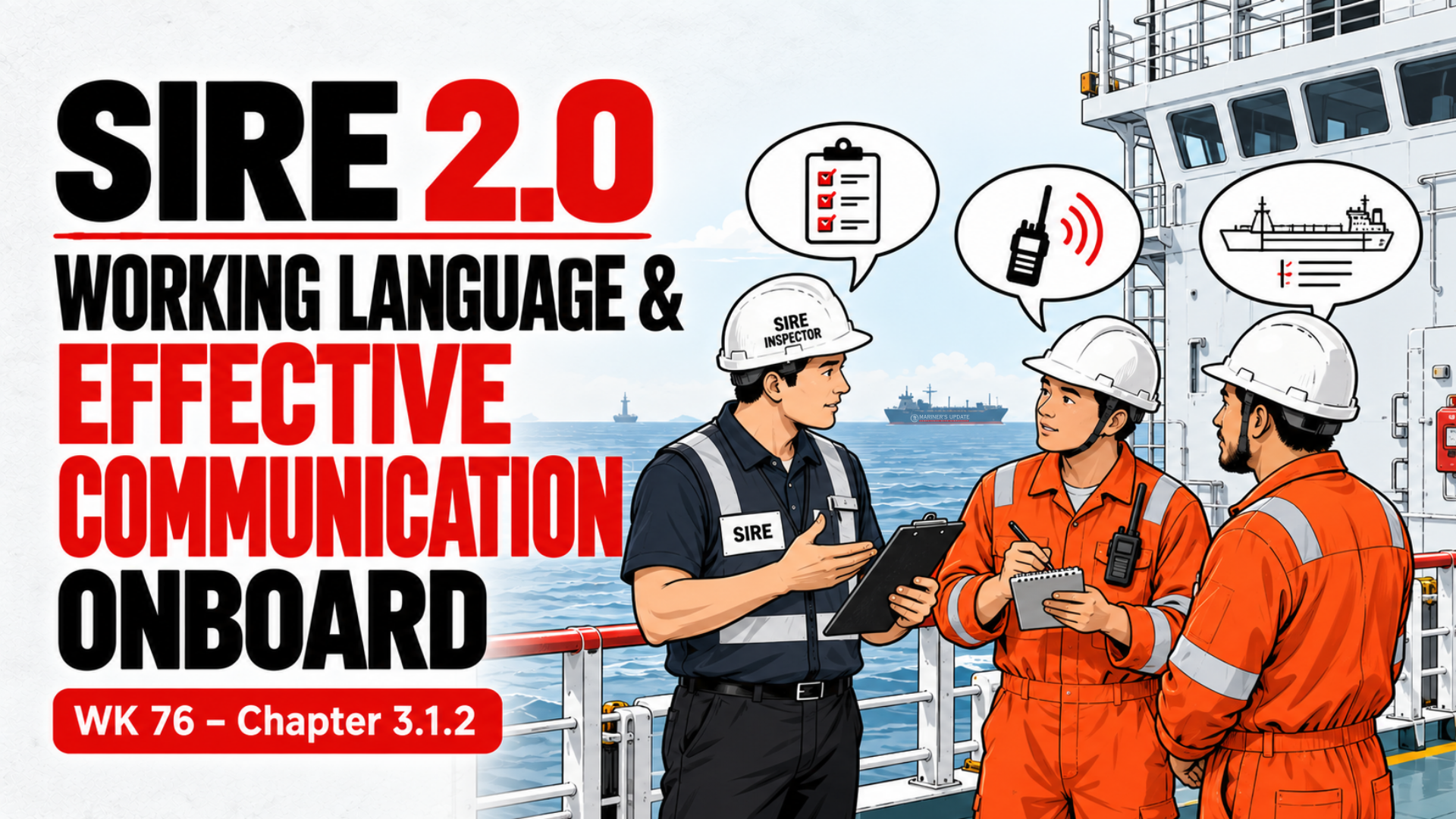
SIRE 2.0 – CHAPTER 3.1.2
Working Language & Effective Communication Onboard
Applies to: Oil Tanker | Chemical Tanker | LNG | LPG
Chapter 3.1.2
Were procedures and instructions contained within the Safety Management System and signs posted around the vessel available in the designated working language of the vessel or a language(s) understood by the crew and, were the Master, officers and ratings able to communicate verbally in the designated working language?
Potential Ground for Negative Observation (OBS)
• The designated working language of the vessel had not been determined by the vessel operator.
• The designated working language in use during the inspection was not the same as declared through the HVPQ and/or entered in the logbook.
• An officer or rating was observed to be unable to communicate verbally in the designated working language of the vessel.
• An officer or rating was observed to be unable to read a safety sign or instruction in any of the language(s) in which it was displayed.
• Where the common working language was not an official language of the Flag State, plans and notices required to be posted did not include a translation into the designated working language.
• The sections of the Safety Management System required to be read and understood by all onboard had not been translated into the designated working language of the vessel and, where necessary, another language(s).
• Checklists and/or safe working procedures were not available in the designated working language of the vessel.
Where there was a concern around the standard of spoken English with any officer, address the concern based on the guidance provided in question 3.1.1.
Any observation(s) arising from this question should be entered into the Process response tool.
An observation that relates to an officer or rating being unable to communicate verbally in the designated working language of the vessel is related to a deficiency in procedures and not the individual(s). The supporting comment should describe the general circumstances and not identify the personnel involved beyond officer or rating.
Checklist for You
1. Are all officers and ratings able to communicate effectively in English?
2. Is the working langwage on board recorded in ship’s logbook?
3. Do officers communicate with each other and with ratings in English in the presence of the inspector?
4. Are officers able to show designated working language stated in SMS?
Guidelines
PROCESS
1. Working Language Documentation
- Ensure the vessel’s designated working language is:
- Documented in the SMS.
- Declared in the HVPQ and pre-inspection questionnaire.
- Recorded in the ship’s logbook.
2.Communication Expectations
- With the Inspector: Officers must communicate in English.
- During Inspection Discussions: Officers should use English unless declared otherwise via the OCIMF crew matrix.
- While Working: Officers and Ratings should communicate in the working language or English.
3. Signage and Safety Instructions
- Verify safety signs and instructions are:
- In the designated working language.
- Translated into a language Ratings can understand, if needed.
- Accompanied by photos for clarity, wherever possible.
4. SMS Content
- Ensure key safety instructions in the SMS are:
- In the designated working language.
- Translated into additional languages as needed.
- Checklists and procedures must also follow this rule.
5. Inspector Observations
- Check if crew members can:
- Verbally communicate in the working language.
- Translate questions and answers effectively when asked.
- Verify the accuracy of safety communication onboard.
Train the crew regularly in the designated working language to maintain smooth operations and compliance.
HUMAN
1. Certification Records
- The Senior Officer accompanying the Inspector must be familiar with certification records of Officers and Ratings.
- Certification for Deck Ratings involved in cargo or equipment duties must include basic training for oil, chemical, or liquefied gas tanker operations (based on vessel type).
2. English Proficiency
- The Inspector will assess the English comprehension and speaking skills of the Master, Chief Engineer, and other Officers.
- If communication issues are found, the Inspector will document the level of English proficiency in the Officer matrix against the individual’s rank.
Ensure all Officers and Ratings have valid certifications for their roles and provide regular English language training to improve onboard communication.
Reference
TMSA KPA 1A.1.3
TMSA KPA 1A.1.3 requires that procedures and instructions are written in plain language and contain sufficient detail to ensure that tasks can be completed correctly and consistently.
IMO: ISM Code
6.6 The company should establish procedures by which the ship’s personnel receive relevant information on the safety management system in a working language or languages understood by them.
6.7 The company should ensure that the ship’s personnel are able to communicate effectively in the execution of their duties related to the safety management system.
IMO: SOLAS
Chapter V Regulation 14 Ship’s manning