
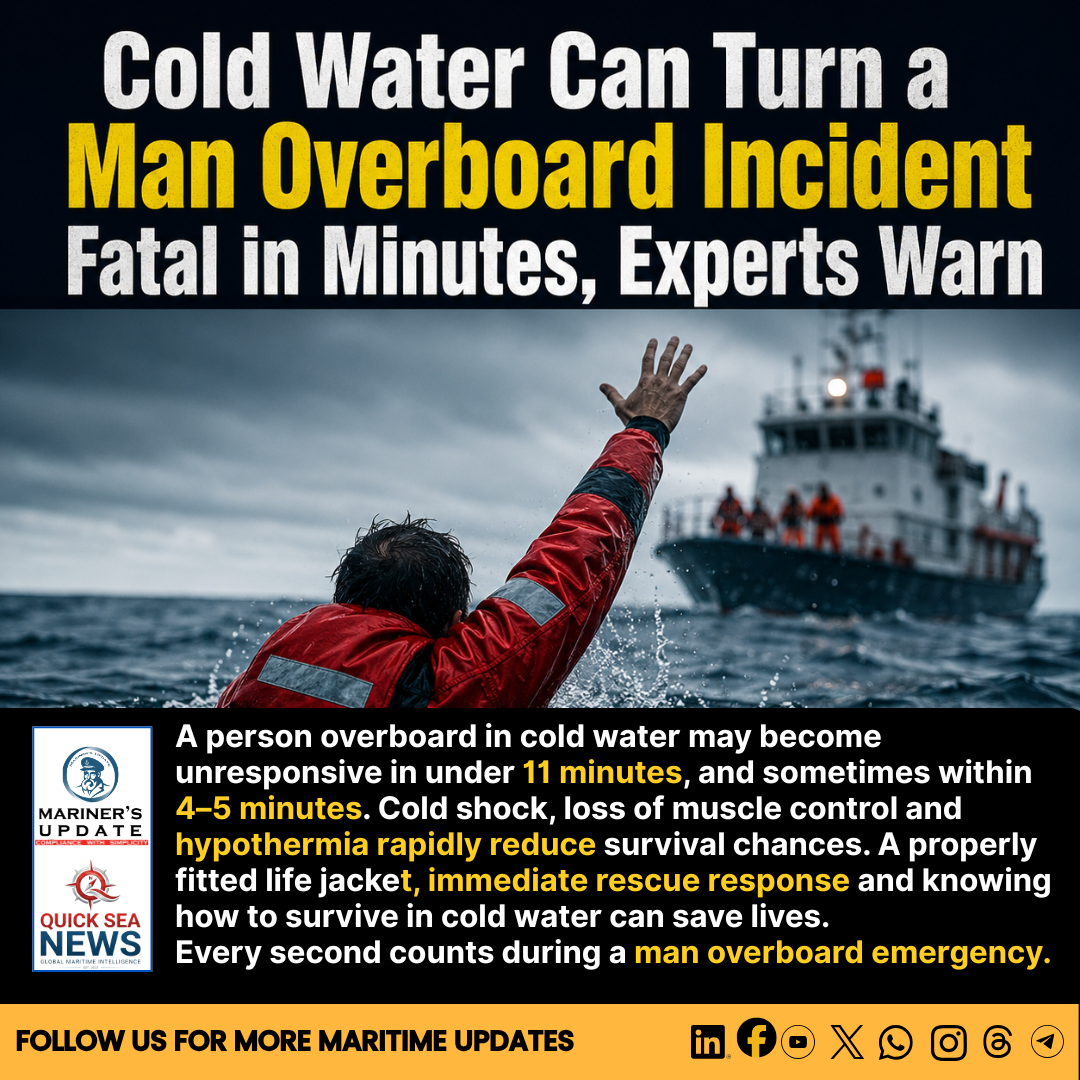
A person falling overboard into cold water has only a very small window of time before becoming unable to help themselves. Maritime safety experts are urging seafarers, ship operators, and offshore personnel to understand how the human body reacts to cold-water immersion, emphasizing that awareness, preparation, and immediate emergency response can make the difference between life and death.
According to an analysis by the UK Maritime Accident Investigation Branch (MAIB), crews have an average of less than 11 minutes to recover a person who has fallen into cold water before they become unresponsive. In harsher conditions, particularly where water temperatures are lower or sea states are rough, that survival window can shrink dramatically to just 4–5 minutes.
The findings are based on an analysis of 20 man overboard incidents between 2017 and 2021, highlighting how every second counts once a person enters cold water.
Why Cold Water Is So Dangerous
Whenever a vessel sounds three prolonged blasts followed by a “Man Overboard” announcement, every crew member understands that an immediate life-saving response is required.
Cold water presents multiple life-threatening dangers long before hypothermia develops.
The body’s first reaction is cold shock, which causes panic, uncontrolled breathing, rapid heartbeat, and severe stress on the cardiovascular system. Although this initial shock usually subsides after a few minutes, valuable time is already being lost.
Soon afterwards, victims experience cold incapacitation. Hands and feet rapidly lose strength and sensation, making it almost impossible to fasten life jacket straps, hold rescue lines, grip floating objects, or even swim effectively. Severe pain and reduced mental clarity further impair decision-making, leaving many victims unable to assist in their own rescue.
If rescue is delayed, hypothermia develops as the body loses heat much faster in water than in air.
Understanding Hypothermia
Cold water removes body heat at an extremely rapid rate because water conducts heat away from the body far more efficiently than air.
The stages of hypothermia include:
Mild Hypothermia (32°C–35°C)
- Strong shivering
- Anxiety
- Increased heart rate
- Victim remains conscious and capable of responding
Moderate Hypothermia (28°C–32°C)
- Shivering begins to reduce
- Slow, laboured movements
- Weak, shallow breathing
- Confusion, drowsiness and disorientation
- Rapid decline in body temperature
Severe Hypothermia (Below 28°C)
- Heat production almost stops
- Vital signs become dangerously weak
- Loss of consciousness
- High risk of cardiac arrest and death without immediate rescue and medical treatment
A drop of only 3–4°C in core body temperature can leave a person unable to care for themselves, while a 6–7°C drop becomes life-threatening.
Survival Depends on More Than Water Temperature
Although computer models and survival charts help search and rescue authorities estimate survival times, actual outcomes vary considerably depending on several factors.
These include:
- Body size and body fat
- Physical fitness
- Swimming ability
- Cold tolerance
- Clothing worn
- Availability of life jackets or flotation devices
- Sea state and weather
- Mental determination and the will to survive
- Behaviour while in the water
Training and correct actions during an emergency can significantly improve survival chances.
How Seafarers Should Prepare Before an Emergency
Preparation begins long before an emergency occurs.
Maritime safety experts recommend that every crew member:
- Know escape routes from every work area.
- Locate immersion suits, life jackets, emergency beacons, SARTs, and survival craft.
- Understand how all survival equipment operates before an emergency.
- Wear multiple clothing layers—even in tropical regions—to reduce heat loss.
- Always wear a properly fitted life jacket when working near the ship’s side.
- Whenever abandoning ship, board survival craft without entering the water if possible.
What To Do If You Fall Into Cold Water
If accidental immersion occurs:
- Stay calm and control your breathing during the initial cold shock.
- If entering the water deliberately, enter slowly whenever possible.
- Keep as much of your body out of the water as possible.
- Avoid unnecessary swimming because swimming increases body heat loss.
- Swim only if a safe refuge is close and rescue is unlikely.
- Swim on your back using mainly your legs.
- If approaching floating equipment, aim downwind and allow the wind to carry the object toward you.
- If remaining in the water, adopt the Heat Escape Lessening Position (HELP) by keeping your legs together, elbows close to your body, and arms folded across your chest.
- Use a whistle or shout to attract attention.
- Without a life jacket, avoid waving your arms because doing so reduces buoyancy.
- Stay mentally focused and maintain the determination to survive.
During Rescue
Victims should avoid exhausting themselves while being recovered.
Allow rescuers to perform the recovery and remain mentally alert throughout the rescue process. Maintaining the will to survive until safely recovered is often critical.
Every Minute Matters
Maritime experts stress a simple but powerful message:
Putting on a life jacket takes seconds—but recovering a person from cold water can be incredibly difficult.
Even experienced swimmers can drown in cold water within minutes due to cold shock, loss of muscle control, and hypothermia.
With maritime activity increasing in Arctic waters, the Southern Ocean, and other cold-weather regions, continuous training, emergency drills, and awareness of cold-water survival techniques remain essential for protecting lives at sea.
Early response, proper preparation, suitable survival equipment, and understanding the body’s reaction to cold water continue to be the strongest defenses against fatal man overboard incidents.