
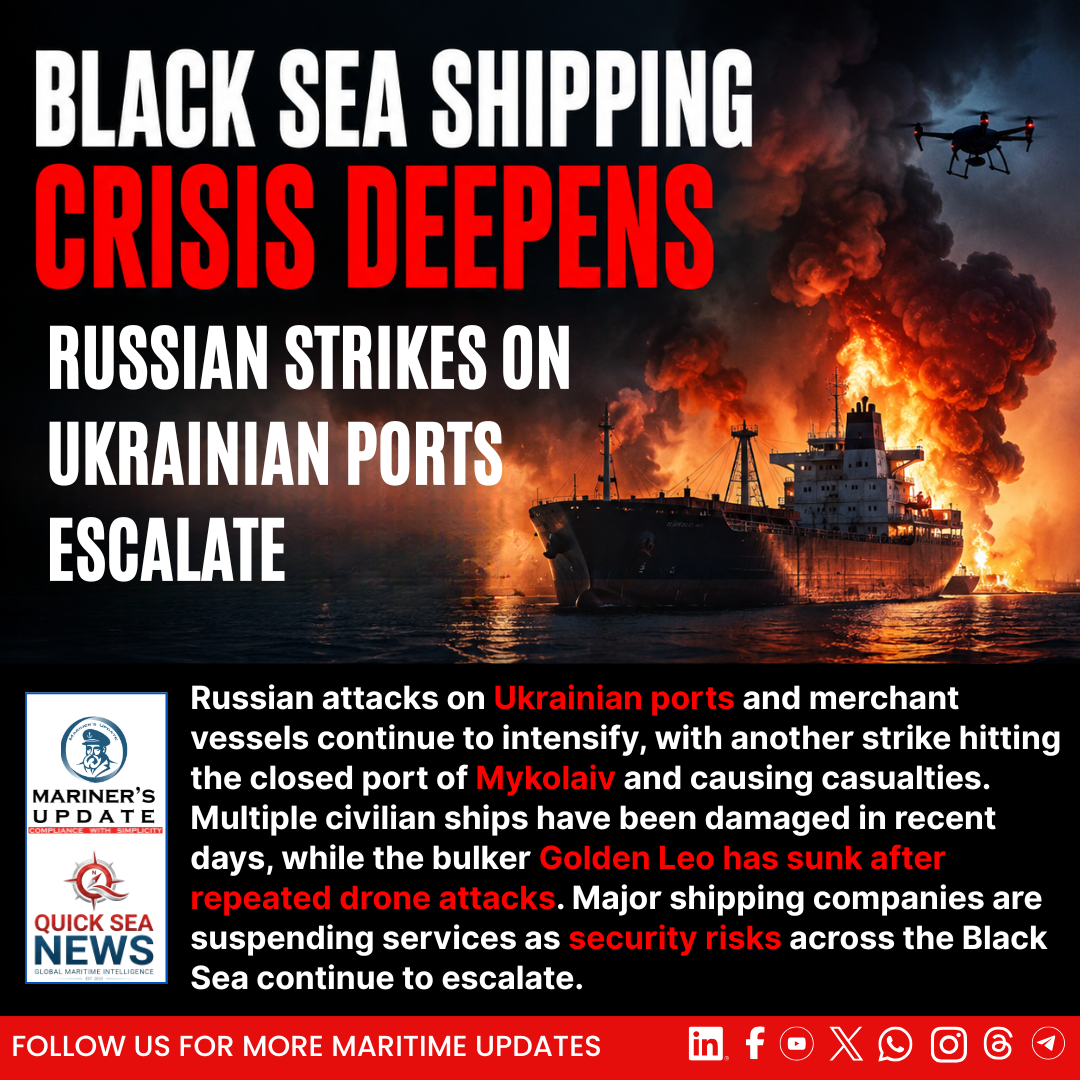
The security situation in the Black Sea has deteriorated further as Russian attacks on Ukrainian ports, civilian vessels, and maritime infrastructure continue to intensify. The latest strikes highlight the growing risks faced by commercial shipping in the region, with repeated attacks disrupting maritime operations and raising serious concerns for global shipping and crew safety.
According to the Ukrainian Seaport Administration, the blocked port of Mykolaiv was attacked overnight, marking at least the third strike on the port within the past 10 days. Although the port has remained closed since Russia’s invasion of Ukraine in 2022, the attacks have continued to target vessels and infrastructure inside the harbor.
During the latest attack, an unidentified cargo ship anchored inside the closed port was struck. The incident resulted in one fatality, while several other people were injured. Ukrainian authorities emphasized that the vessel was not engaged in commercial operations and had remained trapped inside Mykolaiv since the beginning of the war, making the attack particularly difficult to justify from an operational perspective.
The latest strike follows a series of recent attacks on Mykolaiv. On July 24, drone strikes damaged two civilian ships, while an earlier attack on July 17 caused significant damage to port facilities and surrounding urban infrastructure, killing two Ukrainian civilians.
The escalation extends beyond Mykolaiv. Just one day before the latest attack, a Turkish-operated cargo vessel navigating the Danube region was also hit during a Russian strike. In the previous week, multiple merchant vessels operating near the Odesa region came under attack, including the bulk carrier Golden Leo. Ukrainian officials reported that the vessel suffered repeated drone strikes that killed 10 seafarers before ultimately sinking due to the extensive damage sustained.
The worsening security environment had already prompted Ukrainian President Volodymyr Zelensky to warn that Russia was expected to intensify attacks on Black Sea port infrastructure and shipping. Following the escalation, several international shipping companies reassessed their operations in the region. Maersk suspended its container services to the Ukrainian port of Chornomorsk, while several shipowners announced they would avoid sending cargo vessels into Ukrainian ports because of the increasing security threats.
Meanwhile, Ukraine continues its own campaign targeting Russian port infrastructure. Reports from Russian media and local residents indicated drone activity around the important port city of Rostov-on-Don, a key logistics hub supporting operations in the Sea of Azov. Images circulating online reportedly showed smoke rising near the fourth cargo terminal, while authorities also reported fires and falling drone debris after air defense systems intercepted several drones.
The continued exchange of attacks on both Ukrainian and Russian port infrastructure is significantly increasing operational risks across the Black Sea and Sea of Azov. With merchant vessels increasingly caught in the conflict, shipping companies are reassessing voyage planning, insurance coverage, crew safety, and regional trade routes as maritime security remains highly volatile.