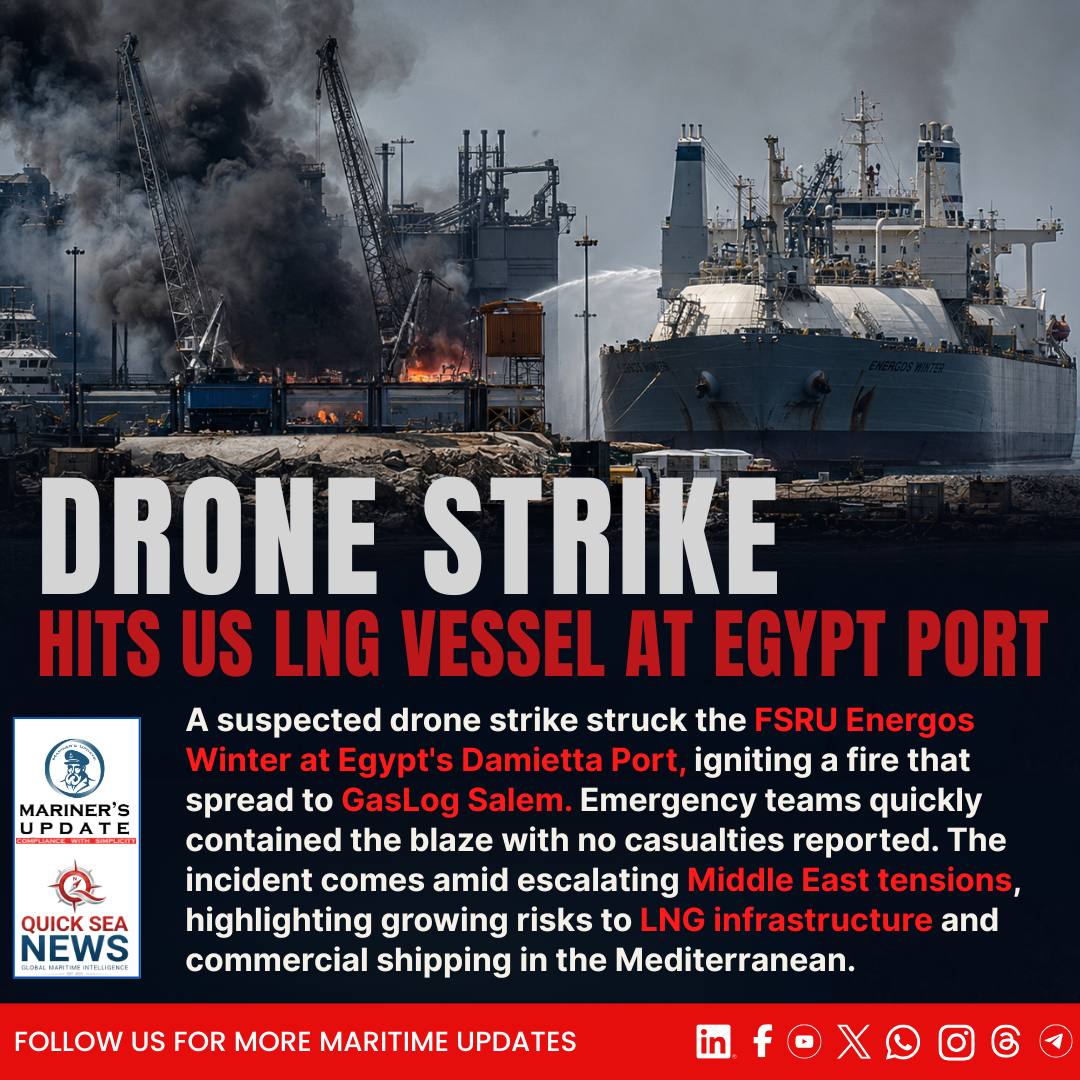
A significant maritime security incident unfolded at Egypt’s Damietta Port after a drone strike reportedly hit the US-owned floating LNG storage vessel Energos Winter, triggering a fire that spread to a nearby LNG carrier, GasLog Salem. The incident marks another alarming development in the rapidly expanding Middle East conflict, raising fresh concerns over the safety of commercial shipping and critical energy infrastructure in the Mediterranean.
According to British maritime security firm Ambrey, the drone attack targeted the Energos Winter, a Floating Storage and Regasification Unit (FSRU), while it was berthed at Damietta Port on Egypt’s Mediterranean coast. Initial reports indicate that the impact caused a fire which later spread to the adjacent LNG carrier GasLog Salem.
Egypt’s Cabinet confirmed that a fire broke out on two vessels at Damietta Port, adding that preliminary investigations are ongoing. However, officials have not officially confirmed a drone strike, and no group has claimed responsibility for the incident. Egyptian authorities stated that all necessary measures are being taken to safeguard national security and protect Egypt’s strategic interests.
Separate reports from port services provider Inchcape also confirmed that two gas tankers caught fire at the port during the incident.
British maritime risk management company Vanguard reported that the Energos Winter was struck by an unidentified projectile on its starboard side, resulting in a localized fire that was successfully extinguished by emergency response teams.
The timing of the attack has drawn significant attention due to the broader geopolitical situation across the Middle East. The incident occurred shortly after heightened military exchanges involving Iran, the United States, and Iran-backed groups in the region. At the same time, Yemen’s Houthi movement has declared a naval blockade against Saudi Arabia, further increasing concerns that the regional conflict is spreading into new maritime theatres beyond the Red Sea.
Investigators have not identified those responsible for the attack, and no organization has claimed responsibility. Maritime security analysts continue to monitor whether the incident represents an isolated strike or signals an expansion of threats targeting energy shipping in the Eastern Mediterranean.
Open-source intelligence researchers verified the incident using video footage, satellite imagery, port infrastructure, vessel tracking data, and archive images, confirming the vessels involved as:
- ENERGOS WINTER (IMO: 9256614)
- GASLOG SALEM (IMO: 9638915)
The footage matched the vessels’ hulls, mast configurations, foredeck layouts, and port surroundings. Media reports and official confirmation from Egypt’s Petroleum Ministry further established the authenticity and timing of the incident.
The Energos Winter is an important Floating Storage and Regasification Unit (FSRU) with a storage capacity of approximately 138,250 cubic metres of LNG. The vessel is owned by US-based Energos Infrastructure, while its technical, safety, and commercial management is handled by Wilhelmsen Ship Management.
Egypt’s Petroleum Ministry confirmed that emergency response plans were immediately activated after the fire broke out on both the regasification vessel and the storage vessel. Firefighting teams and security personnel successfully contained the blaze.
Egyptian Petroleum Minister Karim Badawi personally visited Damietta Port to oversee emergency response operations and assess the situation.
Authorities confirmed that no injuries or fatalities were reported. Emergency crews continue to evaluate the condition of both vessels and assess any operational or environmental impact resulting from the incident.
The attack highlights the growing vulnerability of LNG infrastructure and commercial shipping as geopolitical tensions continue to intensify across the Middle East. Maritime stakeholders are expected to closely monitor security developments in both the Mediterranean and Red Sea regions as regional instability increasingly affects global energy supply chains and maritime operations.