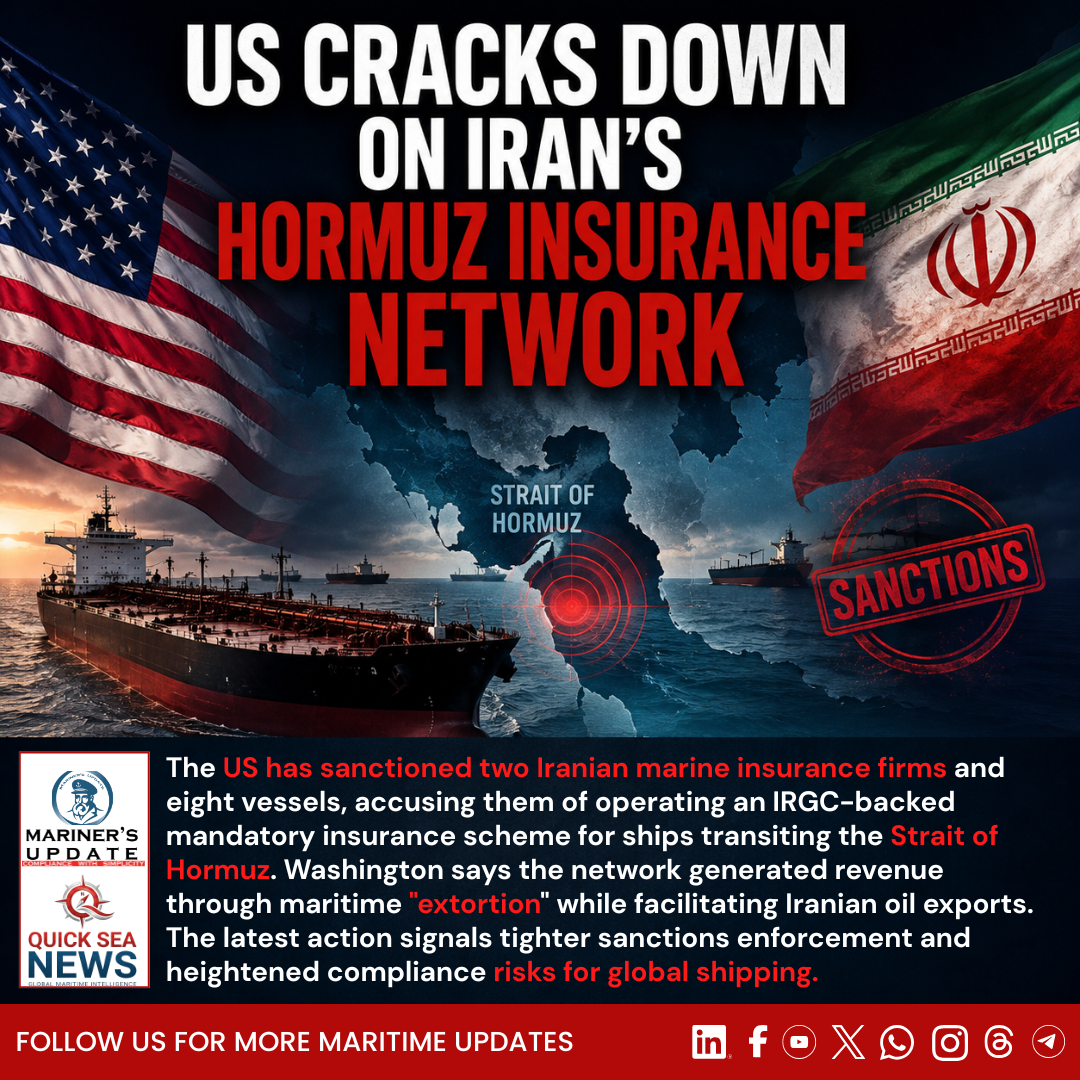
The United States has significantly intensified its sanctions campaign against Iran by targeting what it describes as an Islamic Revolutionary Guard Corps (IRGC)-backed maritime insurance extortion network operating in the Strait of Hormuz. The latest measures, announced by the US Treasury’s Office of Foreign Assets Control (OFAC), include sanctions against two Iranian marine insurance companies and eight vessels allegedly involved in transporting Iranian oil while supporting Tehran’s sanctioned activities.
According to OFAC, Persian Gulf Marine Insurance Company (PGMIC) and HormuzSafe Marine Services Authority have been operating a mandatory insurance scheme that forces vessels transiting the Strait of Hormuz to purchase Iranian-backed insurance coverage.
US authorities allege that the scheme is not designed to genuinely protect shipping interests but instead generates revenue for the Islamic Revolutionary Guard Corps (IRGC). OFAC stated that although the insurance claims to cover risks such as vessel seizure, “those risks are overwhelmingly created by Iran itself,” effectively describing the arrangement as an extortion mechanism imposed on international shipping.
The sanctions reflect Washington’s continued emphasis on protecting freedom of navigation through one of the world’s most strategically important maritime chokepoints. The Strait of Hormuz handles a substantial share of global oil exports, making any disruption or additional transit costs a matter of international concern.
The latest action comes despite a brief diplomatic shift earlier this year. Following the signing of a US-Iran Peace Memorandum of Understanding (MoU), OFAC had issued a 60-day sanctions waiver. However, that policy changed rapidly when sanctions were reimposed on 7 July, and the US Senate subsequently approved legislation on 29 July extending sanctions against Iran through 2031, signalling a renewed hardline approach.
Two Iranian Companies Sanctioned
The newly sanctioned entities are:
- Persian Gulf Marine Insurance Company (PGMIC) – Accused of brokering and issuing mandatory insurance policies for ships transiting the Strait of Hormuz with approval from the US-designated Persian Gulf Strait Authority.
- HormuzSafe Marine Services Authority – A digital marine insurance provider that OFAC alleges participated in the same IRGC-backed insurance network.
US officials argue that both companies generated significant revenue through compulsory insurance policies imposed on vessels passing through the waterway.
Eight Additional Ships Added to OFAC Sanctions List
OFAC also expanded its sanctions list by adding eight vessels accused of transporting Iranian crude oil or petroleum products in violation of US sanctions.
The designated vessels include:
- Product Tanker Well Sail (IMO 9321938) – Built in 2007, allegedly transported hundreds of thousands of barrels of Iranian petroleum products to the UAE during 2026.
- VLCC Lily (IMO 9294331) – Built in 2005 and reportedly operating under a false Mozambique flag.
- Panamax Al Salmi (IMO 9298296) – Built in 2005 and currently sailing without a recognised flag after leaving the Panama registry. OFAC clarified that this vessel is not the Kuwait-flagged VLCC of the same name that was struck by a projectile near Dubai earlier this year.
- VLCC Breeze V (IMO 9259355) – Built in 2003, recently shifted from the Comoros registry and now claims Barbados registration.
- VLCC Natsumi (IMO 9331244) – Built in 2006, claims Barbados flag and has reportedly changed its name three times since 2024.
- Aframax Yehope (IMO 9243320) – Built in 2003, changed ownership, name and reflagged to Barbados in January 2026.
- VLCC Crystal (IMO 9223887) – Built in 2002 and currently registered under Vanuatu.
- VLCC Nireta (IMO 9237785) – Operating under the Vanuatu flag since April 2026.
According to OFAC, seven of these vessels transported millions of barrels of Iranian crude oil to China, while Well Sail allegedly carried Iranian petroleum products to the United Arab Emirates.
US Treasury Sends Strong Warning
US Treasury Secretary Scott Bessent said Iran’s worsening economic conditions, including triple-digit inflation, have increased the regime’s reliance on illicit revenue sources.
He stated that the United States would not allow Iran to use international shipping or commercial maritime trade to finance the IRGC’s activities or threaten global commerce.
Implications for the Maritime Industry
The latest sanctions reinforce the growing compliance risks facing shipowners, operators, insurers, charterers and financial institutions involved in Middle East trading routes.
Companies operating in the region should continue to:
- Conduct enhanced sanctions due diligence.
- Verify vessel ownership, flag history and beneficial ownership.
- Screen counterparties against updated OFAC sanctions lists.
- Review marine insurance arrangements carefully.
- Monitor developments affecting Strait of Hormuz transit requirements.
With geopolitical tensions remaining elevated, shipping companies navigating the Gulf region are likely to face increased regulatory scrutiny and compliance obligations in the months ahead.