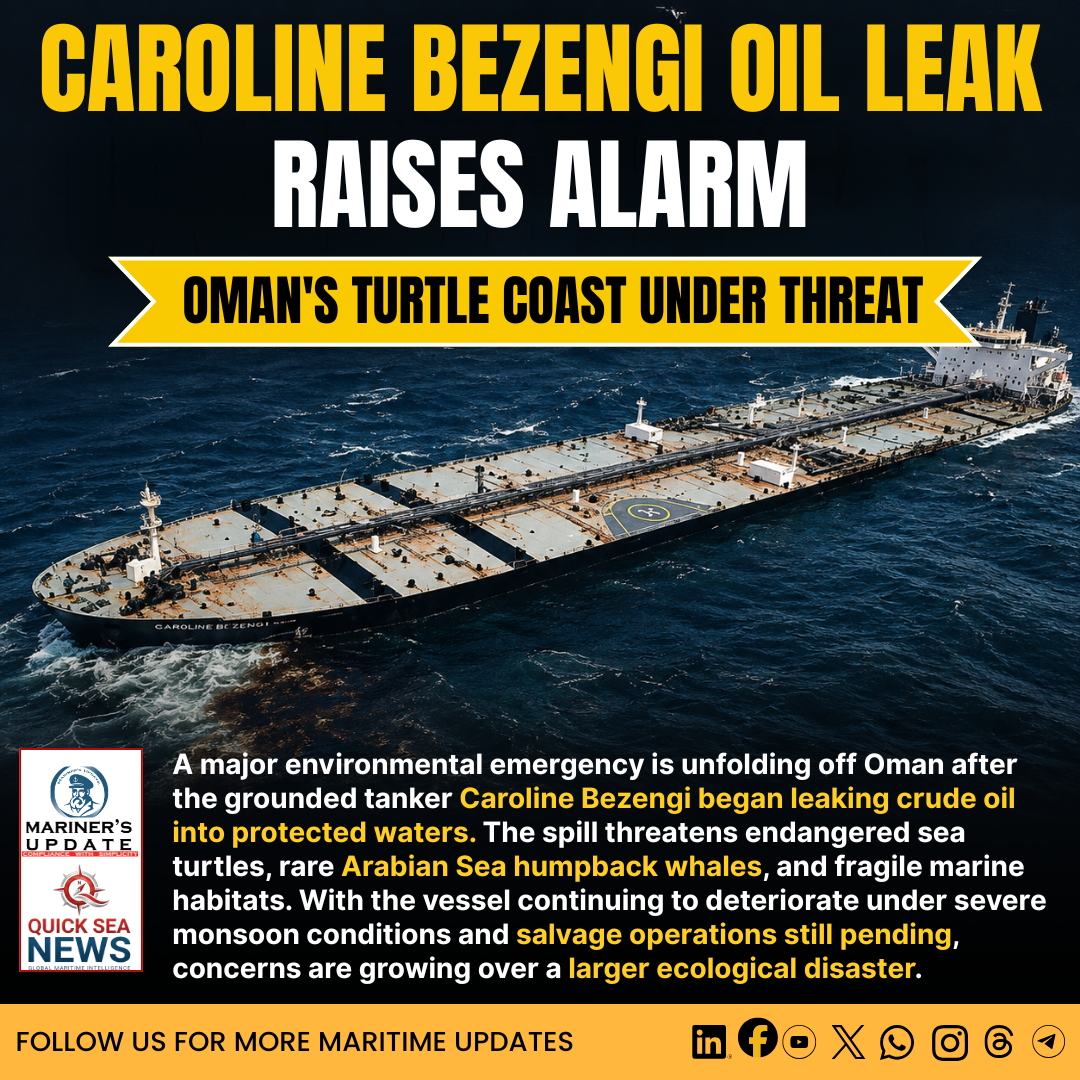
An environmental disaster is rapidly developing off the coast of Oman after the stranded crude oil tanker Caroline Bezengi began releasing oil into the Arabian Sea, threatening one of the region’s most sensitive marine ecosystems and globally significant turtle nesting beaches.
The Cameroon-flagged Supermax tanker Caroline Bezengi (159,168 DWT) has remained grounded on rocky shores near Jazirat Al Qibliyyah, part of Oman’s Hallaniyat Islands, since suffering an explosion on 8 June while sailing off the Omani coast.
Prior to the incident, the vessel had transited the Suez Canal on 30 May before departing the Maritime Security Transit Corridor. Four days after the explosion, all crew members were safely evacuated without injuries. The damaged vessel later drifted onto rocks along the island’s southwest coastline.
The tanker was carrying a full cargo of crude oil loaded at Novorossiysk, Russia, bound for Gujarat, India. The vessel has previously been linked to Russian state shipping company Sovcomflot and has been sanctioned by the European Union, United Kingdom, and the United States (OFAC) as part of measures targeting Russia’s so-called “dark fleet.”
Vessel Condition Continues to Worsen
The tanker remains stranded in one of the most exposed locations along Oman’s coast during the powerful Khareef monsoon season, where heavy seas continue to batter the vessel.
Surveyors report that the bow is firmly grounded on rocks while additional rocky outcrops lie alongside the vessel and behind its stern, creating a high risk of structural failure should the ship shift in rough weather.
An onboard inspection conducted by Omani maritime authorities on 12 July revealed significant deterioration compared to aerial surveys conducted just days earlier.
Officials observed that:
- The vessel was sitting noticeably lower in the water.
- The ship had developed a greater list.
- Structural integrity had weakened, increasing the risk of the vessel breaking apart.
- Almost every cargo tank showed signs of seawater ingress.
- Crude oil had leaked into ballast tanks and double-hull spaces.
- Accumulated hydrocarbon vapours created a potentially explosive atmosphere onboard.
Only one cargo tank remained undamaged and empty, while the remainder of the vessel’s cargo compartments had suffered varying degrees of damage.
Salvage Plan Identified but Yet to Begin
Marine surveyors identified a technically feasible salvage option involving the transfer of the remaining cargo through an approximately 1,000-yard pipeline to another tanker positioned in sheltered waters behind the island.
Reducing the vessel’s weight could potentially allow it to be refloated.
However, specialists warn that the operation carries substantial risks, including:
- Further structural failure during cargo removal.
- Explosion hazards caused by trapped hydrocarbon vapours.
- Complete breakup of the vessel under ongoing wave action.
The cargo onboard is estimated to be worth well over US$100 million.
Owners Ordered to Remove Vessel
On 23 July, Oman’s Ministry of Transport, Communications and Information Technology reportedly issued an emergency directive requiring the shipowners to remove the vessel within 24 hours.
The registered owner, Rentoor Ship Management, listed in Shanghai, has reportedly not responded publicly. Industry reports indicate the registered business address appears to be linked to a residential property rather than an operational shipping office, reflecting a pattern commonly associated with vessels operating within Russia’s shadow tanker fleet.
Satellite Images Confirm Oil Spill
Recent satellite imagery captured on 2 August indicates that several small vessels were operating near the stranded tanker.
Despite their presence, there is no visible evidence that cargo lightering or salvage operations have commenced.
Instead, satellite observations show a growing oil slick spreading from the wreck and drifting northeast across the Arabian Sea.
The spill is expected to move toward the Omani coastline between Sharbithat and Ras Madrakah, an isolated stretch of coast renowned for its pristine beaches and minimal human disturbance.
Critical Wildlife Habitat Under Threat
The affected coastline serves as one of Oman’s most important nesting grounds for sea turtles, where females come ashore to lay eggs largely undisturbed.
Nearby offshore waters are also protected as a marine reserve supporting several endangered species, including:
- Rare Arabian Sea humpback whales.
- Petrels and other protected seabirds.
- Numerous marine organisms that depend on the fragile coastal ecosystem.
Environmental experts fear the expanding oil slick could have long-lasting ecological consequences if containment and recovery operations are not initiated quickly.
Questions Remain Over Explosion Cause
Investigators continue examining the circumstances surrounding the original explosion.
Industry analysts believe the damage pattern is consistent with a limpet mine attack, with some assessments suggesting the operation may have targeted Russian-linked shadow fleet shipping.
Reports indicate that if such an explosive device was used, it was most likely attached while the vessel was anchored after departing Novorossiysk or during waiting periods associated with Suez Canal transit.
The incident also draws attention to the broader issue of Russian-linked shadow fleet tankers operating under alternative flags. Reports indicate that 39 of the 43 vessels currently registered under the Omani flag are associated with Russia’s dark fleet, raising wider concerns about sanctions enforcement, maritime security, and environmental risk.
Growing Environmental and Maritime Concern
With oil now visibly entering the Arabian Sea, deteriorating weather conditions, and no confirmed large-scale salvage operation underway, pressure is mounting on authorities and vessel owners to act before the Caroline Bezengi suffers catastrophic structural failure.
The incident represents not only a major pollution emergency but also another reminder of the environmental risks posed by ageing, sanctioned shadow fleet tankers operating across international shipping routes.