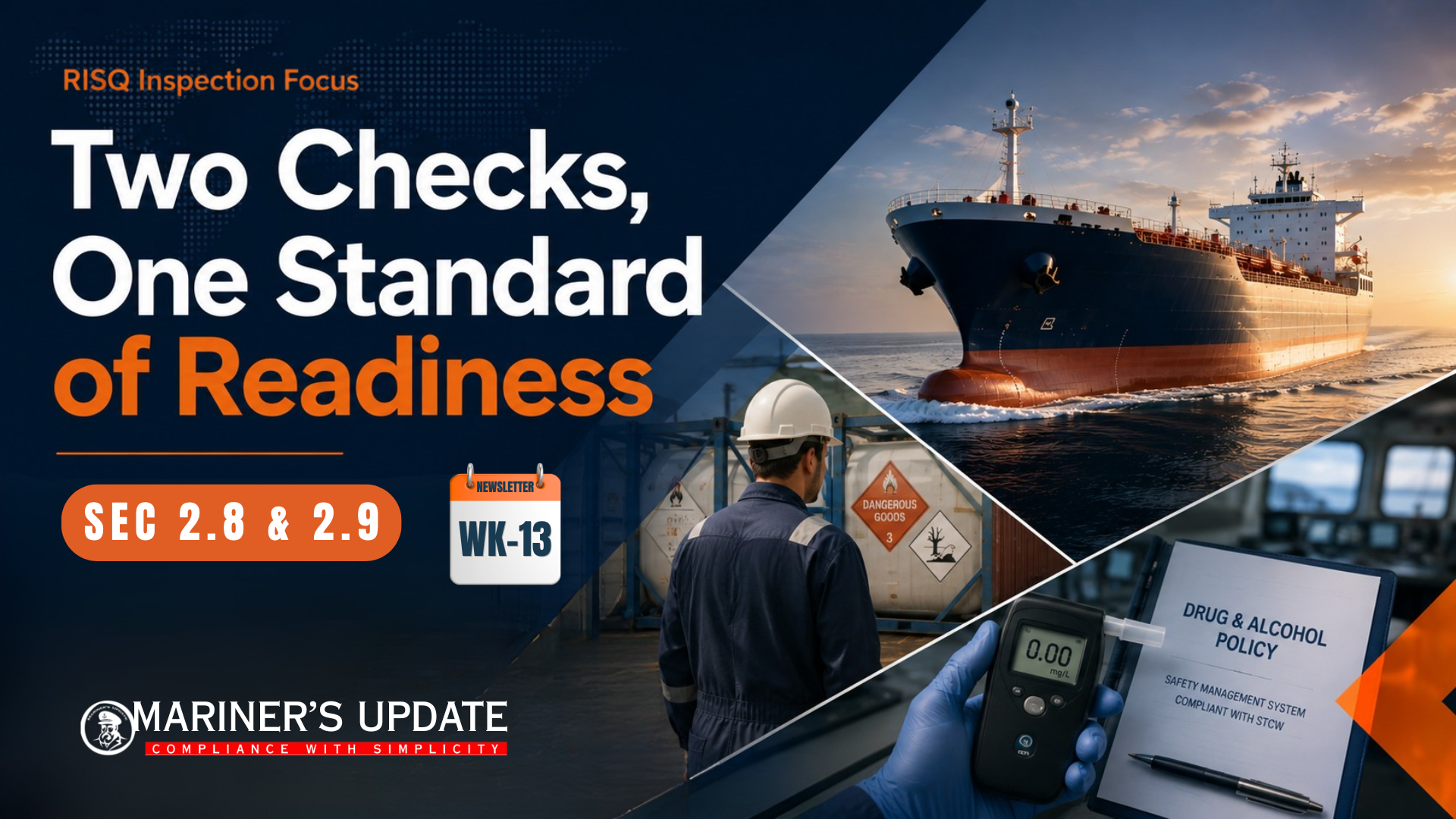
Two very different checks, one shared goal: making sure the people on board are ready, capable, and fit for the job. This week we look at how crew are trained to handle dangerous cargo safely, and how a strong drug and alcohol policy keeps the whole ship’s operation sound.
Questions Covered:
2.8 – Have officers and ratings responsible for cargo handling on ships carrying dangerous and hazardous substances in packaged form, undergone formal training ?
2.9 – Has an SMS policy and procedure been established to enforce the STCW Convention and Code requirements for the purpose of preventing drug and alcohol abuse?
2.8 — DANGEROUS CARGO HANDLING TRAINING
Any officer or rating involved in handling dangerous, hazardous, or harmful cargo in packaged form needs to have gone through formal, structured training for it — not just picked it up on the job.
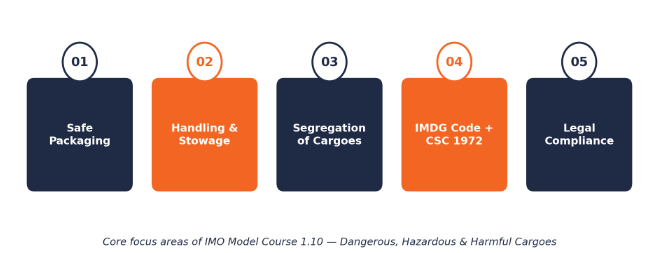
Core training areas :
- Safe Packaging
- Handling & Stowage
- Segregation of Cargoes
- IMDG Code + CSC 1972
- Legal Compliance
Guide to Inspection – what it means for you:
- If the ship isn’t carrying this type of cargo — and didn’t on the previous voyage either — the item is simply marked Not Applicable.
- Training should leave crew able to safely plan and carry out the loading, stowage, and segregation of dangerous and hazardous cargo, not just recognise the rules on paper.
- Crew should understand the legal side too, and be able to check that packaging and handling instructions are actually being followed.
- The training also needs to cover how dangerous cargo interacts with other cargo on board, in line with the IMDG Code and the International Convention for Safe Containers (1972).
2.9 — DRUG & ALCOHOL POLICY UNDER THE SMS
Every company should be able to show a clear drug and alcohol policy under its Safety Management System — one that lines up with STCW requirements and leaves no room for confusion about what’s expected on board.
- The policy should spell out exactly who it applies to — including contractors, not just the ship’s own crew.
- It should state clearly which substances are restricted, covering anything that affects judgement or alertness, regardless of the circumstances.
- Prescription medicine has its place too — permitted use should be backed by a valid prescription from a qualified doctor or the ship’s medical store.
- A company can absolutely run a zero-alcohol, zero-drug policy across its ships and premises — many do.
What good policies clearly cover:
- Using, distributing, or possessing prohibited substances at work.
- Not meeting STCW standards of training, certification, and watchkeeping.
- Being under the influence, or otherwise unfit for duty.
- Ignoring a stand-down order after a positive test.
- Refusing to test, or interfering with the testing process.
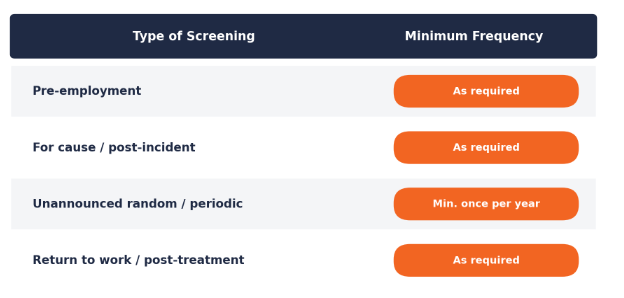
Testing usually comes down to two methods — blood or breath — and it matters that a company’s policy sets clear limits for both, rather than leaning on rough conversions between the two.
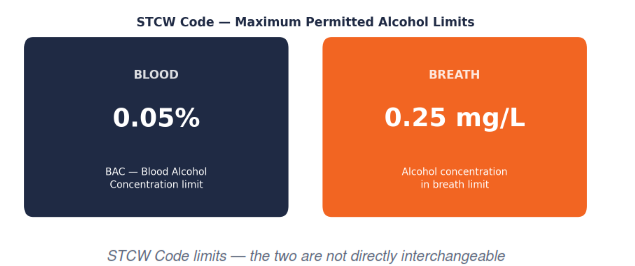
Blood vs. Breath Testing — STCW Code limits:
- Blood (BAC): 0.05%
- Breath: 0.25 mg/L Note: the two are not directly interchangeable.
- Blood and breath results don’t convert cleanly — physiology, temperature, and testing method all introduce variation, which is exactly why disputes and audit findings happen.
- Where urine testing is used, there’s currently no fixed statutory limit, so the policy should explain how those results are interpreted, ideally with the testing provider.
- Unannounced testing can be run by the ship or by an outside party, for both drugs and alcohol — and it can be initiated by the Master, a terminal manager, or the company.
- Legal advice matters here — drug and alcohol rules differ by country, and getting it wrong can create real legal exposure for both the company and the individual.
Readiness on board isn’t only about equipment and procedures — it’s about whether the people carrying them out are properly trained, and properly fit to do the job. Both start well before the inspector ever steps on deck.