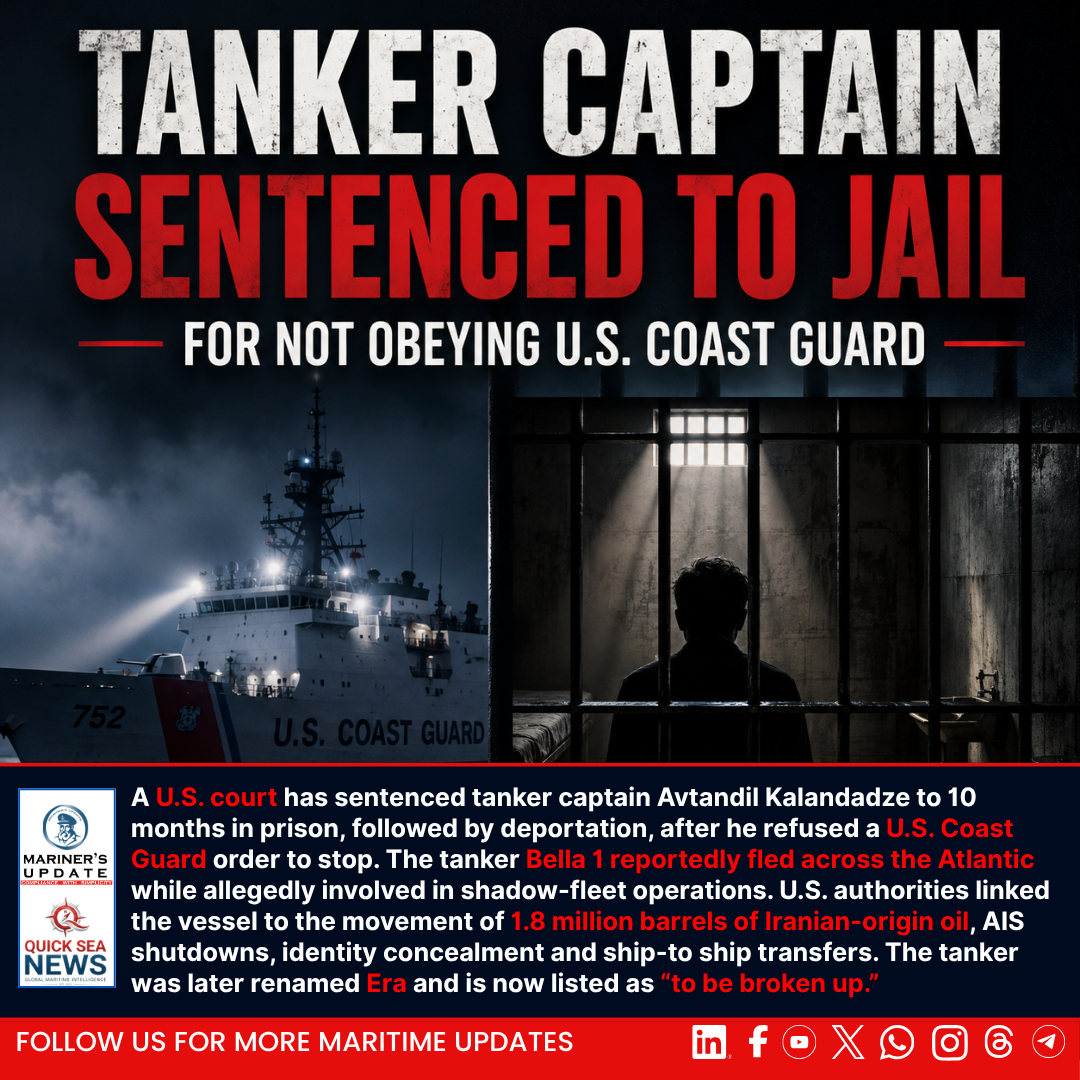
A U.S. federal court has sentenced the captain of the tanker Bella 1, later renamed Marinera, to 10 months in prison followed by deportation after he pleaded guilty to refusing an order from the U.S. Coast Guard to stop his vessel.
On August 7, the U.S. District Court sentenced 47-year-old Avtandil Kalandadze, a Georgian national, following his guilty plea in June to one count of failing to “heave to” when ordered by the U.S. Coast Guard Cutter Munro.
Kalandadze was master of the 318,518-DWT tanker from September through late December 2025. The vessel was reportedly sailing toward Venezuela when it was intercepted by the Munro as part of U.S. enforcement operations. Instead of complying with the order to stop, the tanker continued sailing and attempted to evade the Coast Guard.
From Bella 1 to Marinera: A Flight Across the Atlantic
The tanker, then operating as Bella 1, reportedly fled across the Atlantic while being pursued by the Munro. During the voyage, the vessel declared that it had changed its name to Marinera and claimed to have switched to the Russian flag.
The pursuit eventually ended on January 7, when U.S. authorities stopped the tanker and brought it to Scotland under U.S. command.
The case has attracted particular attention because of the vessel’s alleged links to the shadow fleet, sanctions evasion and the transportation of Iranian-origin oil.
Alleged Shadow-Fleet Operations and Sanctions Evasion
According to U.S. authorities, the tanker had operated within the shadow fleet for several years. Built in 2000 by Hyundai Heavy Industries in South Korea, the vessel changed names and ownership several times before appearing as Bella 1 in 2023.
In 2024, the United States sanctioned Louis Marine Shipholding Enterprises, identified as the registered owner of the Panama-flagged Bella 1, over its alleged involvement in transporting sanctioned cargo on behalf of Hezbollah.
By late 2024, U.S. authorities also alleged that the tanker was falsely presenting itself as operating under the Guyana flag.
1.8 Million Barrels of Iranian Oil Allegedly Transported
The case goes beyond the captain’s refusal to stop.
The U.S. Attorney’s Office alleged that while Kalandadze was master, the tanker transported approximately 1.8 million barrels of Iranian-origin crude oil to Asia.
Authorities also alleged that the vessel used several commonly observed maritime obfuscation techniques associated with sanctions-evasion operations.
These reportedly included:
- Operating with its AIS switched off or inactive.
- Concealing the vessel’s identity during operations.
- Conducting a ship-to-ship transfer involving Iranian-origin oil.
- Changing the vessel’s identity and reported flag during its attempted escape.
Such practices can make it considerably more difficult for authorities, insurers, charterers and other maritime stakeholders to establish a vessel’s true movements, ownership and cargo history.
Captain Faces Prison Before Deportation
Kalandadze was ultimately sentenced to 10 months in prison, after which he will be deported from the United States.
He had faced a maximum possible sentence of five years’ imprisonment, although the final sentence was considerably lower.
The captain was reportedly moved out of Scotland in January while lawyers attempted to challenge his extradition and prevent his transfer to U.S. custody.
What Happened to the Tanker?
The Bella 1 was among several tankers seized by the United States during enforcement operations connected with Venezuela, with other vessels also stopped during operations involving Iran.
U.S. authorities were reportedly pursuing forfeiture proceedings against the vessels.
The tanker was subsequently towed to the United States. In early June, it reportedly resumed movement under another identity — ** Era ** — and was registered under the Comoros flag.
The vessel’s ownership situation has also changed. Global Marketing Systems (GMS), one of the world’s largest cash buyers of ships, had confirmed as early as January that it was discussing the acquisition of the tanker.
Equasis now lists Global Marketing Systems as the owner and records the vessel’s status as “to be broken up.”
Why This Case Matters to Shipping
The case highlights the growing legal and operational risks surrounding vessels operating in the shadow fleet and transporting sanctioned commodities.
For shipowners, operators, masters and compliance teams, the case demonstrates that sanctions-related exposure is no longer limited to companies and cargo interests. Masters and individual crew members can also face criminal prosecution when authorities allege that they deliberately ignored enforcement orders or participated in sanctions-evasion activities.
The combination of AIS manipulation, identity changes, flag discrepancies, ship-to-ship transfers and sanctioned oil movements can create significant legal exposure for everyone connected to a vessel.
The Bella 1 case therefore serves as another warning that operating within the increasingly scrutinised shadow-fleet ecosystem can carry consequences extending from vessel seizure and forfeiture to criminal prosecution and imprisonment of individuals.