Northern Sea Route attracts new container services as carriers look beyond the Cape of Good Hope
The Northern Sea Route (NSR) is gaining fresh attention from container shipping companies as carriers explore the Russian Arctic as a seasonal alternative for moving cargo between North Asia and North Europe.
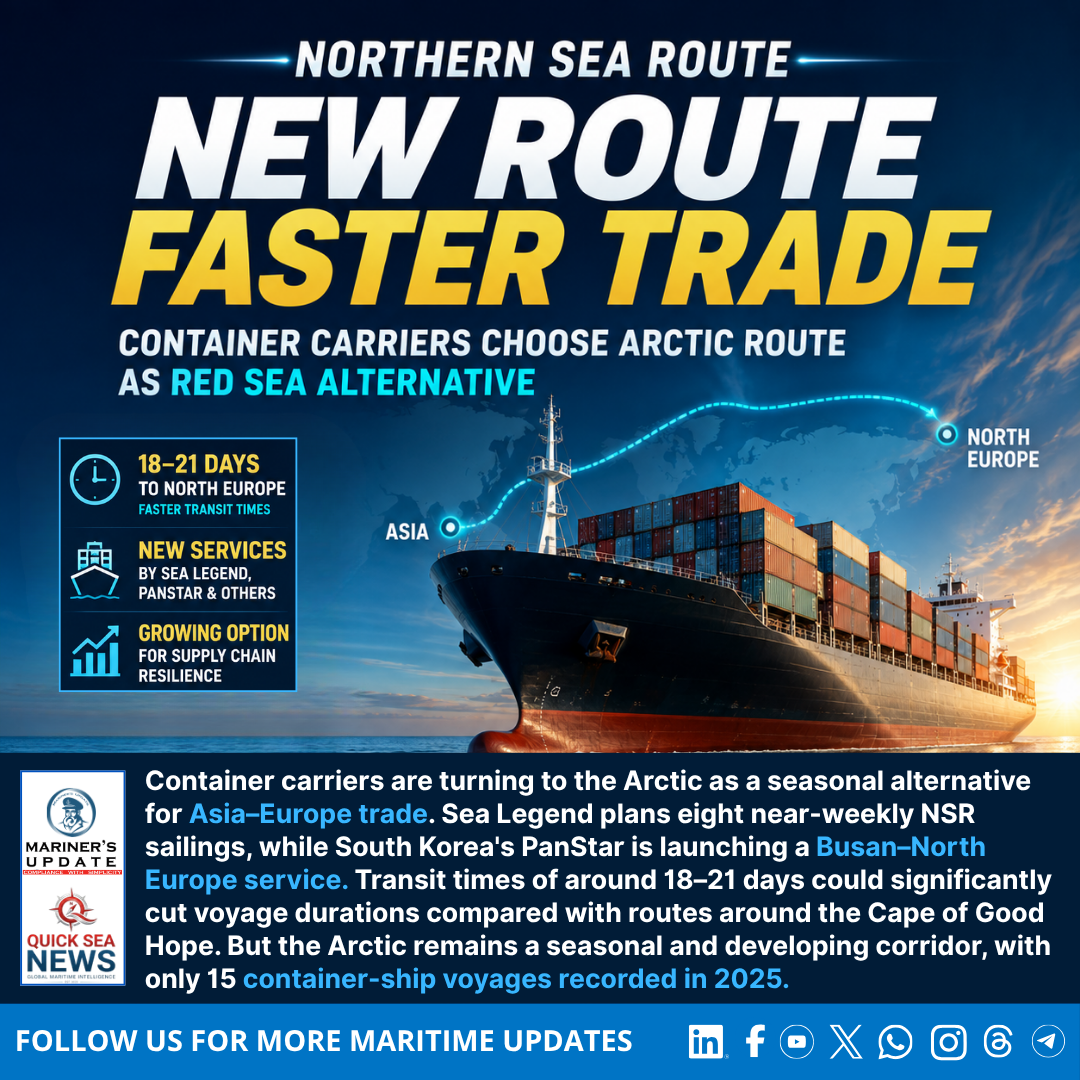
With the Arctic becoming increasingly navigable during the summer ice season, several shipping companies from China and South Korea have announced or launched services through the NSR. The development could introduce additional capacity into the Asia–North Europe trade while offering significantly shorter transit times compared with routes currently sailing around the Cape of Good Hope.
According to liner analyst Linerlytica, a series of Arctic services announced during August is adding capacity to North Europe and Baltic Russia. Chinese operators Sea Legend, New New Shipping and OVP Shipping, along with South Korea’s PanStar, are among the companies entering or expanding operations on the route.
Sea Legend prepares Arctic Express service
Chinese carrier Sea Legend is preparing to operate eight near-weekly sailings through the NSR during the summer season under its China Arctic Express (CAX) service.
The first sailing is scheduled to use the Liberia-flagged 1,740 TEU container ship Dubai Tower, which is due to depart from Ningbo.
UK freight forwarder Davies Turner is already offering customers access to space on Sea Legend’s Arctic services. The forwarder says cargo moving between Ningbo-Zhoushan and Felixstowe can complete the voyage in approximately 21 days.
This represents a major reduction in sailing time compared with conventional Asia–Europe services that are currently routing around the Cape of Good Hope.
Davies Turner highlighted the growing need for flexibility and resilience in global supply chains, describing the seasonal Arctic service as an additional multimodal option for time-sensitive cargo.
The forwarder also views the Polar Silk Road as an opportunity to provide faster transit than conventional ocean freight while avoiding the substantially higher cost of air freight.
Under the arrangement, Davies Turner will consolidate cargo from six major Chinese ports — Dalian, Fuzhou, Nansha, Qingdao, Shanghai and Taicang — at Ningbo before the cargo moves directly toward Felixstowe.
PanStar enters Arctic container shipping
South Korean ferry operator PanStar is also making its first move into Arctic container shipping.
The company is deploying the South Korean-flagged 2,700 TEU PanStar Acro on an NSR service linking Busan with North European ports. The 2011-built vessel was acquired from HMM in early August.
PanStar describes the operation as South Korea’s first pilot operation involving a container ship travelling through the Arctic shipping route, potentially marking a new stage in the country’s participation in Arctic logistics.
The vessel is scheduled to depart Busan New Port on 22 August and reach Felixstowe on 9 September, giving the voyage a planned transit time of approximately 18 days.
After Felixstowe, the vessel is expected to call at Rotterdam, Hamburg and Gdansk before returning to Busan through the Arctic route.
More operators eye the Northern Sea Route
The expansion is not limited to Sea Legend and PanStar.
Chinese carrier New New Shipping is also reported to be deploying three vessels on voyages linking China with Russia and North Europe through the NSR.
The growing number of operators indicates that the Arctic route is moving beyond being viewed solely as an experimental shipping corridor. For carriers and cargo interests facing longer voyages through traditional routes, the NSR is emerging as a seasonal option that could provide faster connectivity during its navigable period.
However, the route remains highly seasonal and operationally different from established Asia–Europe corridors, meaning its expansion will depend on ice conditions, vessel suitability, navigation requirements and the reliability of the Arctic operating window.
NSR activity remains relatively limited
Despite the recent increase in container services, overall commercial activity on the Northern Sea Route remains modest compared with established global shipping lanes.
Data from the Centre for High North Logistics recorded 103 NSR transit voyages involving 88 vessels between 30 June and 30 November 2025.
Of these, only 15 voyages involved container ships, comprising eight eastbound and seven westbound passages.
Tankers accounted for the largest share of Arctic passages, completing 34 voyages during the period.
The latest container-service announcements therefore represent a notable development, but they are still at an early stage compared with the scale of conventional Asia–Europe container shipping.
A route with growing strategic importance
The increasing interest in the Northern Sea Route reflects the shipping industry’s search for alternative corridors capable of reducing transit times and strengthening supply-chain resilience.
For Asia–Europe cargo owners, a seasonal Arctic service could provide a valuable option when speed is important and air freight is too expensive. For carriers, the route could create opportunities to add capacity and differentiate services during the limited Arctic navigation season.
The expansion of Sea Legend, PanStar and other operators will therefore be closely watched as the current Arctic shipping season develops.
If these services demonstrate reliable transit times and commercially viable operations, the Northern Sea Route could gradually become a more significant component of the Asia–Europe container network — although its seasonal nature means it is likely to complement, rather than immediately replace, established routes around the Cape of Good Hope and through the Suez Canal.