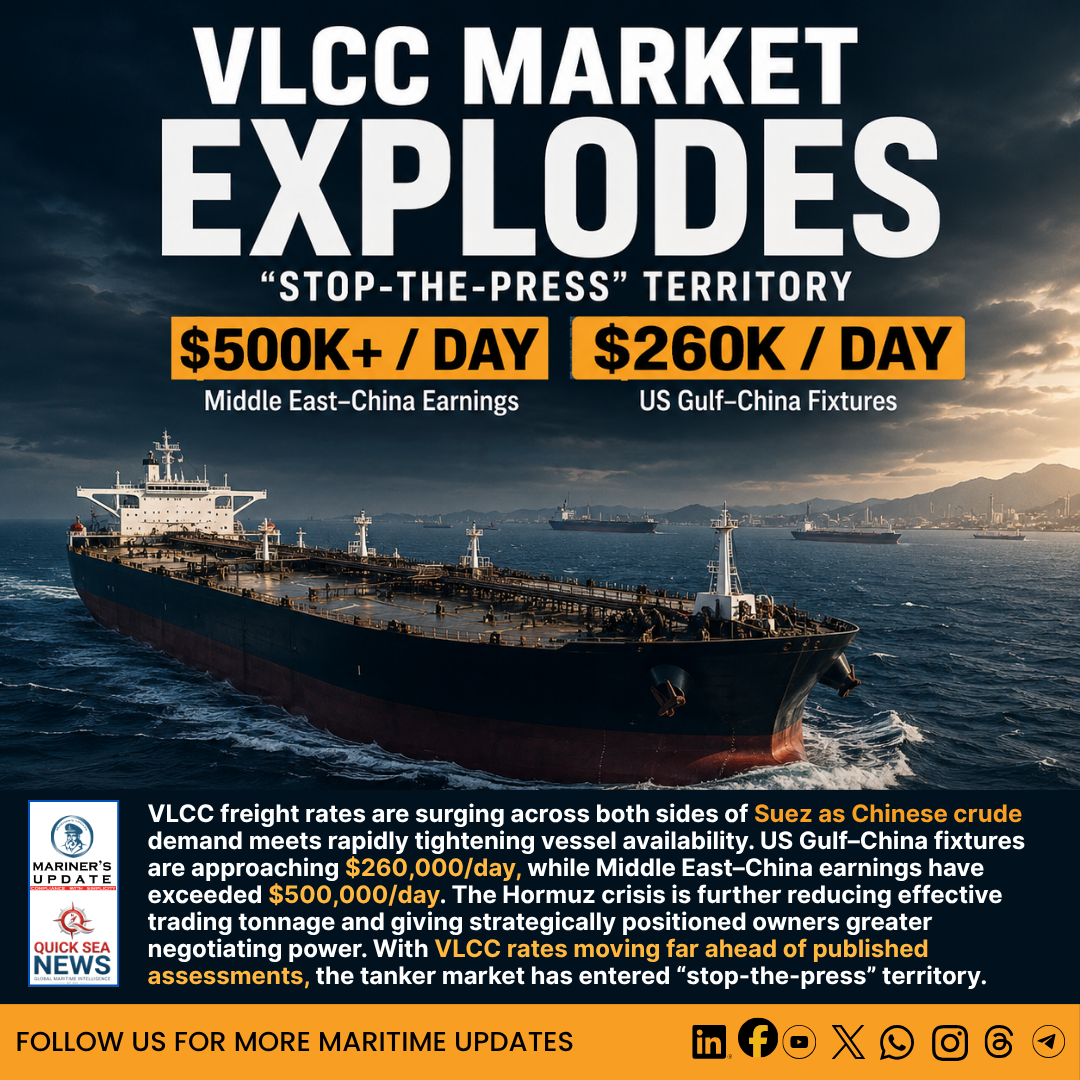
The Very Large Crude Carrier (VLCC) market has entered exceptional territory, with freight rates surging simultaneously across both sides of the Suez Canal. Strong Chinese crude buying, rapidly tightening vessel availability and the continuing security challenges around the Strait of Hormuz are combining to create one of the most dramatic tanker markets seen in recent years.
Norwegian shipbroker Fearnleys described the current environment as being in “stop-the-press” territory, highlighting the speed at which VLCC rates are accelerating across multiple trading regions, alongside similarly strong conditions in the Suezmax and Aframax segments.
Atlantic VLCC Rates Surge
The Atlantic market has been particularly aggressive.
A Brazil-to-China VLCC cargo was reportedly fixed at around Worldscale 197.5 on Wednesday, according to Fearnleys. This followed another fixture at approximately WS182.5.
The broker also pointed to an unconfirmed West Africa-to-East fixture at around WS210, while cargoes from Fujairah/Oman to the Far East have been testing levels of WS200 and above.
Fresh activity from the US Gulf is reinforcing the strength of the market.
A VLCC associated with major Greek interests reportedly went on subjects at approximately $24.8 million lump sum for a US Gulf-to-China voyage. Tankers International estimated this at roughly $260,000 per day.
This followed another fixture involving a Sinokor vessel at approximately $22.2 million, equivalent to around $252,000 per day.
A Major Gap Between Fixtures and Market Assessments
The latest fixtures are also creating a striking difference between actual market activity and published freight assessments.
Analysts at Scandinavian bank SEB noted that physical-market earnings are moving considerably faster than benchmark assessments.
On Wednesday, the Baltic Exchange was assessing the US Gulf-China VLCC route at approximately $146,000 per day. This means the latest reported fixtures were more than $100,000 per day above the benchmark assessment.
SEB believes that, if the latest fixtures are confirmed, current tanker assessments and consensus fourth-quarter earnings expectations could be significantly below the levels the physical market is now capable of generating.
That could provide additional upside potential for tanker owners and tanker-related equities.
China Becomes a Major Driver
One of the key forces behind the Atlantic surge is China’s increased crude oil purchasing activity.
Higher Chinese crude imports are generating additional demand for long-haul VLCC voyages. At the same time, the number of vessels readily available for trading elsewhere is being reduced by the extraordinary operating conditions surrounding the Strait of Hormuz.
This combination is creating a classic tanker-market squeeze: more cargo demand at a time when effective vessel availability is tightening.
Gulf Earnings Reach Extraordinary Levels
The strongest returns are being generated inside the Gulf.
According to Baltic Exchange data, Middle East-China VLCC earnings reached approximately $510,000 per day earlier this week.
Some individual owners prepared to accept the heightened security risks associated with operating in the region have reportedly achieved returns approaching $550,000 per day.
These figures demonstrate just how dramatically the security situation around Hormuz has changed the economics of tanker operations.
Hormuz Crisis Changes the Value of Tanker Ownership
The current market is also changing the strategic value of owning modern VLCCs.
Prices for modern VLCCs have climbed above $130 million, as Gulf oil producers seek greater control over the ships required to maintain reliable export flows.
A notable example is ADNOC Logistics & Services, which has committed approximately $1.3 billion to acquire six VLCCs and five VLGCs.
Nine of the vessels were reportedly secondhand acquisitions, allowing the company to secure additional tonnage for relatively rapid deployment.
The move highlights a broader strategic trend: in an increasingly uncertain tanker market, access to suitable vessels is becoming an asset in itself.
Available Tonnage Is Becoming Increasingly Scarce
The freight-rate surge is being amplified by the shrinking pool of straightforward trading tonnage.
Hundreds of tankers are currently concentrated around the Gulf, while a significant number of vessels are operating without transmitting AIS signals. At the same time, a declining proportion of Hormuz transits is associated with transparent, mainstream shipowners.
This situation is making vessel availability increasingly difficult to assess.
For owners with suitable ships positioned in the right locations, the result is substantial negotiating power. Charterers competing for limited prompt tonnage may have little choice but to accept rapidly escalating freight levels.
Position Lists Tighten by the Hour
Fearnleys warned that vessel position lists are becoming thinner “by the hour” on both sides of Suez.
That creates the possibility that today’s seemingly expensive fixture could look inexpensive only a short time later if the market continues to accelerate.
The current VLCC market is therefore being shaped by several forces simultaneously: stronger Chinese crude demand, constrained vessel availability, elevated security risks around Hormuz, repositioning of tanker fleets and growing strategic demand for vessel ownership.
For owners, the environment represents extraordinary earning potential. For charterers, however, rapidly rising rates and shrinking prompt availability are creating a significantly more challenging operating environment.
The tanker market is moving exceptionally quickly, and the latest fixtures suggest that the headline assessments may be struggling to keep pace with the physical market.
As Fearnleys concluded in its latest commentary: “Time and tide wait for no man.”