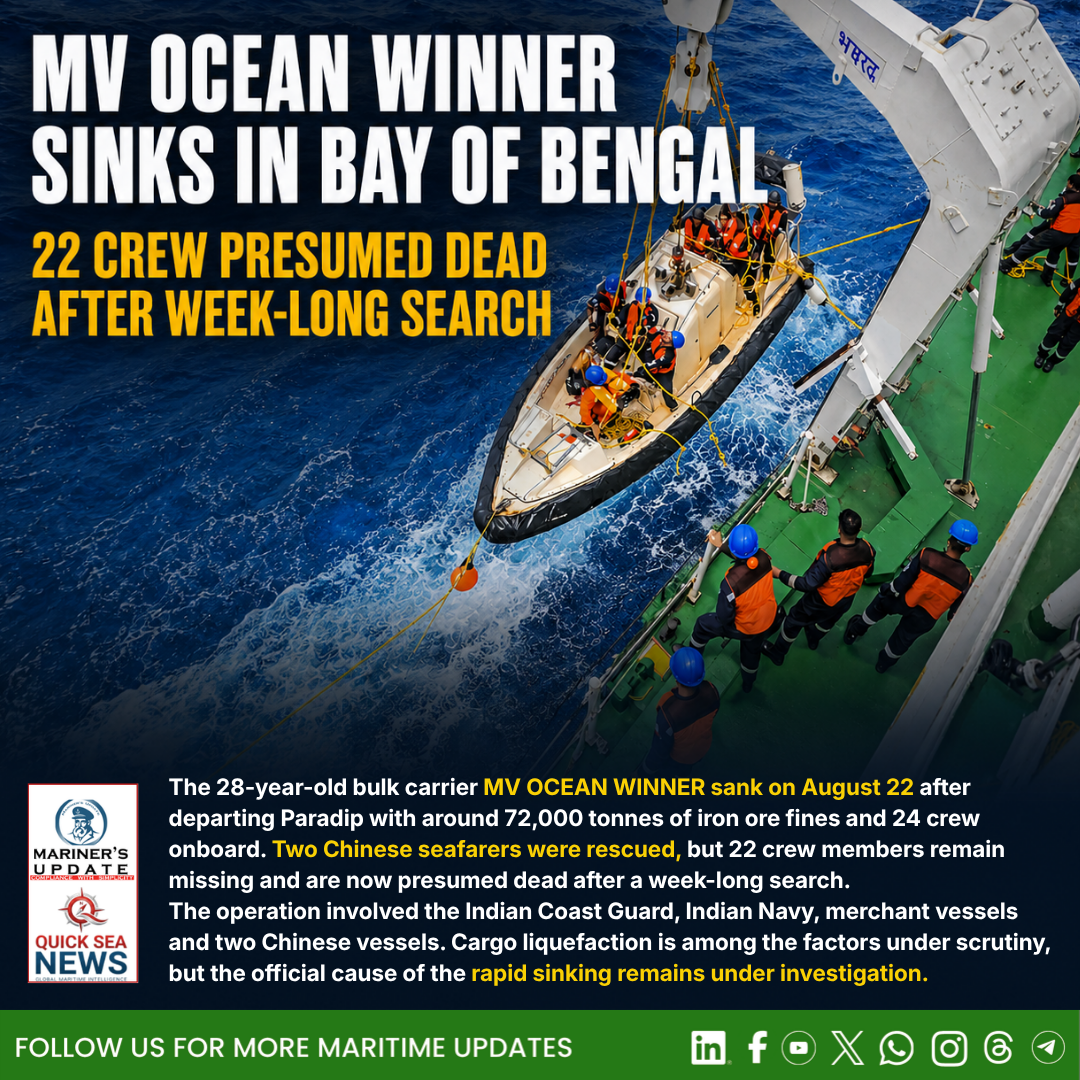
The maritime industry is facing a tragic loss following the sinking of the Panama-flagged bulk carrier MV OCEAN WINNER in the Bay of Bengal on August 22, 2026, only shortly after the vessel departed Paradip Port, Odisha, with a large cargo of iron ore fines.
The 28-year-old, approximately 225-metre bulk carrier was carrying around 72,000 tonnes of iron ore fines and had 24 crew members on board. The multinational crew comprised 20 Chinese nationals, three Myanmar nationals and one Bangladeshi national. Reports place the sinking roughly 230–290 nautical miles from Paradip, with the vessel ultimately going down in deep waters.
The Voyage Turns Into a Maritime Emergency
MV OCEAN WINNER had loaded iron ore at Paradip and departed for its onward voyage towards China, with Singapore reported in some initial accounts as a routing point. After sailing into the Bay of Bengal, the vessel lost communication and tracking contact.
A distress alert was received on August 22, triggering a coordinated response involving the Indian Coast Guard, Indian Navy, Maritime Rescue Coordination Centre and nearby merchant vessels. The vessel reportedly experienced a rapid loss of stability before sinking, with some reports indicating that the ship went down within only a matter of minutes.
Two Seafarers Rescued
In the immediate aftermath of the sinking, two Chinese crew members were found alive on a liferaft and rescued by the merchant vessel MT AISOPOS.
The survivors were later identified as Pan Tonglai and Chen Jianhe. They received medical assistance during their return voyage and were subsequently brought to Paradip aboard Indian Coast Guard Ship Varad on August 27.
After completing the necessary immigration and other formalities, the two survivors were handed over to representatives of their employer. Their firsthand accounts could become an important part of the investigation into what happened aboard OCEAN WINNER before the sinking.
Intensive Search for the Remaining Crew
Following the rescue of the two seafarers, an extensive search-and-rescue operation continued for the remaining 22 crew members.
The operation involved Indian Coast Guard ships, Indian Navy aircraft and vessels, merchant ships operating in the area and, subsequently, two Chinese vessels coordinated through the relevant maritime rescue authorities.
Despite the scale of the operation and difficult sea conditions, no further survivors were located. An emergency beacon associated with the vessel and an empty lifeboat were recovered during the search, but neither discovery led rescuers to additional crew members.
Search Operation Called Off
After approximately a week of searching, the Maritime Rescue Coordination Centre and Indian Coast Guard called off the SAR operation for the 22 missing seafarers.
The missing crew are now presumed dead, bringing the human toll of the tragedy to 22, while two crew members survived. The conclusion of the search marks a shift from an active rescue effort toward determining why the vessel lost stability and sank so rapidly.
Cargo Liquefaction Under Scrutiny
One of the major issues now attracting attention is the vessel’s cargo of approximately 72,000 tonnes of iron ore fines.
Maritime experts have raised the possibility of cargo liquefaction as a contributing factor. Iron ore fines can present serious stability risks when transported with excessive moisture. If the cargo’s moisture content exceeds the applicable Transportable Moisture Limit (TML), ship motions and vibration during a voyage can cause the cargo to lose its solid characteristics and behave more like a fluid.
Such a sudden change in cargo behaviour can result in cargo shift, rapid loss of stability and potentially catastrophic listing or capsizing.
However, it is important to stress that liquefaction has not been officially established as the cause of the OCEAN WINNER casualty. The vessel’s sudden loss of stability, cargo condition, loading records, moisture certification, weather and sea conditions, vessel condition and other operational factors will need to be examined before a definitive conclusion can be reached.
A Familiar Risk in the Paradip Region
The suspected liquefaction angle has particular significance because the waters off Odisha have previously witnessed a major bulk-carrier casualty associated with cargo liquefaction.
The MV BLACK ROSE capsized off Paradip in 2009 while carrying iron ore fines, with cargo liquefaction identified as a key factor in that tragedy.
The OCEAN WINNER incident therefore once again highlights the importance of rigorous cargo acceptance procedures, moisture testing, TML compliance, appropriate sampling and certification, loading practices and continuous assessment of cargo behaviour during the voyage.
Questions Now Facing the Investigation
With the SAR phase concluded, attention will increasingly turn toward reconstructing the final moments of MV OCEAN WINNER.
Among the issues likely to receive scrutiny are:
- The condition and moisture content of the iron ore fines loaded at Paradip
- Cargo sampling, testing and certification records
- Compliance with the applicable TML and associated cargo requirements
- The vessel’s stability condition at departure
- Loading and stowage arrangements
- Weather and sea conditions at the time of the incident
- The vessel’s age and technical condition
- The sequence of events between the distress alert and sinking
- Statements from the two surviving seafarers
- The circumstances surrounding the abandoned lifeboat and recovered emergency beacon
Reports have also raised questions over the legal and investigative response following the casualty, including whether a police case/FIR had been registered. These matters are expected to form part of the wider scrutiny surrounding the incident.
A Tragedy With Wider Lessons for Bulk Shipping
The loss of MV OCEAN WINNER is not only a devastating human tragedy but also a reminder of the risks associated with the carriage of moisture-sensitive bulk cargoes.
For shipowners, operators, masters, charterers, cargo interests, surveyors and terminals, the incident reinforces a fundamental principle: cargo that appears stable on the quay can present an entirely different risk once exposed to the dynamic conditions of a sea voyage.
Until the official investigation establishes the precise cause, it would be premature to attribute the casualty to any single factor. Nevertheless, the combination of a rapid loss of stability, a substantial iron ore fines cargo and the vessel’s operating circumstances makes cargo safety and stability issues central areas of attention.
The maritime community now awaits the findings that may explain how a large bulk carrier carrying thousands of tonnes of cargo could lose stability so quickly, and whether warning signs existed before the vessel left Paradip.
The OCEAN WINNER tragedy leaves 22 seafarers presumed dead and two survivors — and raises important questions that could have implications for bulk-cargo safety well beyond this single casualty.