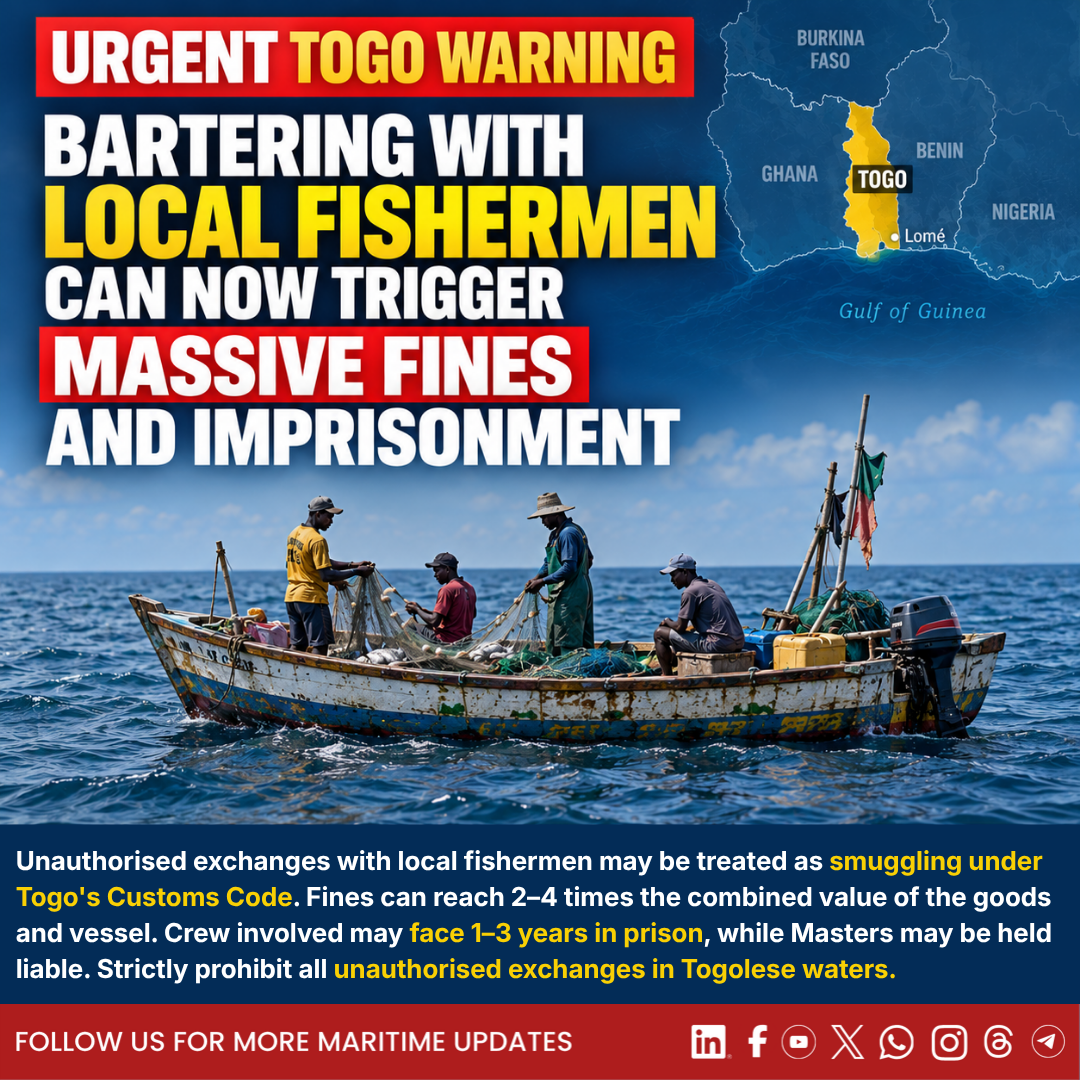
A renewed warning has been issued to vessels operating in Togolese waters following continued strict enforcement by Customs authorities against the informal exchange or bartering of goods between ships and local fishermen or small craft.
The warning, provided by local correspondents BUDD Togo, follows an earlier alert issued on 6 March 2024 concerning customs fines arising from such transactions. The latest update indicates that Customs authorities continue to treat these activities as serious customs violations, with potentially severe financial and criminal consequences for both the vessel and crew.
Unauthorised Exchanges May Be Treated as Smuggling
Shipboard personnel are being warned that exchanging items with local fishermen or other small boats at anchorages can be considered undeclared importation or smuggling under Togo’s Customs Code.
This includes seemingly routine or low-value exchanges involving:
- Sludge or waste oil
- Drinking water
- Scrap metal
- Old ropes
- Other shipboard materials
In return, vessels or crew may receive items such as seafood, SIM cards or other goods.
Even when such exchanges appear informal, customary or commercially insignificant, they may still trigger customs enforcement.
Potential Fines Can Reach Extraordinary Levels
The financial consequences are particularly serious.
According to the warning, Customs fines are calculated not simply from the value of the goods involved. The assessment may also take into account the estimated market value of the vessel, with fines potentially reaching two to four times the combined market value of the exchanged goods and the vessel.
As a result, the financial exposure can become enormous. The warning cites a recent case in which the fine reportedly reached approximately €129 million.
Crew Members Could Face Imprisonment
The consequences are not limited to financial penalties.
Crew members involved in unauthorised transactions may face prison sentences ranging from one to three years, highlighting the seriousness with which the Togolese authorities are treating these activities.
Master May Be Held Personally Responsible
The warning also highlights significant responsibility placed on the Master.
Under the reported enforcement approach, the Master can be held strictly liable for Customs infringements committed on board, even where the Master did not authorise the transaction or was unaware that it had taken place.
This makes effective crew briefing, supervision and strict onboard instructions particularly important when a vessel is operating or anchored in Togolese waters.
Caution When Signing Customs Documents
Another important point concerns the Procès-Verbal, or Customs fine statement, presented following an alleged infringement.
Masters and vessel representatives are warned against adding conditional annotations such as “Without Prejudice” or “For Receipt Only” to the document.
According to the warning, adding such wording is not accepted by Customs and may result in formal discussions being suspended, potentially extending the vessel’s detention while the matter remains unresolved.
Key Action for Shipowners and Masters
Vessels operating in Togo should ensure that all crew members clearly understand that no exchange, barter or transfer of goods with local fishermen, small craft or other parties is permitted unless properly authorised and compliant with local Customs requirements.
Particular attention should be given to materials that crew may otherwise regard as waste, surplus or low-value items, including waste oil, sludge, drinking water, scrap metal and old ropes.
The safest approach is to prohibit unauthorised exchanges altogether and ensure the instruction is clearly communicated to every crew member before and during operations in Togolese waters.