3.2 — MASTER’S STANDING ORDERS & THE NIGHT ORDER BOOK
What inspectors check
Inspectors are checking whether the Master’s Standing Orders have actually been explained to the deck officers — not just filed away — and whether Night Orders are being written by the Master and countersigned by the officers on a genuinely daily basis.
Why it matters
Standing Orders exist to support the ship’s Safety Management System. They should clearly set out when the OOW is required to call the Master, covering situations such as minimum CPA, the ECDIS display layers required for different navigation conditions, and the safety risks around relying on VHF communication with other vessels or AIS information for collision avoidance. Both AIS and VHF should be treated strictly as identification tools, never as a substitute for proper collision-avoidance action, and the Master should always be called well before it becomes necessary to exit the vessel’s planned track (XTC).
These requirements should be documented in line with the Bridge Procedures Guide checklist for “calling the Master,” and the Master should personally walk new officers through what is expected of them, so the orders genuinely support — rather than just restate — the SMS. Company and Master’s Standing Orders should be read, signed and dated by every Bridge Team member on joining the ship, and a copy should always be kept on the bridge for easy reference.
Night Orders operate on top of the Standing Orders. At least once every 24 hours, the Master should write specific instructions covering what is expected of the OOW for that period — and each OOW should sign the book when taking over a watch, confirming they have read, understood and will comply with those instructions. The OOW should also brief other Bridge Team members, as appropriate, on upcoming activities or requirements for the next watch. Because the Master issues Night Orders specifically to cover periods of rest, these entries should include clear, specific information about the current leg of the passage — not generic instructions.
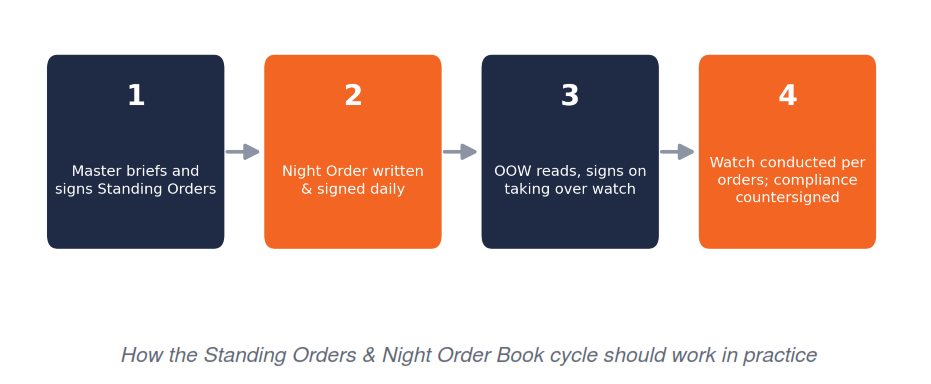
Inspectors expect to see at least one Night Order Book entry made by the Master every day the vessel is at sea — gaps in this pattern are a common finding.
Quick reference for the bridge team
- Read, sign and date the Master’s Standing Orders on joining the ship, and keep a copy on the bridge at all times.
- Understand exactly when you’re required to call the Master — CPA limits, ECDIS layer requirements, and XTC situations should all be specified.
- Expect a fresh, specific Night Order entry from the Master at least once every 24 hours, especially covering rest periods.
- Sign the Night Order Book before taking over each watch to confirm you’ve read, understood and will comply.
- Brief incoming or other Bridge Team members on anything relevant for the watch ahead.
- Treat AIS and VHF strictly as identification tools — never rely on them for collision avoidance.
3.3 — MANOEUVRING INFORMATION & BRIDGE WATCHKEEPING RECORDS
What inspectors check
This checkpoint covers whether manoeuvring information is properly displayed on the bridge, and whether the bridge logbook, bell book, radar performance book and Change of Watch at Sea checklist are being correctly and consistently maintained.
Why it matters
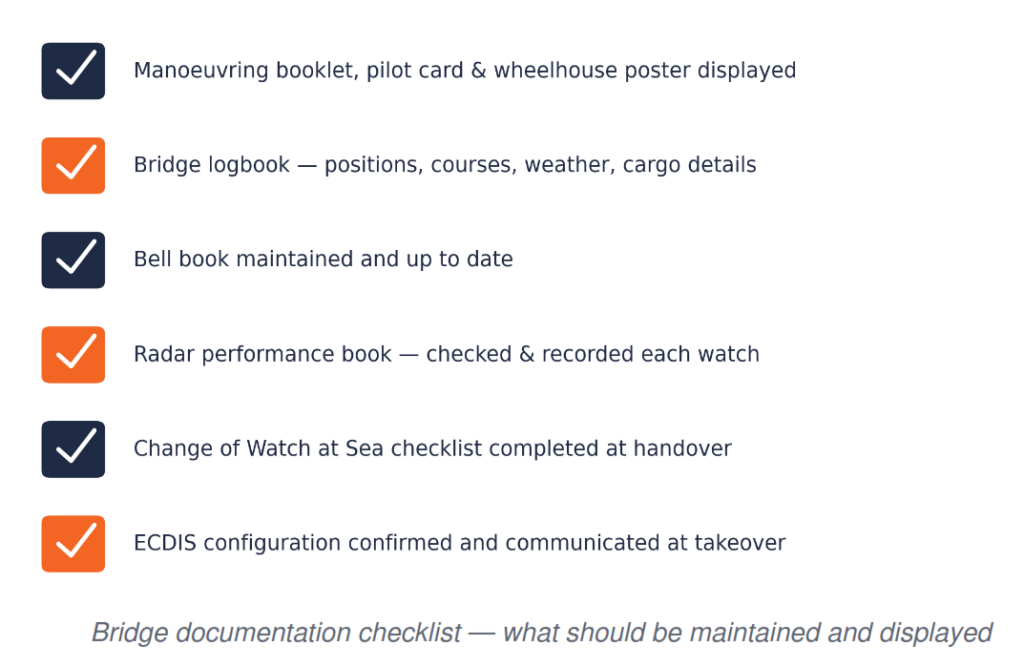
The OOW should understand the practical differences between X-band (3 cm) and S-band (10 cm) radar — including how each is affected by weather conditions, and their respective blind sectors and shadow areas. Every ship of 100 metres or more in length, and all chemical tankers and gas carriers regardless of size, should carry a pilot card, wheelhouse poster and manoeuvring booklet, in line with IMO guidance on the provision and display of manoeuvring information.
Officers should be familiar with the vessel’s handling characteristics and stopping distances, and understand how these change with current conditions and machinery status — this information should be recorded on the Pilot Card, Wheelhouse Poster and in the manoeuvring booklet, cross-referenced against the Bridge Procedures Guide checklists covering manoeuvring and stopping information. Ships on international voyages are also required under SOLAS to keep a record of navigational activities and incidents — if this isn’t captured in the logbook itself, it must be recorded in another form approved by the flag Administration.
Radar performance should be checked regularly, ideally using an automatic performance monitor, and RightShip recommends that this be checked and recorded by the OOW at the end of every watch, using a numeric, percentage, graphical or other measurable value — not just a tick box.
The bridge logbook itself should capture: navigational information and positions at regular intervals (including method of position fixing), courses steered, compass error and leeway allowances, course and speed made good, a full set of routine weather observations at the end of each watch (including sea and swell conditions), details of any severe weather encountered and the action taken, and full details of anything affecting the cargo or its condition.
Before taking over a navigation watch, the incoming officer should positively confirm the ECDIS configuration against the passage plan requirements, and the outgoing officer should highlight any changes to that configuration that fall outside the passage plan parameters. If an ECDIS alarm needs to be disabled for any reason, this should be logged on a formal tracking form and approved by the Master, and handed over to subsequent watches. RightShip recommends that ECDIS configuration be incorporated into the Change of Watch at Sea checklist itself, which should be used in line with the Bridge Procedures Guide and at any other time required by the SMS.
Finally, following updated IMO guidance, the Pilot Card, Wheelhouse Poster and manoeuvring booklet should also reflect manoeuvring characteristics for when the vessel is running on shaft or engine power that has been limited — not just full-power conditions.
Quick reference for the bridge team
- Confirm the Pilot Card, Wheelhouse Poster and manoeuvring booklet are displayed, current, and reflect any power-limited conditions.
- Know the difference between X-band and S-band radar performance in different weather.
- Record full navigational, position, course and weather details in the bridge logbook every watch.
- Check and log radar performance at the end of every watch using a measurable value.
- Positively confirm ECDIS configuration against the passage plan at every handover, and log any disabled alarms on a formal tracking form approved by the Master.
- Complete the Change of Watch at Sea checklist at every handover, incorporating ECDIS configuration checks.
Good bridge documentation is not paperwork for its own sake — it’s the evidence that the Master’s instructions were passed on, understood, and followed at every watch, and that the bridge team always knows the ship’s true handling limits. Consistent, daily compliance across the Standing Orders, Night Order Book, logbook and handover checklist is what inspectors — and safe navigation — depend on.