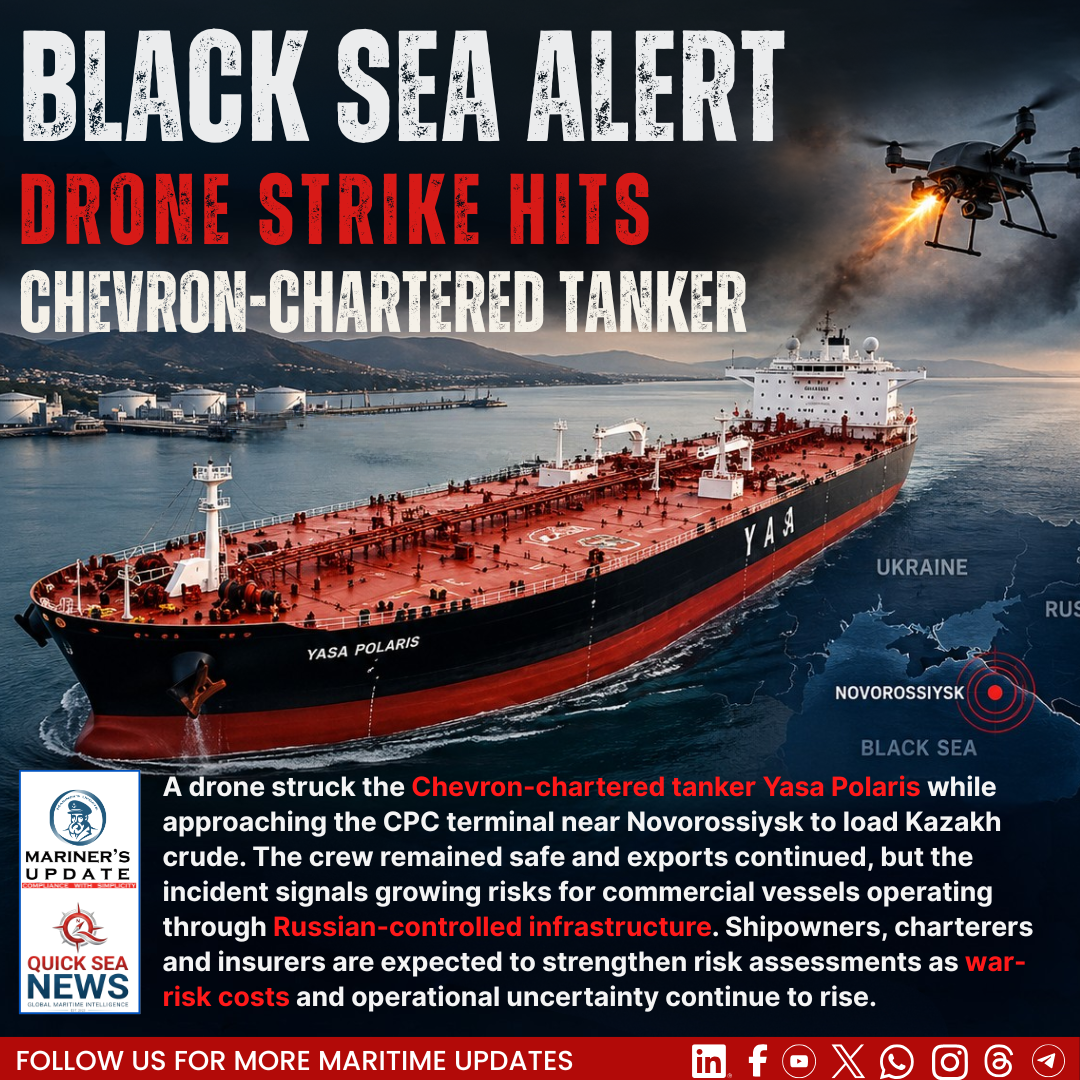
The security environment in the Black Sea has taken another significant turn after a Chevron-chartered Aframax tanker was struck by a drone while approaching the Caspian Pipeline Consortium (CPC) terminal near Novorossiysk, Russia, highlighting the growing risks facing commercial shipping operating in the region.
The incident occurred on 7 July, when the Aframax tanker Yasa Polaris, owned by Turkey’s YASA Holding and chartered by Chevron, was sailing in ballast toward the CPC offshore loading terminal to load Kazakh crude oil.
The drone struck the vessel’s upper accommodation/superstructure, but fortunately there were no injuries to the crew, no pollution, no fire, and no critical structural damage. The vessel remained fully operational and continued under its own power after the attack.
Chevron later confirmed it was aware of an incident near the CPC loading facilities and stated that crude export operations were not interrupted.
A Warning for Commercial Shipping
While the physical damage was limited, the strategic implications are far more significant.
Unlike previous attacks primarily targeting Russian naval assets or vessels linked to Russia’s “shadow fleet,” the Yasa Polaris is a third-party-owned, Western-chartered commercial tanker carrying Kazakh crude, not Russian crude.
This suggests that commercial vessels operating through Russian-controlled export infrastructure may increasingly face elevated security risks, regardless of cargo ownership.
Importance of the CPC Terminal
The Caspian Pipeline Consortium (CPC) terminal at Novorossiysk is one of the world’s most strategically important crude export facilities.
The terminal exports approximately 1.4 million barrels of crude oil per day, accounting for nearly 80% of Kazakhstan’s seaborne crude exports.
Much of this production originates from the Tengizchevroil joint venture, in which Chevron is a major stakeholder.
Although the crude exported through CPC Blend is predominantly Kazakh oil, it is transported via infrastructure located within Russian territory, placing these shipments within an increasingly complex geopolitical environment.
Pattern of Increasing Attacks
The latest incident is not an isolated event.
Since late 2025, Ukraine has expanded drone operations targeting Russian energy infrastructure, including:
- Oil refineries
- Export terminals
- Storage facilities
- Port infrastructure
- Tankers operating near loading terminals
Facilities at Primorsk, Taman, Kerch, Novorossiysk, and other Black Sea and Baltic export hubs have experienced repeated attacks.
The CPC terminal itself has previously been targeted during January and February 2026, when other tankers waiting to load sustained damage.
Why This Incident Matters
The attack on Yasa Polaris marks an important development because it involved:
- A Turkish-owned commercial tanker
- Chartered by a major Western energy company
- Carrying Kazakh crude rather than Russian oil
- Operating within Russian-controlled export infrastructure
This indicates that vessels supporting international energy trade may increasingly become exposed to regional conflict risks, even when transporting non-Russian cargo.
Impact on Shipowners and Charterers
The incident is expected to reinforce concerns among shipowners, charterers and insurers operating in the Black Sea.
Potential consequences include:
- Higher war-risk insurance premiums
- Increased freight rates
- Additional contractual indemnity requirements
- Enhanced voyage risk assessments
- Possible reluctance by owners to accept Black Sea fixtures
Greek and Turkish shipowners, who operate a significant portion of Black Sea tanker traffic, may seek higher compensation for voyages calling at Novorossiysk or reconsider future employment in the region.
Potential Supply Chain Consequences
Although exports continued normally following this incident, a more serious future attack involving fire, pollution or casualties could have much wider implications.
Disruption to CPC exports could force Kazakh crude producers to seek alternative export routes through:
- Existing pipeline networks
- Rail transportation
- Other regional export terminals
Such changes would increase transportation costs and place additional pressure on global crude supply chains.
Growing Importance of Maritime Security
The latest drone strike serves as another reminder that geopolitical conflict continues to influence commercial shipping operations.
Even when cargoes are unrelated to sanctioned Russian exports, vessels operating through strategically sensitive ports remain exposed to operational, financial and insurance risks.
For shipowners, operators, charterers and marine insurers, continuous voyage risk assessment and enhanced security planning are becoming increasingly important as the Black Sea remains one of the world’s highest-risk trading regions.
Conclusion
The attack on Yasa Polaris may not have interrupted exports, but it sends a strong signal to the global shipping industry. Commercial vessels operating through Russian-controlled export infrastructure are facing an increasingly challenging security environment, regardless of cargo origin.
With repeated attacks on Black Sea energy infrastructure and growing war-risk exposure, shipowners and charterers should closely monitor regional developments, reassess voyage risks and ensure appropriate insurance and contingency measures are in place before trading in the area.