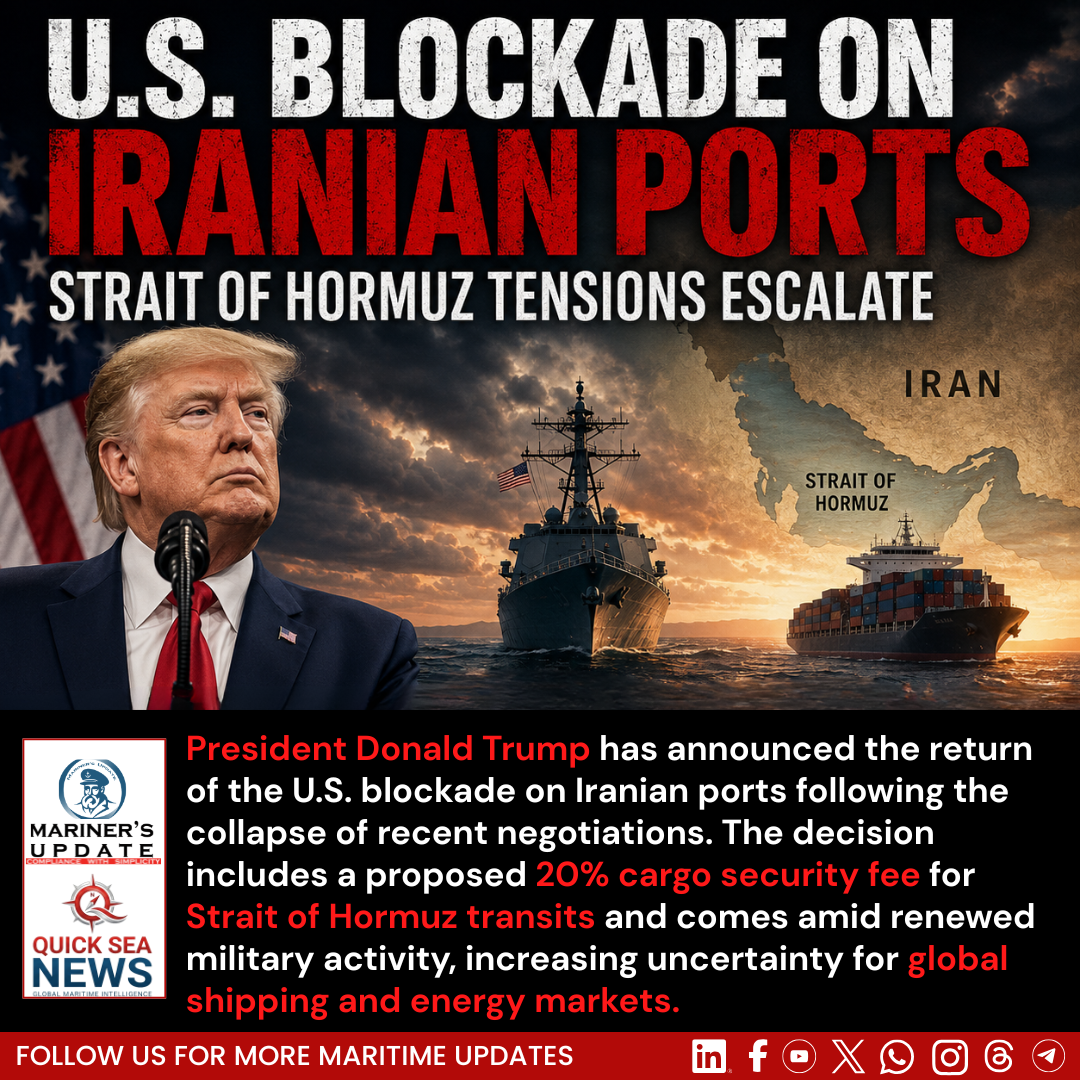
Global maritime trade is once again entering a period of heightened uncertainty after U.S. President Donald Trump announced the reimposition of a naval blockade targeting Iranian ports, effectively ending the temporary understanding reached with Iran just weeks earlier. The development significantly increases geopolitical risks in one of the world’s most strategically important shipping corridors—the Strait of Hormuz.
The announcement follows the collapse of negotiations aimed at maintaining safe navigation through the Strait while discussions over Iran’s nuclear program continued. According to President Trump, the previous memorandum of understanding was intended only as a “test,” and he accused Iran of failing to comply with its commitments.
As a result, the United States has resumed military operations and announced that its naval forces will once again enforce restrictions on vessels entering or departing Iranian ports while allowing commercial traffic from other nations to continue through the Strait.
Key Developments
✔️ The United States has officially reinstated a naval blockade targeting Iranian ports.
✔️ The temporary agreement reached last month to reopen the Strait of Hormuz has effectively collapsed.
✔️ President Trump stated that the Strait of Hormuz will remain open for international shipping “with or without Iran.”
✔️ The U.S. Navy confirmed the blockade would become operational from Tuesday afternoon (Eastern Time).
✔️ The blockade applies specifically to vessels trading with Iranian ports while allowing other international traffic to transit the Strait.
Military Situation Intensifies
The security environment in the Gulf has deteriorated rapidly.
Reports indicate:
- Heavy exchanges of airstrikes between U.S. and Iranian forces.
- Iranian drone attacks targeting commercial shipping.
- Iranian Revolutionary Guard interception of vessels allegedly operating without authorization.
- Reports of attacks against U.S. military facilities across the Gulf region.
- Continued military deployments around the Strait.
The U.S. has reportedly positioned one of its largest naval task groups in recent years, including:
- Two aircraft carriers
- Thirteen destroyers
- Amphibious assault ships
- Cruiser support
- Additional landing vessels
The presence of such a force demonstrates the seriousness of current maritime security operations.
20% Shipping Security Charge Announced
One of the most significant announcements is the proposed 20% fee on cargo transiting the Strait of Hormuz, which President Trump says would fund security operations protecting commercial shipping.
If implemented, this could substantially increase transportation costs for:
- Crude oil
- LNG
- LPG
- Petrochemicals
- General cargo
Since approximately 20% of global oil exports normally transit the Strait of Hormuz, any additional costs or disruptions could have worldwide economic implications.
Oil Markets React Immediately
Financial markets responded quickly to the renewed tensions.
Benchmark crude prices reportedly climbed to approximately US$83 per barrel, reflecting concerns over possible disruptions to one of the world’s most critical energy supply routes.
Iran Responds
Iran rejected U.S. accusations and blamed Washington for the collapse of mediation efforts.
Iranian officials continue to maintain that:
- Iran remains responsible for security in the Strait.
- The previous agreement was not respected by the United States.
- The country will continue defending what it considers its strategic interests.
Iranian leadership has also indicated that control of the Strait remains a key national security priority.
Operational Impact on Shipping Industry
For shipowners, operators, charterers and seafarers, the evolving situation presents several operational challenges:
✔️ Increased naval presence throughout the Gulf
✔️ Elevated security risks for merchant vessels
✔️ Possible voyage delays and rerouting
✔️ Higher insurance premiums and war-risk assessments
✔️ Increased fuel costs if oil prices continue rising
✔️ Potential charter party implications
✔️ Greater compliance with military transit advisories
✔️ Enhanced bridge watchkeeping and security measures
✔️ Continuous monitoring of NAVAREA warnings and company security instructions
Why It Matters
The Strait of Hormuz remains one of the world’s most important maritime chokepoints. Any disruption affects not only regional shipping but also global energy markets, freight rates, supply chains, insurance costs and commercial vessel operations.
Shipping companies, Masters, security officers and chartering teams will need to closely monitor official advisories as the situation continues to evolve.