Capt L** | ENOC
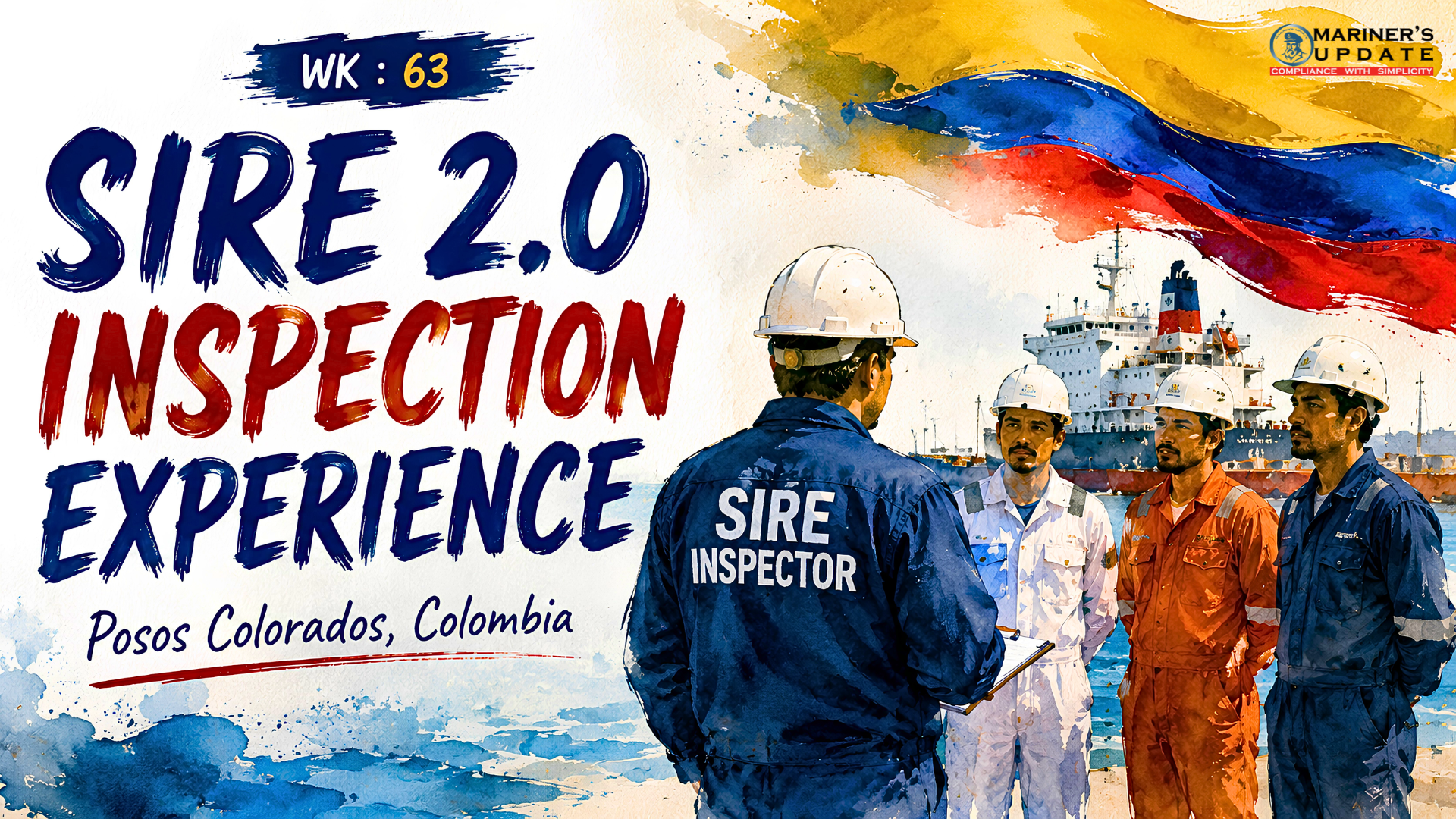
Location: Posos Colorados, Colombia
Inspection Date: 26.06.26
MASTER CABIN
- Checked all Trading and Equipment certificate as per questioner
- Checked rest Hours file along with drill report
- Defect list onboard, and its Reporting procedure
- Checked all Audits checks and procedure reporting and closing procedure for finding
- Officer Handing over report
- Checked crew certificate, cargo and ballast handling course for senior officer, checking for specific IMO/STCW Code mentioned in certificate.
BRIDGE
- DPA poster
- ECDIS layers
- ECDIS safety settings & Calculations
- UKC calculations for the voyage
- What is LDL
- MISSISSIPPI RIVER PI checked for some legs
- In passage plan checked BWL & EWL thoroughly checked. Same cross checked on Ecdis
- Checked amendment plan from Anchor to berth & safety settings
- Post Voyage signature for last passage plan
- E/R Alarm during UMS. What are the actions you take as D/Off
- Passage Plan cross checked randomly with ECDIS markings
- ECDIS ENC last update Week verified
- Procedure for weekly update of ECDIS
- Distractions Policy
- Pilot Card & MPX
- Arrival Checklist
- Pre-Arrival and departure check verified with checklist and bell book entries, Con h/o entries, BWL who all are present and lookout & helmsman mentioned in bell book, Asked how will you include pilot in bridge team
- Company requirement for Magnetron change
- Difference between S band Radar and X band Radar
- Last SART check and verified the GMDSS log entries
- BNWAS Monthly checks & what is 3 level Alarm
- ALDIS lamp Checked and spare 3 bulb checked one by one
- Asked about VDR / Last test / Storage Capacity
- Asked about Steering gear Change over / poster
- Emergency Towing Booklet
- Checked the seal of all 3 GMDSS portable Radio spare battery
- Pyrotechnics Checked
- Bridge Immersion Suit checked
BRIDGE WING & MONKEY ISLAND
Compasses
- Verified the condition of the magnetic compass for bubbles and tested emergency lighting.
Safety Equipment
- Checked the Man Overboard (MOB) lifebuoys and their lines on both sides.
Antennas
- Inspected the condition of all aerial antennas on Monkey Island.
Voyage Data Recorder (VDR)
- Inspected the floating VDR capsule.
GMDSS
- Verified the expiration date of the HRU for the GMDSS battery room.
ACCOMMODATION DECKS (GENERAL ROUND)
Fire & Safety
- Checked all portable fire extinguisher inspection cards for monthly sign-offs.
Emergency Systems
- Inspected all accommodation fire boxes and emergency lighting systems.
LIFEBOAT DECK
Lifeboat Operation
- Requested the 3rd Mate to demonstrate and explain the lifeboat lowering procedure.
- Instructed the 3rd Mate to test the lifeboat engine (ahead and astern kicks).
Lifeboat Inventory & Systems
- Checked the steering system (hard port to starboard), lifeboat air cylinder pressure, Pyrotechnics expiry dates, and the condition/quantities of onboard food and water.
Life Rafts
- Verified the expiration dates of the Hydrostatic Release Units (HRUs) for all life rafts.
C-DECK
Engine Room Controls
- Instructed the 2nd Engineer to close the engine room dampers and verified the operational readiness of the flaps.
A-DECK
Emergency Craft
- Instructed the 2nd Engineer to launch the rescue boat.
Emergency Lights
- Verified the operation of the emergency lighting system on this deck.
EMERGENCY GENERATOR ROOM
Generator Testing
- Requested the 3rd Mate to explain the emergency generator start procedure and the process for taking on-load.
- Instructed the 2nd Engineer to start the generator utilizing the spring (manual) starting method.
Fuel Valves
- Verified the operation and condition of the fuel tank quick-closing valve in the generator room.
UPPER DECK
Compartment Inspections
- Visually inspected the CO2 room, Garbage Store Room, and Paint Locker.
Deck Store
- Inspected the deck store and instructed the Pumpman (P/M) to demonstrate the chipping, grinding, and buffing machines, ensuring all safety guards were intact and functional.
MAIN DECK
Cargo & Pump Systems
- Inspected the Cargo Oil Tank (COT) pump stack area, checking pump pressure gauges and the surrounding structural integrity.
- Compared the current physical condition of the deck against uploaded vessel photographs.
- Verified the operational condition of the Pressure-Vacuum (PV) breaker.
- Tested the high-level and overfill alarms for two Cargo Oil Tanks (COTs).
FORECASTLE (FORECASTYLE)
Mooring & Deck Equipment
- Asked the Chief Officer (C/O) to demonstrate the brake testing kit during a visual inspection of the area.
Store Spaces
- Inspected the forecastle store, verified bilge wells, and successfully tested the bilge alarm.
Ship-to-Ship Transfer
- Inquired if the vessel is equipped with a personnel transfer basket and verified if company procedures cover ship-to-ship personnel transfers.
CREW INTERVIEWS & COMPETENCY ASSESSMENTS
Questions Asked to Ratings
Pumpman (P/M)
- Interviewed regarding Risk Assessment protocols, cargo sampling procedures, and ullaging procedures when the Inert Gas (IG) system is non-operational.
Able Seaman (AB)
- Questioned on Enclosed Space Entry procedures and the required frequency of atmosphere monitoring per company policy.
Ordinary Seaman (OS)
- Tested on emergency escape routes, with a specific focus on engine room emergency escape locations.
Questions Asked to the Duty Officer in the Cargo Control Room (CCR)
Safety Checklist
- Assessed comprehension regarding compliance with the Ship-Shore Safety Checklist and the frequency of repetitive checks.
Emergency Procedures
- Questioned on the operational procedure if the IG system fails, alongside oxygen (O₂) content requirements dictated by company policy.
Cargo Operations
- Reviewed the loading procedures for non-inerted tanks. (Note: The officer was granted time to reference company manuals to answer).
CCR
- Checked the Portable gas measuring instruments if they were complient with new Co2 regulations. Vessel was not complient so checked if vessel had CO2 gas tubes for the same.
- Also checked company requirements for minimum set of tubes to be maintained onboard.
- General inspection of enclosed space permit file.
- Checked last few months entries of work rest hours and compared that with deck log book entries.
- Asked to view the last safety officer inspection checklist.
- Asked to view company procedure for ullagaing in non inerting tanks.
- Asked to view the records for testing of high/overfill alarms records (Pre arrival checklist).
- Checked records of IG monitoring in port.
- Checked in detailed the Ship shore safety checklist of last 3 ports.
- Checked in detail the discharge plan of last three ports. He wanted the loading master sign in the cargo plan. We showed him that the loading master signs the pre cargo meeting in which he acknowledges the cargo plan. He was satisfied with the same.
- Checked the ODME records file.
- He had initially requested for the Framo purging records but didn’t view it.
- Asked CO how is security maintained in port, he wanted to hear that various areas/stores are sealed/locked and records are maintained of the same. He did not view any records for the same.
- Glanced through the Aconis screen.
- Checked in detail the pre cargo transfer meeting T-015.
ENGINE ROOM
- Asked 3rd Engineer about work rest hours, show procedure.
- E/R manning level, show procedure.
- E/R last UMS alarm record in logbook, cross checked with Aconis, cross checked with work rest hours.
- Asked Oiler about emergency escape location and route.
- Asked Wiper about all locations to operate emergency fire pump and portable extinguishing means in ER, quantity and location.
- Asked about company procedure for maintenance of emergency air compressor.
- Checked ozone depletion records.
- Asked about Inert Gas Generator maintenance.
- Checked PMS work orders with periodic maintenance.
- Run OWS in recirculation mode.
- ME hydraulic and FO leak alarm.
- Oil mist detector ME alarm.
- Tried out all bilge level alarms.
- DG leak off alarms.
- Checked emergency escape, flashlight and harness inspected.
- Checked all emergency stops for all equipment in E/R workshop.
- Checked welding equipment condition.
- Tried out emergency steering both the motors.
- Tested all steering alarms.
- Run emergency fire pump in local mode and checked the line pressure.
- Incinerator furnace inspected.
- Checked overall condition of chemical store and PPE.
- Took complete round in engine room.
- Checked thoroughly in engine room for any leakages in ER.