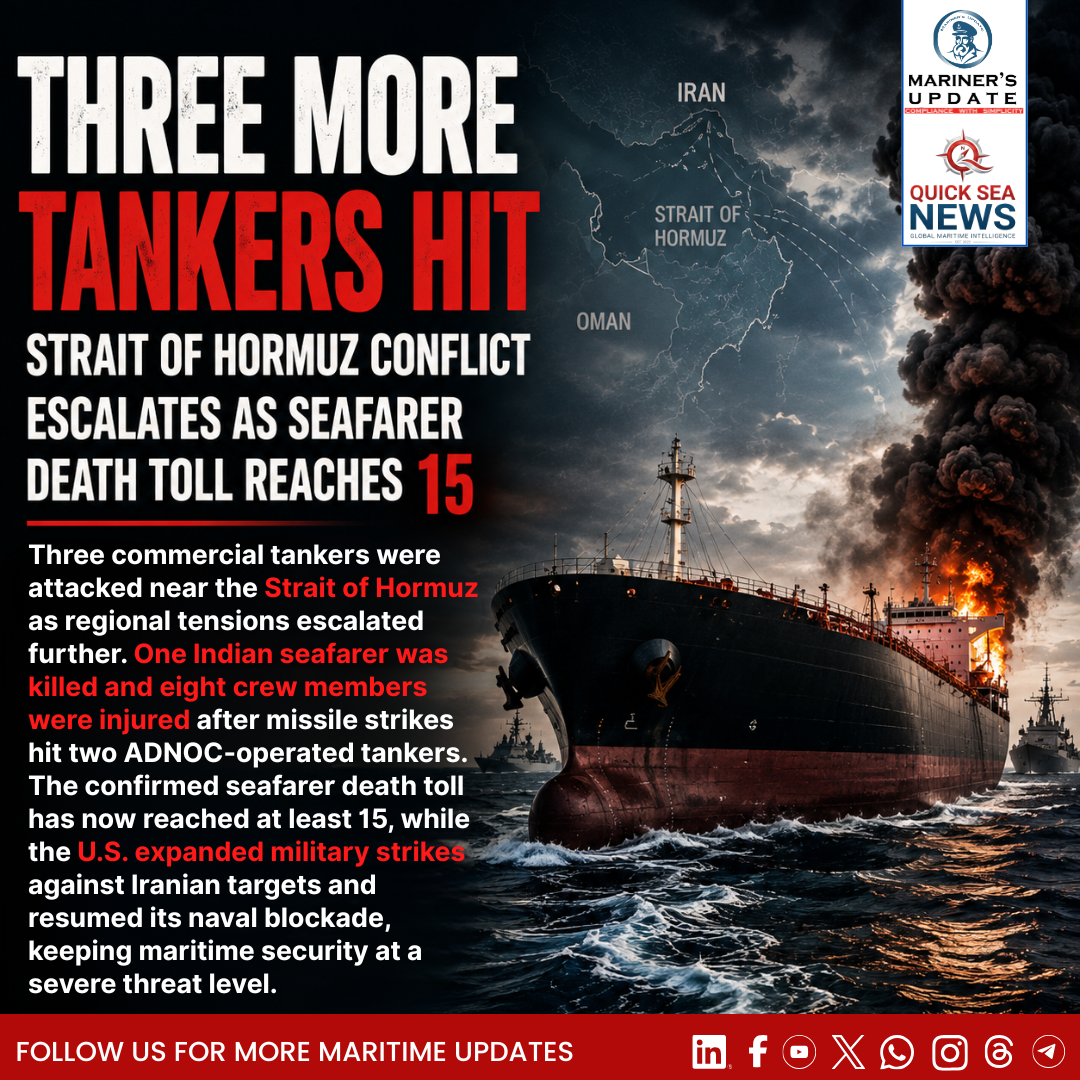
The security crisis in the Strait of Hormuz has deepened after three additional commercial tankers were attacked within 24 hours, marking another major escalation in the ongoing confrontation between Iran and the United States. The latest incidents occurred as U.S. forces launched a fresh wave of coordinated military strikes against Iranian coastal and maritime assets, further heightening concerns over the safety of global shipping through one of the world’s most strategically important waterways.
According to multiple maritime security reports, the United Kingdom Maritime Trade Operations (UKMTO) issued three separate attack warnings involving merchant vessels operating near Oman and the Strait of Hormuz. Two of the incidents involved ADNOC-operated crude oil tankers, MT Mombasa (IMO 9739501) and MT Al Bahiya (IMO 9937799), which were reportedly struck by Iranian cruise missiles while navigating the southern transit route through Omani waters.
The attack on MT Mombasa proved particularly devastating. One Indian seafarer lost his life, while eight crew members sustained injuries, including six Indian nationals and two Ukrainian crew members. Authorities confirmed that four of the injured remain in serious condition. Fires that broke out aboard both tankers were successfully contained by onboard emergency response teams, preventing further damage and possible environmental consequences.
With this latest casualty, the confirmed number of seafarers killed since the escalation of hostilities has risen to at least 15, while another crew member from the GFS Galaxy remains missing following an earlier attack in the southern Strait of Hormuz.
A third merchant tanker was also attacked in the eastern approaches to the Gulf of Oman. The vessel was reportedly struck by an unidentified projectile approximately 40 nautical miles northeast of Qalhat, Oman, damaging its starboard engine room. Fortunately, all crew members were accounted for, and authorities confirmed that no pollution or oil spill resulted from the incident.
Maritime security consultancy EOS Risk Group estimates that at least six merchant vessels have been attacked during the past week, including ships linked to operators such as ADNOC, Bahri, Nakilat and others, highlighting the rapidly deteriorating security environment across the region.
The attacks coincided with another large-scale military operation by the United States. U.S. Central Command (CENTCOM) confirmed that American forces carried out a five-hour overnight campaign targeting Iranian military infrastructure at Bushehr, Chah Bahar, Jask, Konarak, Abu Musa and Bandar Abbas.
According to CENTCOM, the strikes focused on coastal defence systems, missile launch sites, drone facilities and other maritime military capabilities with the objective of reducing Iran’s ability to threaten commercial shipping operating in regional waters.
This represents the fifth consecutive round of U.S. military strikes since diplomatic efforts between Washington and Tehran collapsed last month, ending a temporary understanding that had briefly reduced tensions and allowed commercial traffic to resume through the Strait of Hormuz.
The renewed military campaign also coincides with the formal implementation of the U.S. naval blockade on Iranian ports. Under guidance issued by the Joint Maritime Information Center (JMIC), vessels entering or departing Iranian ports may now face interception, boarding or diversion by U.S. naval forces. However, commercial vessels transiting the Strait of Hormuz to destinations outside Iran remain permitted to continue operations.
JMIC continues to classify the regional maritime threat level as SEVERE, warning shipowners and operators to expect heightened naval activity, continuous monitoring by the Iranian Revolutionary Guard Corps (IRGC), radio challenges, and an ongoing risk of missile or drone attacks despite the availability of the southern Omani transit corridor.
With more than 50,000 U.S. military personnel deployed across the Middle East and naval operations continuing around the clock, commercial shipping remains exposed to one of the most dangerous operating environments in recent years.
The latest incidents once again demonstrate the growing risks faced by merchant seafarers navigating the Strait of Hormuz—a corridor responsible for transporting a significant share of the world’s energy supplies. As geopolitical tensions continue to escalate, the safety of crews, uninterrupted global trade, and regional maritime stability remain under increasing pressure.