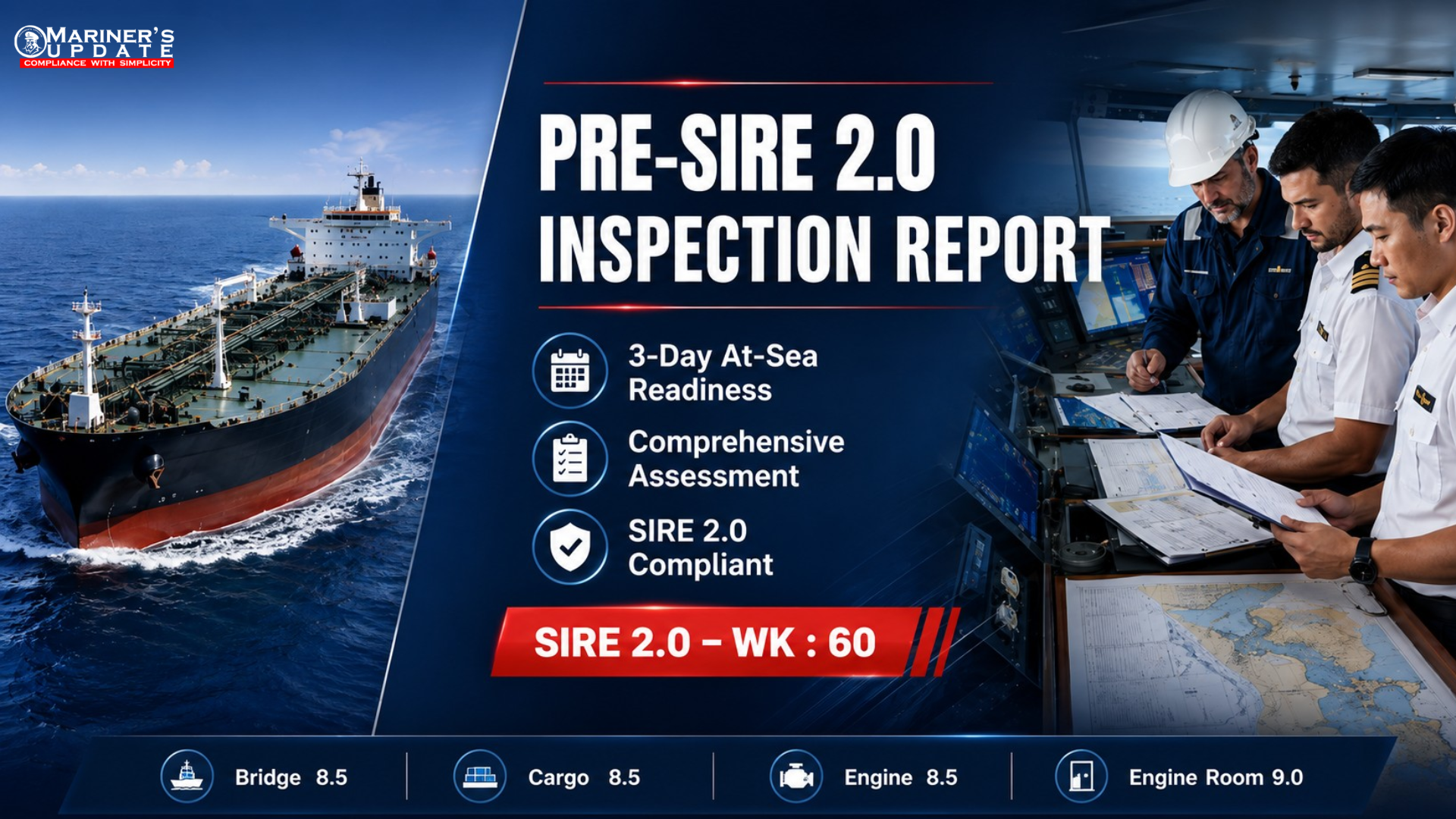
At Sea – During Sailing with onboard crew
No of days: 3
Vessel Pre-SIRE Inspection Summary
Inspection Objective
A comprehensive Pre-SIRE 2.0 inspection was carried out to assess the vessel’s readiness for an upcoming Chevron OCIMF SIRE 2.0 inspection.
Overall Outcome Achieved
Positive Outcomes
✅ Officers demonstrated good knowledge of navigation procedures, ECDIS operation, cargo watchkeeping, emergency response, and company SMS requirements.
✅ Chief Engineer and Engine Department personnel were familiar with critical equipment, MARPOL requirements, bunkering procedures, lubrication oil monitoring, defect reporting systems, and engine room operational controls.
✅ Critical machinery and alarm systems tested during the inspection were operational.
✅ Fire pumps, emergency fire pump, steering gear alarms, bilge alarms, OWS alarms, leakage alarms, OMD alarms, and communication systems were successfully demonstrated.
✅ Crew members interviewed were generally familiar with enclosed space entry procedures, garbage segregation, emergency duties, and stop-work authority.
✅ Engine room housekeeping was satisfactory with no significant leakages or unsafe conditions identified.
✅ Cargo Control Room watchkeeping procedures and documentation were available and generally maintained.
✅ Bridge Team demonstrated capability in chart correction verification and ECDIS update management.
Focus Areas Assessed
1. Bridge Operations
Areas Reviewed
• Chart correction procedures
• ENC update management
• Weekly Notice to Mariners verification
• Pilot Card
• Arrival Checklist
• Departure Checklist
• Bridge Team Management
• Pilot Integration Procedures
• Master’s Standing Orders
• Radar operation (X-Band & S-Band)
• ECDIS update transfer procedures
Inspector Expectations
• Demonstrate actual ENC correction implementation.
• Show objective evidence rather than verbal explanation.
• Explain differences between X-Band and S-Band radars.
• Demonstrate Pilot integration into Bridge Team as per SMS.
• Explain Master’s call criteria from Standing Orders.
• Show ECDIS update procedures for each independent ECDIS.
Focus Score
Bridge Readiness: 8.5 / 10
2. Emergency Procedures
Areas Reviewed
• Emergency duties
• Crew responsibilities
• Emergency response procedures
• SMS emergency references
• LSA and FFA inspection records
Inspector Expectations
• Ship-specific answers only.
• Supporting SMS procedures must be readily available.
Focus Score
Emergency Preparedness: 8 / 10
3. Deck Operations
Areas Reviewed
• Routine deck inspections
• SSO Safety Inspection records
• Mooring Quarterly Reports, LMP, MSMP
• Deck maintenance records
• SMS familiarity
Focus Score
Deck Operations: 8 / 10
4. Cargo Control Room (CCR)
Areas Reviewed
• Cargo Watch Handover Procedures
• Cargo Watch Takeover Checklist
• Comparison Sheets
• SSSCL
• Duty Officer Responsibilities
• Watchkeeping Standards
Focus Score
Cargo Operations Readiness: 8.5 / 10
5. Engine Department
Areas Reviewed
• Defect reporting system
• PMS maintenance records
• RA implementation
• Bunkering procedures
• LO Analysis records
• ORB Part-I
• EPL compliance
• MOC Register
• Critical Equipment testing
Focus Score
Engine Department Readiness: 8.5 / 10
6. Engine Room Inspection
Equipment Demonstrated
• Bilge Alarm
• Steering Gear Low Level Alarm
• Main Engine FO Leakage Alarm
• Auxiliary Engine FO Leakage Alarm
• Engineers Call System
• Incinerator Flame Failure Alarm
• OWS 15 ppm Alarm
• Emergency Fire Pump
• Fire Pumps
• Funnel Flaps
• Hypermist System
• OWS Monitoring System
Focus Score
Engine Room Condition: 9 / 10
Red Flags Identified
Red Flag 1 – Risk Assessment
Observation
RA for single hose handling during crane operation was available; however, supporting SMS guidance or company procedure defining RA requirements could not be demonstrated.
Risk
Potential SIRE observation due to lack of procedural linkage and objective evidence.
Recommendation
• Include RA requirements clearly within SMS.
• Cross-reference RA forms with applicable procedures.
• Train officers on locating SMS references.
Red Flag 2 – Defect Management Summary
Observation
No printed open defect summary available.
Although defect history and closure records were demonstrated through SERTICA, inspector specifically recommended maintaining a readily available defect summary.
Risk
May create negative perception regarding defect tracking and management.
Recommendation
• Maintain printed Open Defect List.
• Maintain Closed Defect Tracking Report.
• Keep monthly defect trend analysis available.
Red Flag 3 – ENC Update Knowledge
Observation
Strong focus placed on ENC correction management.
Inspector expects officers to explain:
• Weekly update process.
• Independent update of each ECDIS.
• Monitoring first ECDIS after update before updating second ECDIS.
Risk
Frequently observed SIRE challenge area.
Recommendation
Conduct dedicated ECDIS update familiarization training for all deck officers.
Red Flag 4 – SMS Reference Familiarity
Observation
Throughout the inspection, repeatedly requested SMS references rather than accepting verbal answers.
Risk
Officers may know procedures but fail to demonstrate objective evidence.
Recommendation
Conduct SMS navigation exercises for all officers.
Red Flag 5 – Crew PTW Awareness
Observation
Random crew members were questioned regarding:
• Enclosed Space Entry
• Working Overside Permit
• Stop Work Authority
• PTW Requirements
Risk
Crew confidence and consistency of responses remain a critical SIRE assessment area.
Recommendation
Conduct targeted PTW toolbox talks before inspection.
Overall Readiness Assessment
| Area | Score |
|---|---|
| Bridge | 8.5 / 10 |
| Emergency Procedures | 8.0 / 10 |
| Deck Operations | 8.0 / 10 |
| Cargo Operations | 8.5 / 10 |
| Engine Department | 8.5 / 10 |
| Engine Room Condition | 9.0 / 10 |