Overview of Regulatory Update
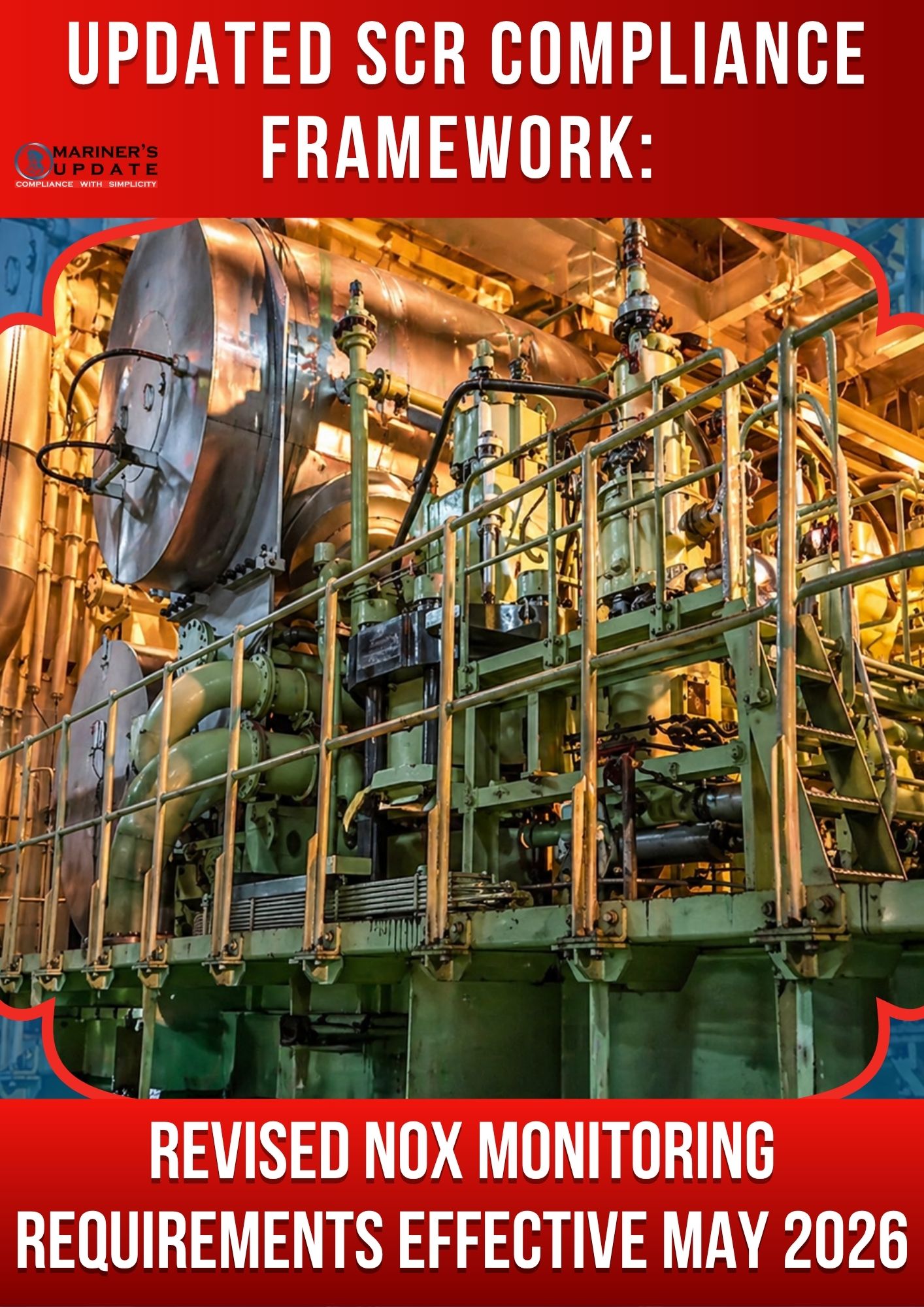
Significant revisions to the Selective Catalytic Reduction (SCR) framework will come into effect on 1 May 2026. These updates introduce a new approach to evaluating NOx measurement performance, particularly in relation to catalyst monitoring. The previously defined ±5% accuracy benchmark has been removed and replaced with a broader requirement for “sufficient accuracy,” shifting more responsibility onto system applicants.
Applicability of the New Rules
These updated provisions apply to:
- Marine diesel engines installed on ships with a keel laid on or after 1 November 2025, or
- Ships delivered on or after 1 May 2026
The 2025 SCR Guidelines (Resolution MEPC.399(83)) officially replace the earlier 2017 SCR Guidelines (MEPC.291(71)), introducing revised expectations for NOx monitoring systems.
Changes in NOx Measurement Expectations
Under earlier guidelines, NOx monitoring devices were required to demonstrate an accuracy of ±5% when compared to a certified reference analyzer (such as a chemiluminescence detector compliant with NTC 2008 standards).
With the 2025 update:
- The fixed ±5% accuracy requirement has been eliminated.
- NOx measurement systems must now demonstrate “sufficient accuracy” for effectively tracking catalyst condition and degradation.
- No explicit numerical threshold has been defined, leaving interpretation open.
What This Means for Applicants
The absence of a strict accuracy benchmark means applicants must now:
- Justify that their NOx monitoring system provides reliable data for assessing catalyst health.
- Demonstrate acceptable deviation levels between onboard instruments and reference analyzers.
- Consider factors such as:
- Instrument precision and inherent accuracy
- Long-term measurement drift
- Proximity to regulatory NOx limits
Additionally, applicants should ensure that not only the raw NOx readings (e.g., ppm values) are reliable, but also that the methodology used to interpret these readings is robust and defensible.
Technical Considerations for Measurement Reliability
Measurement accuracy is influenced by more than just the analyzer itself. Key aspects include:
- Sampling location within the exhaust system
- Exhaust gas mixing quality at the sampling point
These elements must be carefully evaluated and validated during system testing and verification.
Implementation Guidance
To align with the updated SCR Guidelines, stakeholders should:
- Review and revise existing Technical Files for individual engines and engine families
- Incorporate the new requirements into parent engine emission testing plans
- Update supporting documentation for future engine certifications
An accompanying appendix (referenced in the original guidance) provides additional recommendations for practical implementation.
Reference Standard
- IMO Resolution MEPC.399(83)– 2025 Guidelines on Selective Catalytic Reduction (SCR) Systems