Maritime sanctions widen as London targets vessels, ship management and financial networks linked to Russian energy exports
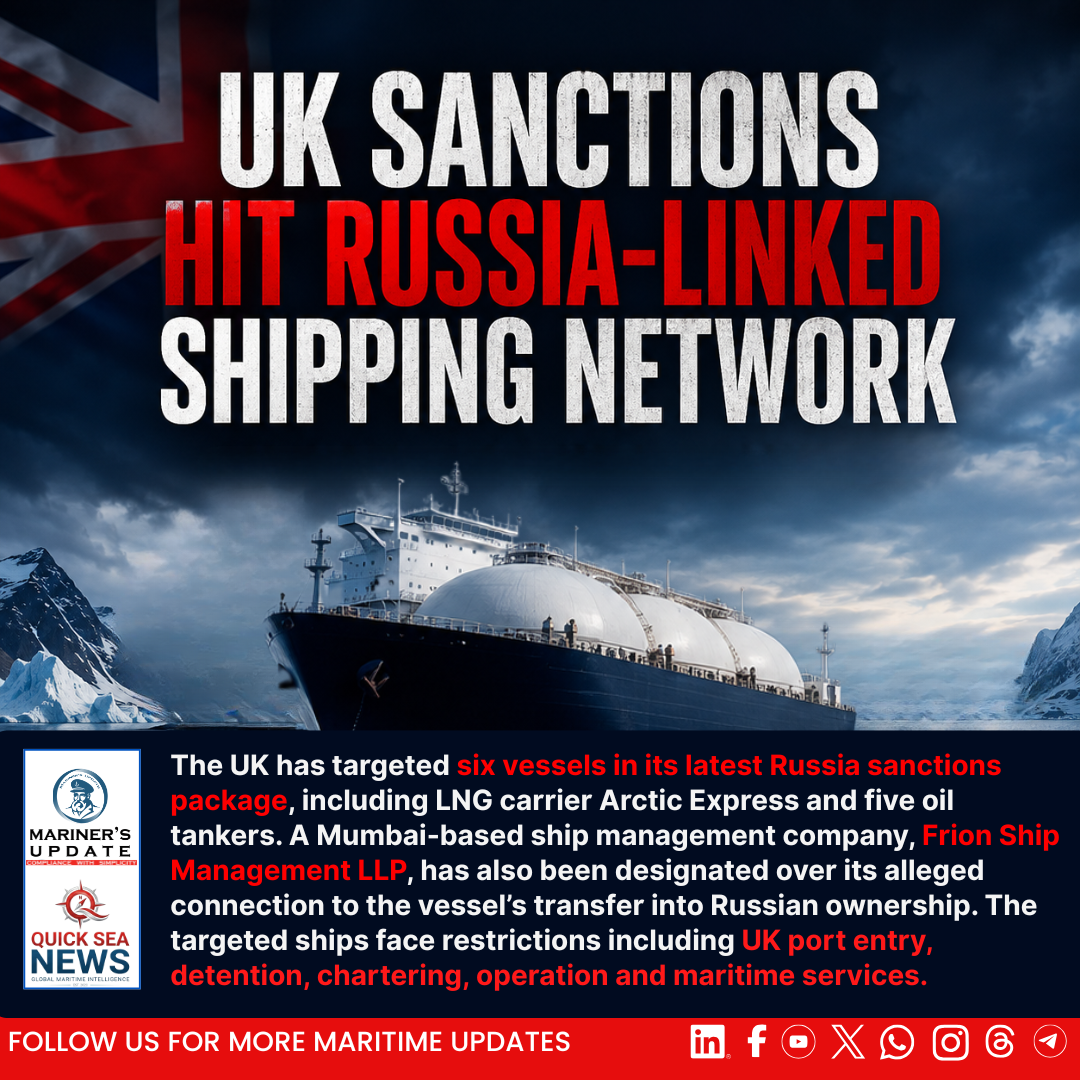
The United Kingdom has further intensified pressure on Russia’s maritime energy trade by expanding its sanctions regime to target an LNG carrier, five oil tankers and a Mumbai-based ship management company allegedly connected to Russian energy exports.
The latest package includes 19 new designations covering vessels, companies, financial institutions and an individual. The maritime-focused measures highlight the UK’s continued strategy of targeting not only Russian energy exports themselves, but also the shipping companies and service networks that enable those cargoes to reach international markets.
Arctic LNG Carrier Comes Under UK Sanctions
At the centre of the latest maritime action is the LNG carrier Arctic Express (IMO 9333591).
According to the UK, the vessel has been involved in transporting liquefied natural gas originating in Russia to third countries. The vessel is believed to be operating under the Russian flag and is associated with SMP Tech Management LLP.
The designation is significant because LNG shipping forms an important part of Russia’s energy export network. Targeting an LNG carrier therefore extends the sanctions campaign beyond the more frequently targeted crude oil and petroleum-product tanker sector.
The UK’s action also reaches into the ship-management chain.
Mumbai-Based Ship Manager Also Targeted
The UK has designated Frion Ship Management LLP, a ship management company based in Mumbai.
British authorities allege that the company supported the sale of Arctic Express into Russian ownership and control.
The designation places the company under a range of restrictions, including an asset freeze, trust-services restrictions, director disqualification measures and transport-related sanctions.
For the maritime industry, this is an important development because it demonstrates that sanctions exposure can extend beyond vessel owners and charterers to companies providing management and supporting services to vessels linked to sanctioned activity.
Five More Oil Tankers Added to the List
The UK has also targeted five oil tankers that it says have transported Russian crude oil or petroleum products from Russia to third countries.
The vessels are:
- Perseas — IMO 9326811 — believed to be sailing under the San Marino flag
- Torvian — IMO 9470131 — believed to be registered in Barbados
- Asteras — IMO 9402263 — believed to be registered in Palau
- Visund — IMO 9378864 — believed to be registered in Palau
- Zenturo — IMO 9346885 — believed to be registered in Barbados
The use of different flag states once again illustrates the international nature of the shipping networks involved in Russian energy transportation.
What the Ship Sanctions Mean
The designation of a vessel under the UK’s specified-ship sanctions can have major operational and commercial consequences.
The targeted vessels can be:
- Prohibited from entering UK ports
- Subject to detention measures
- Restricted from being chartered or operated by UK persons
- Subject to restrictions involving maritime services
- Restricted from receiving technical assistance
- Affected by brokering and chartering restrictions
- Subject to financial-service and funding restrictions
- Restricted from receiving certain crew and operating services
The UK sanctions framework specifically provides for measures affecting specified ships, including port entry, movement, detention, chartering and operating, as well as services such as technical assistance, crew services, operating services, chartering, brokering and financial services.
Sanctions Extend Beyond Shipping
The latest package is not limited to the maritime sector.
The UK has also targeted Northern Engineering LLC, which it says operates in Russia’s strategically significant energy sector.
Four industrial companies accused of supplying goods or technology supporting Russia’s war effort have also been designated.
In addition, five Russian financial institutions have been targeted, including Ozon Bank and the Russian Export-Import Bank.
The financial measures include asset freezes and correspondent banking restrictions, adding another layer of pressure to the commercial networks supporting Russia’s economy and energy trade.
Why This Matters for Global Shipping
The latest sanctions package sends a clear message to the maritime industry: sanctions compliance is no longer limited to checking the immediate owner or flag of a vessel.
Shipowners, managers, charterers, brokers, insurers, banks, technical-service providers, crew-service companies and other maritime stakeholders may all face exposure when dealing with vessels or companies connected to sanctioned Russian energy movements.
The involvement of a Mumbai-based ship management company also underlines the importance of conducting detailed due diligence across the entire ownership, management and transaction chain.
A vessel’s current flag alone may not provide a complete picture of its sanctions exposure. Ownership history, management arrangements, chartering structures, cargo origin, counterparties and previous transactions can all become relevant when assessing sanctions risk.
UK Continues Targeting Russia’s Maritime Energy Network
The latest measures form part of the UK’s broader campaign to disrupt the maritime networks supporting Russian energy exports.
Since Russia’s invasion of Ukraine, London has increasingly used vessel-specific sanctions alongside financial and corporate designations. The UK’s Russia sanctions regime maintains a dedicated category for specified ships, with the government continuing to add vessels and entities to the sanctions framework during 2026.
For the maritime sector, the message is increasingly clear: sanctions risk can follow the cargo, the vessel, the owner, the manager, the charterer and the service network.
As governments continue to target Russia’s energy trade, shipping companies operating internationally will need increasingly robust sanctions screening, counterparty due diligence and voyage-level compliance checks.
The designation of Arctic Express, five oil tankers and Frion Ship Management LLP demonstrates how sanctions are increasingly being applied across the complete maritime supply chain.
For shipowners, operators, managers, charterers, brokers and service providers, maintaining accurate vessel records and conducting comprehensive sanctions due diligence is becoming an increasingly important part of commercial and operational risk management.