
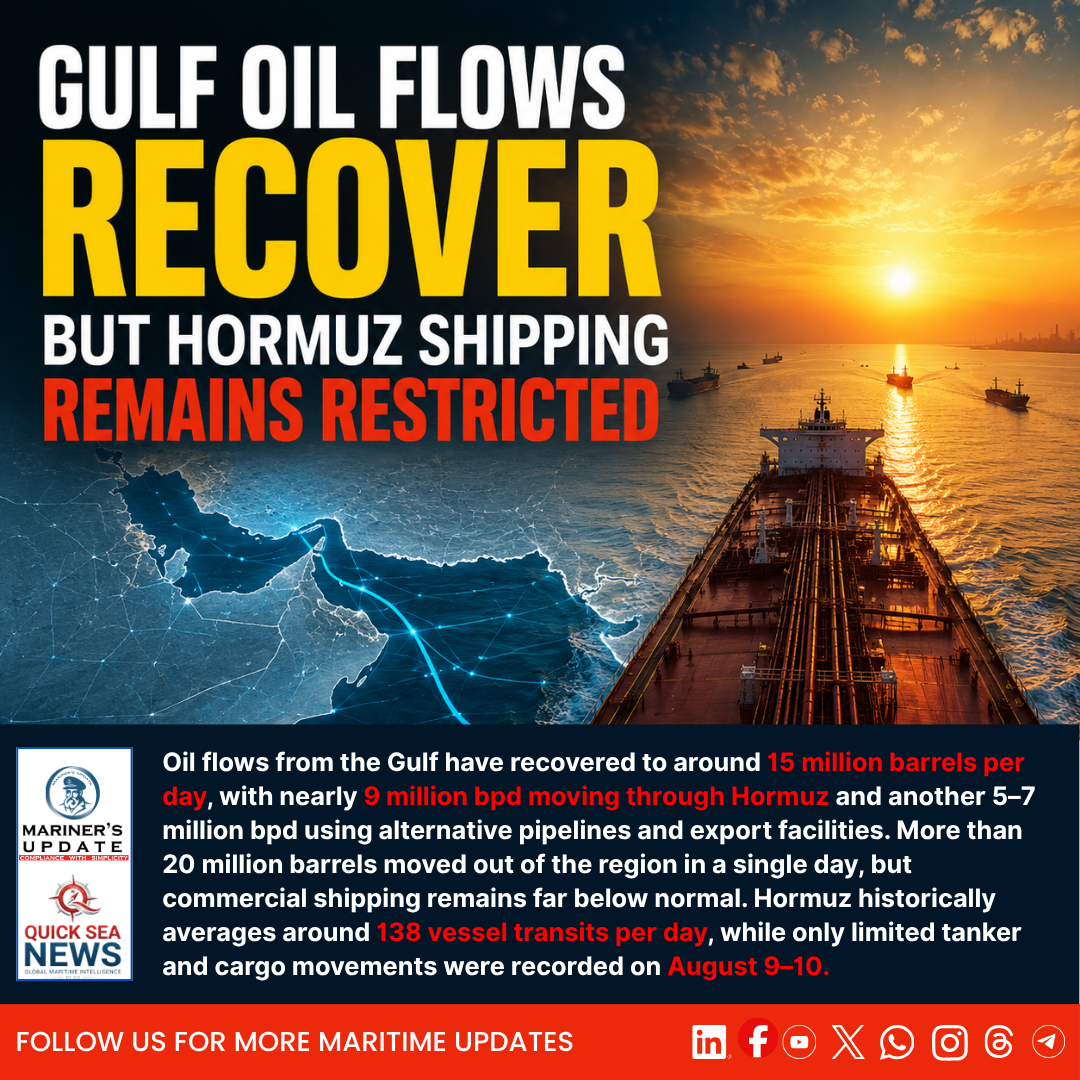
Oil exports are recovering across the Arabian Gulf as alternative pipelines and export facilities help offset continued disruption in the Strait of Hormuz. However, vessel movements through the strategic waterway remain far below normal levels.
Oil flows from the Persian Gulf region have reportedly recovered to approximately 15 million barrels per day, according to U.S. Energy Secretary Chris Wright.
Wright said the seven-day average of oil leaving through the Strait of Hormuz has increased to nearly 9 million barrels per day. A further 5–7 million barrels per day is reportedly reaching export markets through upgraded pipelines and facilities designed to bypass the strategic waterway.
According to Wright, the recovery has been supported by coordinated efforts involving the U.S. military and Gulf allies, alongside increased use of alternative export infrastructure.
More than 20 million barrels moved in a single day
Wright also stated that more than 20 million barrels of oil left the Arabian Gulf region on Sunday, exceeding the region’s pre-conflict daily average.
While this points to a significant recovery in oil exports, questions remain over exactly how much of the additional volume is being transported through the U.S.-supported Omani route, the Iranian side of the Strait, or alternative pipeline networks.
Wright’s statement specifically indicates that almost 9 million barrels per day is currently passing through Hormuz overall, rather than confirming that this entire volume is moving through the Omani corridor.
Alternative pipelines become increasingly important
The reported 5–7 million barrels per day moving through newly upgraded pipelines and export facilities is particularly significant.
Before the conflict, the International Energy Agency estimated that Saudi Arabia and the UAE together had approximately 3.5–5.5 million barrels per day of available capacity to bypass Hormuz.
Saudi Arabia’s East-West pipeline provides the majority of this alternative capacity, while the UAE can transport crude directly to Fujairah, avoiding the Strait.
The latest figures therefore suggest that these alternative routes may now be operating close to, or potentially beyond, the upper end of their previously estimated capacity.
Oil recovery does not mean Hormuz has returned to normal
Despite the improvement in oil flows, overall volumes remain below normal levels when measured over a sustained period.
The IEA estimated that approximately 19.87 million barrels per day of oil moved through the Strait of Hormuz in 2025.
Against that benchmark, the current combined estimate of around 15 million barrels per day through Hormuz and alternative routes remains roughly 5 million barrels per day below the 2025 Hormuz benchmark.
This makes the reported one-day movement of more than 20 million barrels particularly notable, but it does not necessarily demonstrate that normal export patterns have been fully restored.
Commercial shipping remains heavily restricted
The most important distinction is between oil volumes and vessel traffic.
The Joint Maritime Information Center (JMIC) said commercial traffic through the Strait remains at reduced levels. Independent tracking has also shown only a small number of tankers and cargo vessels moving through the waterway.
JMIC places the Strait’s historical average at approximately 138 vessel transits per day, based on 2025 traffic.
By comparison, JMIC recorded 42 U.S.-facilitated transits between August 9 and 10.
Separate tracking of non-facilitated cargo vessels recorded only two transits on August 9 and three on August 10.
Tanker movements were even more limited, with just one tanker transit on each of those two days in the non-U.S.-facilitated data.
Security concerns continue to shape vessel movements
JMIC expects shipping activity to remain reduced across both the northern Iranian-controlled route and the southern Omani corridor.
The continued reduction is linked to the broader security environment, including vessel attacks, U.S. blockade enforcement and heightened regional tensions.
This means that the recovery in oil exports should not be interpreted as a full return to normal maritime operations.
What the latest figures mean for shipping
The current situation presents a complex picture for global energy and maritime markets.
Large volumes of Gulf crude are once again reaching international markets, reducing some of the immediate pressure created by the disruption. However, the extremely low number of commercial vessel movements shows that maritime confidence and operational normality have not yet been restored.
The key question now is how sustainable the recovery will be.
It remains unclear how much of the recovered oil volume is coming from restored traffic through the Omani corridor, continued movements through the Iranian side of Hormuz, or increased reliance on alternative pipeline and export infrastructure.
For shipowners, operators, charterers and energy markets, oil-flow recovery and safe maritime passage remain two separate issues. Until vessel traffic through the Strait consistently returns toward historical levels, the global shipping industry will continue to face elevated operational and security uncertainty.