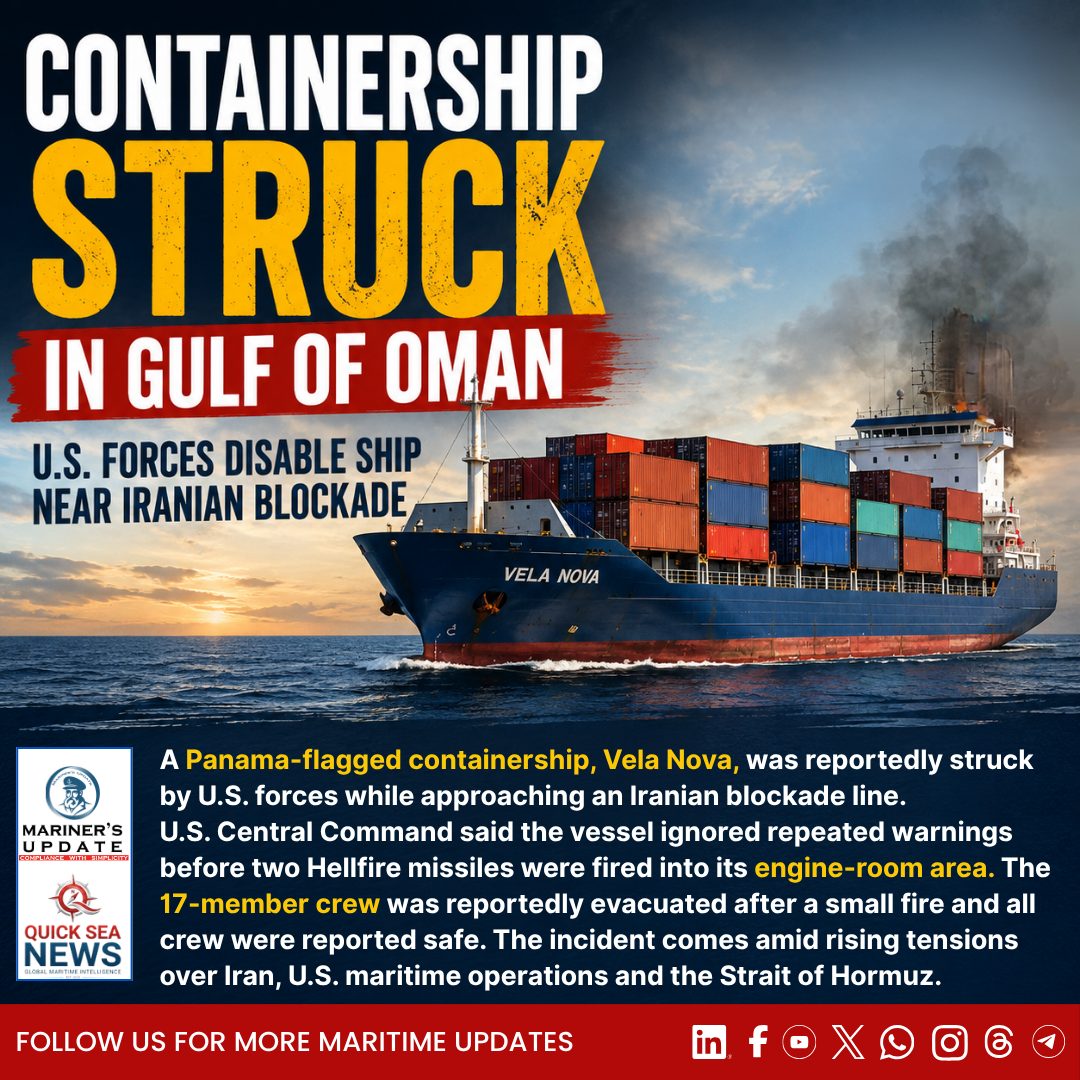
A small containership approaching the Iranian blockade line in the Gulf of Oman was reportedly struck by U.S. forces on August 10, in a significant escalation of the ongoing confrontation surrounding Iranian shipping and the Strait of Hormuz.
According to The Wall Street Journal, U.S. forces opened fire on the vessel as it approached the blockade area. Initial reports said a U.S. helicopter fired a missile that struck the vessel’s rudder. The U.S. Central Command (CENTCOM) later confirmed the incident, stating that the vessel had ignored repeated warnings from American forces.
Two Hellfire Missiles Fired
CENTCOM said that an MH-60 U.S. Navy helicopter fired two Hellfire missiles into the engine room of the cargo vessel. Other independent reports indicated that the vessel’s steering gear area was targeted with the intention of disabling the ship and preventing it from continuing toward the blockade.
The action highlights the increasingly direct enforcement measures being used by U.S. forces against vessels approaching the designated blockade area.
Containership Identified as Vela Nova
The vessel involved was identified as the Panama-flagged Vela Nova, a containership of approximately 13,248 dwt and a reported capacity of around 1,050 TEU.
The ship reportedly had 17 crew members on board at the time of the incident. Sources cited by The Wall Street Journal said that a small fire broke out following the strike but was subsequently extinguished.
The crew was reportedly evacuated to another nearby vessel, with all 17 seafarers accounted for and reported uninjured.
The incident occurred approximately 71 miles off the coast of Pakistan in the Gulf of Oman. AIS information reportedly showed the vessel sailing from Nhava Sheva, India, to Jebel Ali, UAE.
Vessel’s Management and Compliance History Under Scrutiny
The Vela Nova reportedly changed ownership in February 2026 and was subsequently managed by Sino Hellenic Ships Management, a Greece-based company.
While there are reportedly no sanctions records directly identifying the vessel or its manager, sources have raised questions regarding the movements of some other vessels associated with the management company.
The ship was built in 1996, making it approximately 30 years old.
Its recent compliance history has also attracted attention. Equasis reportedly lists the vessel’s DNV class as suspended, with a survey overdue. The ship also received deficiencies during five consecutive port state inspections in 2024 and 2025, with inspections carried out in Japan, China and South Korea.
These details do not, by themselves, establish a connection between the vessel’s compliance history and the military action, but they are relevant to understanding the broader background of the ship.
U.S. Naval Presence Continues to Grow
The incident comes amid a continuing U.S. military presence in the region.
CENTCOM had previously highlighted that more than 20 U.S. warships remained deployed in the area, supporting the blockade and other regional assignments.
Since the U.S. blockade of Iranian shipping and ports resumed, 55 vessels have reportedly been redirected. According to the information released by CENTCOM, three vessels have now been disabled and two have been boarded as part of enforcement operations.
The latest strike therefore represents another major development in what is becoming an increasingly consequential maritime security situation in the Gulf of Oman and wider Persian Gulf region.
Strait of Hormuz Tensions Remain High
The incident also comes as Washington and Tehran continue to exchange increasingly strong statements over the reopening and management of the Strait of Hormuz, one of the world’s most strategically important maritime chokepoints.
Reports indicate that Iran and Oman were working toward an agreement concerning management of the Strait without direct U.S. involvement.
At the same time, factions within Iran have reportedly indicated that they would not negotiate directly with the United States while Donald Trump remains in office.
The U.S. administration, meanwhile, has continued to maintain that an agreement concerning the Strait could be close.
What This Means for Shipping
The disabling of a commercial containership by U.S. forces represents a serious development for the international shipping industry.
The incident raises concerns over vessel routing, crew safety, freedom of navigation, war-risk exposure, insurance, AIS monitoring and operational decision-making for ships operating in and around the Gulf of Oman and Strait of Hormuz.
For shipowners, operators and masters, the situation reinforces the need for continuous monitoring of maritime security advisories, strict compliance with coastal-state and naval warnings, updated voyage risk assessments and robust communication procedures.
With military assets remaining heavily deployed and diplomatic negotiations still uncertain, the security situation around the Strait of Hormuz remains highly fluid.