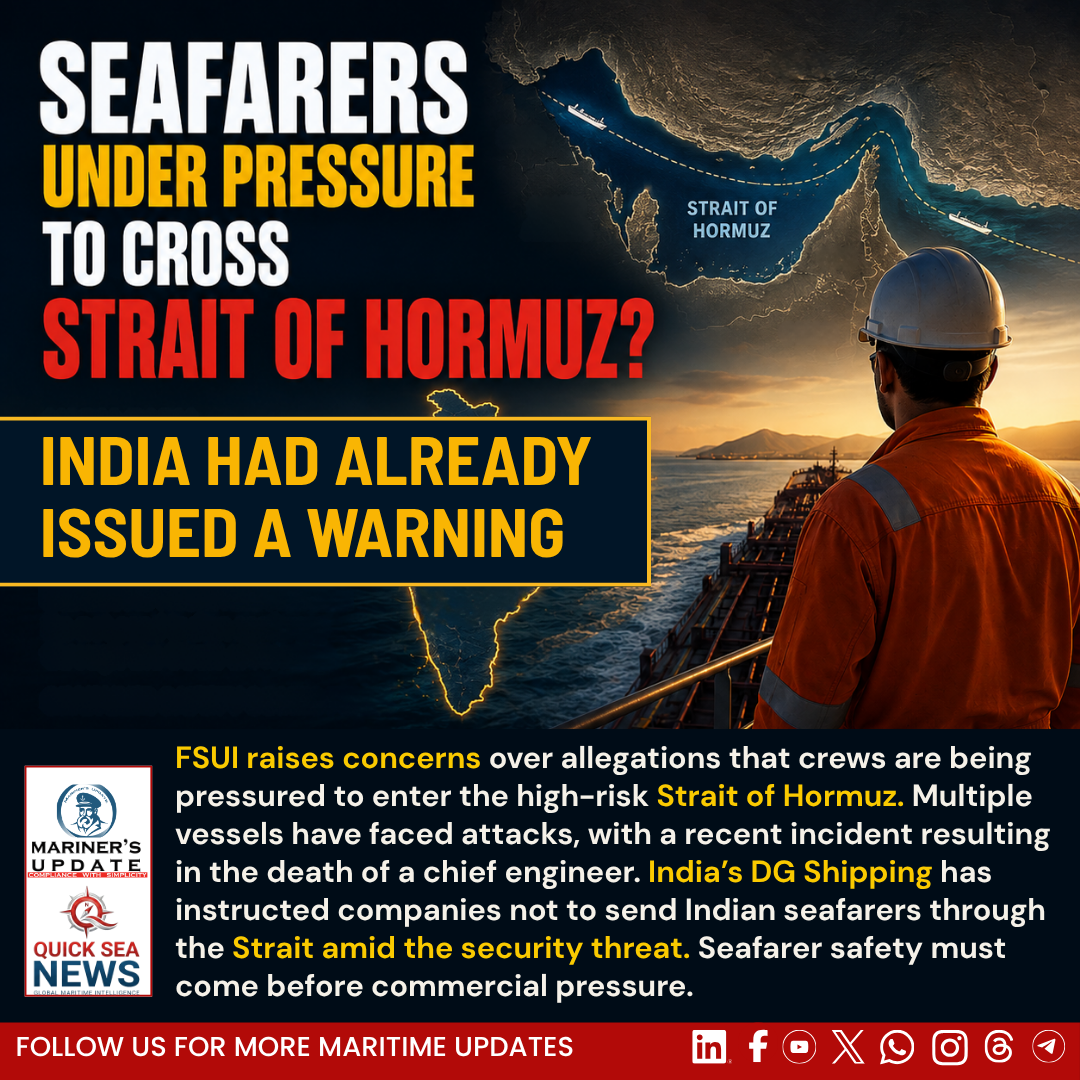
The safety of Indian seafarers navigating the Strait of Hormuz has come under renewed scrutiny after the Forward Seamen’s Union of India (FSUI) raised concerns that some shipowners and operators may be pressuring crews to enter the high-risk waterway despite their concerns over personal safety.
The issue comes at a time when tensions around the Strait of Hormuz remain extremely high. Several vessels have reportedly come under attack by Iran’s Islamic Revolutionary Guard Corps in recent weeks, while a recent attack on a bulk carrier resulted in the death of a chief engineer.
FSUI Raises Alarm Over Crew Pressure
FSUI has been campaigning for seafarers to have a genuine choice when faced with voyages through designated war-risk areas.
In a video appeal released on August 17, the master of the foreign-flagged MPSV AM Pioneer alleged that the vessel’s operator was pressuring the crew to transit the Strait of Hormuz and proceed towards Fujairah.
According to the master, the vessel’s crew had joined approximately one month earlier to carry out survey work. He said they had agreed to transit the Strait only once the waterway was formally considered open and safe for shipping, rather than entering while significant security risks remained.
The master further alleged that the company had begun making security arrangements involving U.S. forces for a passage from Ras al-Khaimah towards the Gulf of Oman through the southern route of the Strait, an area where neutral commercial shipping has also faced attacks.
The company subsequently denied that it had pressured the captain to undertake the voyage. However, FSUI stated that the captain was removed from the vessel and signed off with immediate effect the following day.
India Had Already Issued a Warning
The concerns come against the backdrop of an Indian regulatory directive issued earlier this year.
Effective July 15, India’s Directorate General of Shipping instructed shipping and crewing companies not to deploy Indian seafarers on voyages through the Strait of Hormuz because of the potential danger posed by attacks from Iranian forces.
The situation has become particularly complicated because Iran has repeatedly targeted vessels that it says have failed to comply with its “Persian Gulf Strait Authority” traffic-management arrangements.
For crews, the combination of military activity, changing passage requirements and attacks on commercial vessels has created a highly uncertain operating environment.
Seafarer Safety Versus Commercial Pressure
FSUI has stressed that commercial considerations should not override the safety and rights of seafarers.
The union has specifically highlighted the importance of seafarers being able to exercise their rights when faced with serious security threats, including provisions relating to repatriation under the Maritime Labour Convention (MLC).
FSUI’s position is that Indian seafarers should not be expected to accept unacceptable risks simply to maintain a vessel’s commercial schedule.
The union has called for immediate repatriation, with wages and outstanding contractual dues protected, where seafarers are unwilling or unable to safely undertake such a voyage.
A Major Concern for the Global Seafarer Workforce
The issue has implications well beyond individual vessels.
Indian seafarers account for more than 10% of the global maritime workforce, according to FSUI, and the proportion of Indian crew members waiting on vessels on the western side of the Strait could be even higher.
That makes the situation particularly significant for the international shipping industry.
The Strait of Hormuz remains one of the world’s most strategically important maritime chokepoints, carrying a substantial volume of global energy trade. Any prolonged security crisis in the region therefore affects not only shipowners and charterers, but also the seafarers who are required to operate vessels through the area.
The latest allegations underline a critical question for the industry: when a maritime route becomes a designated high-risk or war-risk area, who ultimately decides whether a seafarer should be required to enter it?
For seafarers, the answer must remain closely tied to safety, applicable regulations, contractual rights and the instructions issued by the relevant maritime authorities.
As tensions continue around the Strait, shipping companies, crewing managers and vessel operators face increasing pressure to ensure that operational decisions do not come at the expense of crew safety.
For the maritime industry, the message is clear: no commercial schedule should come before the safety of the people operating the vessel.