
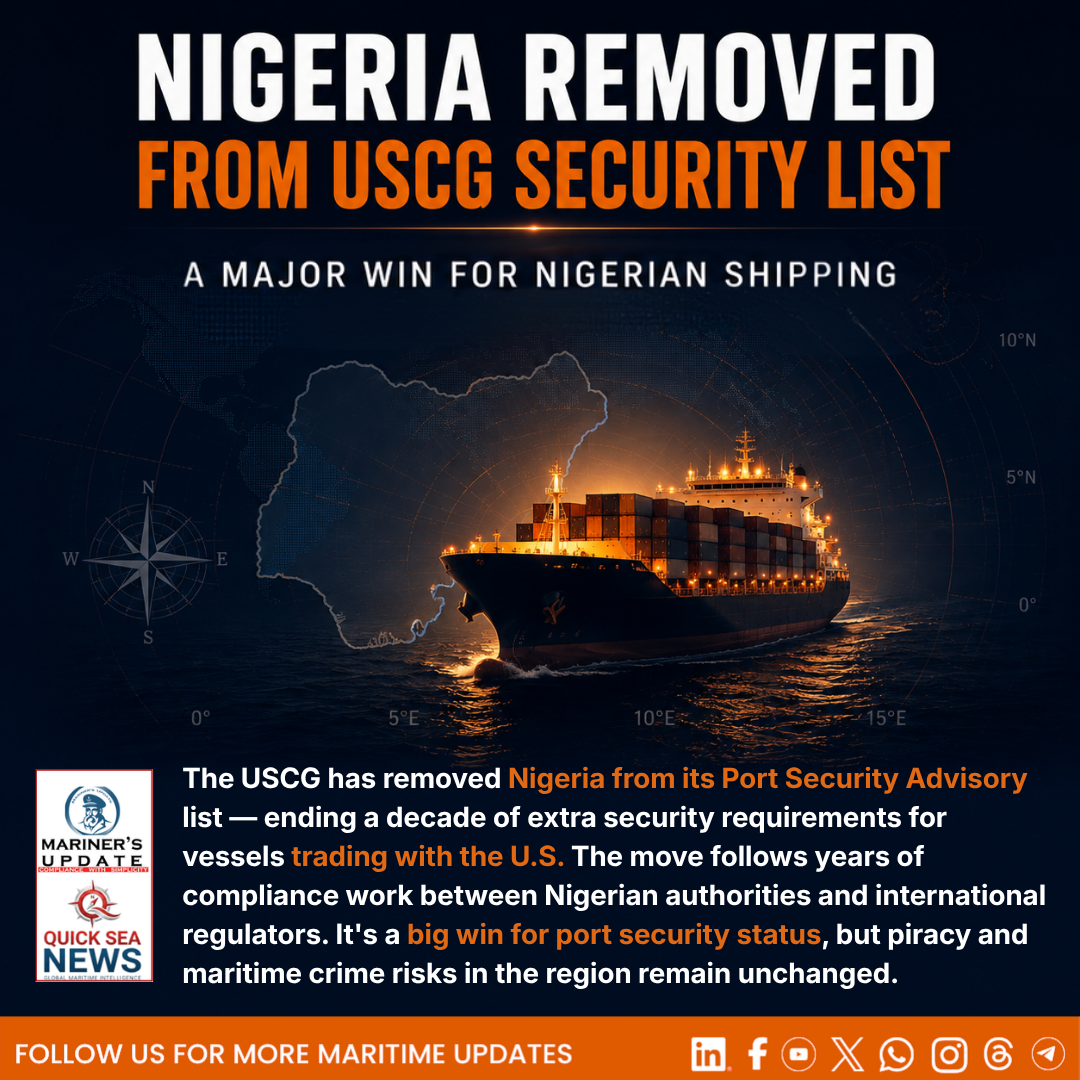
Nigeria Sails Clear: USCG Lifts Port Security Advisory After Decade-Long Compliance Push
In a significant development for West African maritime trade, the U.S. Coast Guard has officially removed Nigeria from its Port Security Advisory list, recognizing the country’s ports as maintaining effective antiterrorism measures for the first time since restrictions were first imposed.
What Changed
Under Port Security Advisory (4-26), issued this month, the Coast Guard confirmed that the Federal Republic of Nigeria now meets the antiterrorism benchmarks required under the Maritime Transportation Security Act (MTSA) of 2002. As a result, all Conditions of Entry that previously applied to vessels calling at Nigerian ports before heading to the United States — restrictions that had been in place since 2014 — have been lifted with immediate effect.
Why It Matters
For over a decade, ships trading between Nigeria and the U.S. were required to implement enhanced security protocols before arrival at American ports, including elevated Security Level 2 measures, guarded access points, mandatory Declarations of Security, detailed security logging, and advance reporting to the Captain of the Port. Vessels that failed to comply risked delays, additional boarding examinations, or even denial of entry.
With Nigeria’s removal from the affected list, these additional compliance burdens no longer apply, easing the operational and administrative load on vessels and operators engaged in U.S.–Nigeria trade.
The Road to Compliance
The upgrade follows sustained engagement between the U.S. Coast Guard and Nigeria’s maritime regulator, the Nigerian Maritime Administration and Safety Agency (NIMASA). A three-year structured programme focused on strengthening adherence to the International Ship and Port Facility Security (ISPS) Code appears to have been central to closing the compliance gap that kept Nigeria on the advisory list for so long.
Who Feels the Impact
Vessel-tracking data shows around 10 vessels sailed directly between Nigeria and the United States over the past month alone — a relatively modest volume, suggesting that while the policy shift is symbolically important, the immediate operational impact is limited to a small segment of trade routes. Still, for operators on this corridor, it removes a long-standing layer of cost and complexity.
A Caveat Worth Noting
While this marks a milestone for Nigeria’s port-security credentials, it’s important to separate port security compliance from broader maritime security risk. The advisory speaks specifically to antiterrorism measures at port facilities — it does not reflect any change in the ongoing risks of piracy, kidnap-for-ransom incidents, or wider maritime crime in Nigerian waters, which remain separate and active concerns for operators transiting the region.
Other Countries Still on the List
Nigeria’s exit leaves 24 countries still designated under the advisory, including Iran, Iraq, Libya, Syria, Yemen, Venezuela, Cuba, North Korea, and several small island and coastal states across Africa, the Caribbean, and the Pacific. Vessels calling at ports in these countries continue to face the full set of Conditions of Entry before U.S. arrival.
This advisory supersedes the previous version and takes immediate effect.