Bridge Readiness: Passage Safety, Fire Watch & Navigation Equipment
Charting a Safe Passage
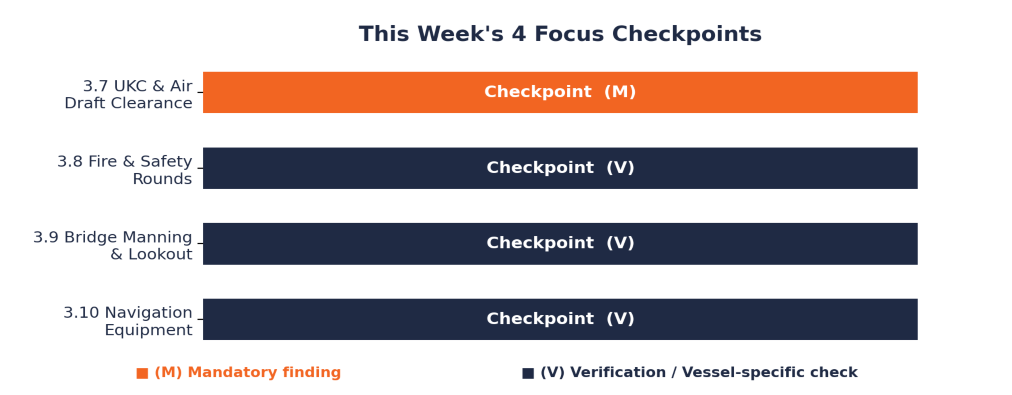
3.7 – Under Keel Clearance & Air Draft Clearance Guidelines (M)
Has the vessel’s manager actually produced a guideline covering under keel clearance (UKC) and air draft clearance? It’s a simple question with real consequences — inspectors aren’t just checking that a policy exists on paper, they’re verifying that the calculations behind it are accurate and genuinely usable on the bridge.
A sound UKC policy needs to set the minimum allowed clearance for both coastal and river navigation, and while alongside — with clear, actionable guidance on what the bridge team should do if clearance tightens in shallow water. Minimum air draft for passing under bridges or overhead cables must also be clearly defined by the manager, since a miscalculation here carries just as much risk as running aground.
The ship’s own guidelines should spell out exactly how Dynamic Under Keel Clearance (DUKC) and air draft are calculated on board, and this calculation must take Zone of Confidence (CATZOC) data into account.
Why CATZOC matters: CATZOC tells navigators how far they can trust the chart data for a given area, across six categories:
- A1 & A2 – High-precision modern survey data — high confidence
- B & C – Moderate confidence — some caution warranted
- D & U – Low confidence to unassessed — wide safety margins required
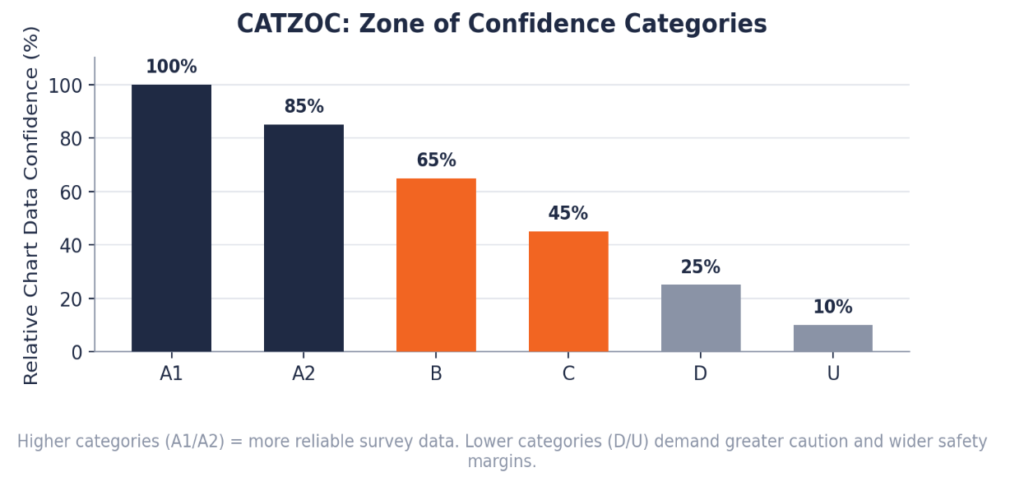
Companies are expected to define their own minimum acceptable UKC and operating procedures for each CATZOC value within the Safety Management System. For each Zone of Confidence value, reference should be made to Hydrographic publication UKHO NP 5012.
Fire Watch Never Sleeps
3.8 – Fire & Safety Rounds at the End of Watch (V)
Are fire and safety rounds actually being carried out at the end of each watch? This checkpoint looks small on paper, but it tests discipline and consistency far more than documentation.
The guiding principle is clear: no other duty or responsibility should be allowed to interfere with keeping a proper lookout. The Officer of the Watch should never be pulled away to become the sole lookout during hours of darkness — lookout duties and fire rounds must not compete for the same pair of eyes.
In areas not covered by a fixed fire detection system, regular fire patrols become even more critical to compensate for that gap. These patrols should be planned and scheduled in a way that specifically avoids using the bridge lookout to carry them out during darkness hours.
Key takeaway: Fire rounds and lookout duties should run on separate, clearly assigned resources. Vessels without automatic fire detection coverage in certain spaces should treat manual patrols as a non-negotiable routine — scheduled so that bridge watchkeeping is never compromised in the process.
Enough Eyes on the Bridge
3.9 – Bridge Manning & Lookout Adequacy (V)
Does bridge manning, at every stage of the voyage and at anchor, meet or exceed what’s required by the vessel’s Bridge Manning Matrix — and are lookout arrangements genuinely adequate for the conditions at hand?
The Bridge Manning Matrix should exist in a recommended form, complete with a worked example, and — critically — it must actually be posted on the bridge where the watchkeeping team can reference it in real time, not buried in a manual.
Under the STCW Code, the Officer of the Watch may, in certain circumstances, act as the sole lookout during daylight conditions. But this is a conditional allowance, not a default setting — it depends on factors like traffic density, weather, and visibility. Clear, specific guidance on exactly when sole lookout is acceptable should be written into the Safety Management System, rather than left to individual judgement in the moment.
Ready, Tested, Trusted
3.10 – Navigation Equipment in Good Order (V)
Is the navigation equipment in good order? On the surface this reads as a maintenance question — but the inspection guidance treats it as a readiness and record-keeping question too.
Shipborne navigational systems and equipment must comply with SOLAS Chapter V, Regulation 19. Once radar or other navigation equipment is fitted on the bridge, it’s expected to be operational — regardless of whether legislation technically requires the vessel to carry it in the first place. Random checks should be carried out to confirm equipment actually works, not simply that it’s present and switched on.
A practical nuance worth knowing:
If a radar magnetron hasn’t been changed strictly per the manufacturer’s recommended interval, that alone isn’t automatically a finding — provided mitigation is in place. Regular Performance Monitor tests each watch, a spare magnetron held as an essential spare item, and a clear comment recording when the last change occurred and what mitigation is active, together demonstrate control of the risk rather than neglect of it. Documentation is what separates a manageable deviation from a genuine non-conformity here.