Sec 3.13 – Magnetic, gyro and GNSS compasses on the bridge
Are the magnetic compass, gyro compass and GNSS compass fitted where required, operational, adjusted and properly maintained?
WHY COMPASSES STILL MATTER
Heading information drives almost everything on the bridge, from the autopilot to radar and AIS. A compass that is wrong, unserviced or never checked can quietly feed wrong data into every one of those systems. This week we look at what good compass care looks like on board.
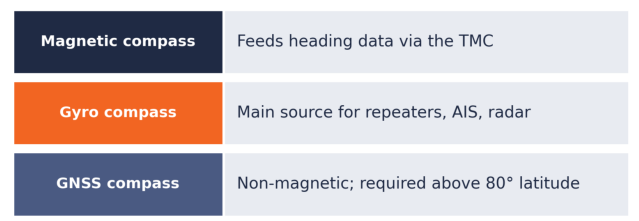
Three heading sources, each with a distinct job:
THE MAGNETIC COMPASS AND THE TMC
Where it lives
The magnetic compass is normally fitted above the navigating bridge on the centreline, with a periscope so the helmsman can read it from the steering position. Where other bridge systems need heading data from it, a transmitting magnetic compass (TMC) is also fitted.
Test it weekly
TMC outputs should be corrected for compass error, and the TMC should be tested once a week.
Know the right corrections
A TMC may apply variation automatically, but that correction does not include deviation. When correcting TMC outputs for compass error, make sure the correct values for both variation and deviation are applied.
Watch point: Automatic variation is not the full picture. Deviation still has to be accounted for by the crew.
DEVIATION: MEASURE IT, RECORD IT, ACT ON IT
A compass deviation card must be kept on the bridge. Deviation has to be determined and the compass adjusted at intervals through the ship’s life, especially after major steel conversion work.
Extra care is needed on ships that carry, or have recently carried, magnetic cargoes such as iron ore and steel. Such cargoes can shift how the compass behaves.
Safe distances matter too. Electrical bridge equipment carries compass safe distances, which set the minimum spacing from the magnetic compass. Check them before installing or moving any equipment.
The 5-degree rule
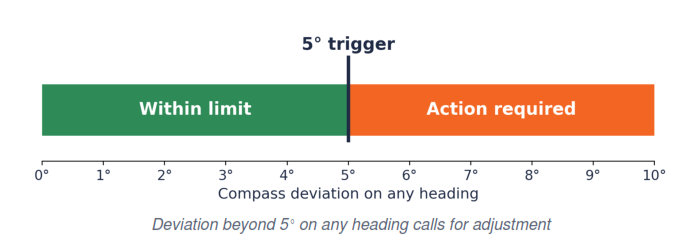
If observations show a deviation of more than 5 degrees on any heading, the compass must be adjusted by a qualified compass adjuster or by the Master to correct it. Where the Master makes the adjustment, RightShip recommends a qualified compass adjuster checks it at the next available opportunity.
WHEN MUST THE COMPASS BE SWUNG?
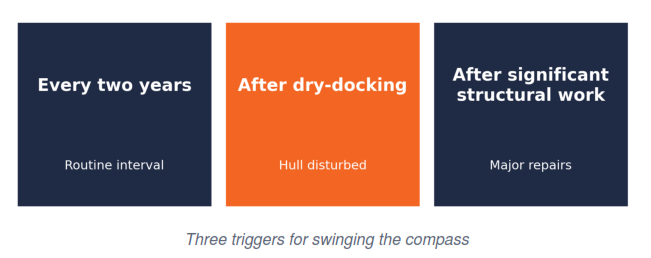
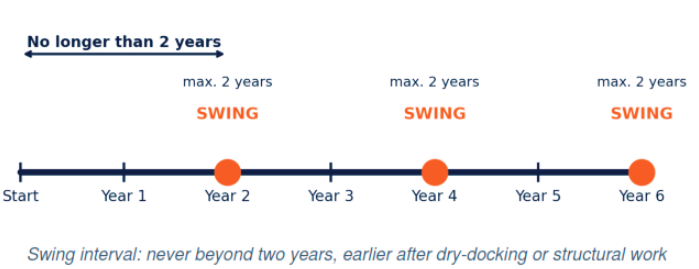
All magnetic compasses should be swung and adjusted at least:
- every two years,
- after dry-docking, or
- after significant structural work.
Flag State rules: Where the flag State has its own requirements, those should be followed.
THE GYRO COMPASS
Run it continuously The gyro compass should run all the time. If it stops for any reason, restart it and do not rely on it again until it has settled and the error is known.
Manual corrections
Where the gyro has no direct speed log or position input, manual corrections should be made as required.
Repeaters need checking too
The gyro supports several repeaters, including one required at the emergency steering position. Repeaters on the bridge should be compared with the main gyro at least once per watch and after significant maneuvering. Other repeaters should be checked frequently.
Inspector watch point:
A Finding should be recorded if the gyro compass has not been serviced as per the manufacturer’s recommendation.
THE GNSS COMPASS
A Global Navigation Satellite System (GNSS) compass is a non-magnetic transmitting heading device. It can provide heading data to AIS, radar and automatic plotting aids, and it works as an alternative to a gyro compass.
A GNSS compass, or equivalent, is required on ships navigating in polar waters at latitudes above 80 degrees.
QUICK ONBOARD CHECKLIST
- Magnetic compass readable from the helm; periscope clear.
- TMC tested weekly; variation and deviation both applied.
- Deviation card on the bridge and up to date.
- Deviation within 5 degrees on all headings; adjuster called if not.
- Swing date within two years and after any dry-dock or structural work.
- Gyro running continuously; service history matches manufacturer advice.
- Repeaters compared with the main gyro every watch and after major manoeuvres.
- Compass safe distances respected for all bridge equipment.
- Magnetic cargo history considered when relying on the magnetic compass.
Good compass practice is routine, not reactive. Check often, record deviation, swing on schedule and keep every heading source in agreement.