Inside IACS’s Landmark Year-Long Inspection Campaign and What It Means for SOLAS Compliance
The Wake-Up Call From Tokyo
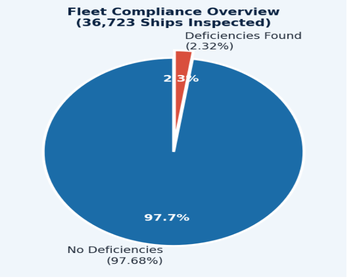
In a landmark safety initiative, the International Association of Classification Societies (IACS) has released findings from its year-long Concentrated Inspection Campaign (CIC) on Emergency Power Supply (EPS) Tests — the largest of its kind, covering over 36,723 vessels throughout 2025. Triggered by concerns raised by the Tokyo Memorandum of Understanding (MoU) over questionable “simulated blackout” test practices, the campaign has revealed critical gaps that put seafarer safety and SOLAS compliance at risk.
What the Numbers Tell Us
| Metric | Value |
|---|---|
| Total ships inspected | 36,723 |
| Ships with no deficiencies | 35,870 (97.68%) |
| Ships with deficiencies found | 853 (2.32%) |
| Inspection period | Jan–Dec 2025 |
| Campaign trigger | Tokyo MoU warning |
Anatomy of Failure: Where Ships Fell Short
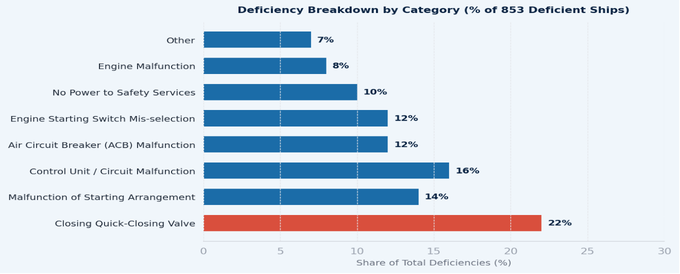
Among the 853 ships where deficiencies were recorded, failures clustered around a handful of recurring equipment and procedural issues.
| Deficiency Category | Share |
|---|---|
| Closing Quick-Closing Valve | 22% |
| Malfunction of Control Unit / Circuit | 16% |
| Malfunction of Starting Arrangement | 14% |
| Air Circuit Breaker (ACB) Malfunction | 12% |
| Engine Starting Switch Mis-selection | 12% |
| No Power to Essential Safety Services | 10% |
| Engine Malfunction | 8% |
| Other | 7% |
Root Causes: Three Industry-Wide Vulnerabilities
Equipment Reliability: Recurring failures in quick-closing valves, PCB/relay control circuits, and EDG starting systems point to systemic shortfalls in maintenance regimes, installation quality, and component lifecycle management.
Procedural Gaps in the SMS: Many Safety Management Systems lacked a formal procedure for conducting a controlled blackout test. Instead, widely-used “simulated blackout” tests bypass actual circuit paths — giving engineers a false sense of readiness that real emergencies will ruthlessly expose.
Human Factors: Crew unfamiliarity with EDG operation and incorrect selection of engine starting switch modes underline that training, competency, and safety culture remain decisive — and under-addressed — variables.
“Over 97% of ships inspected had no deficiencies, but the range of issues identified in the remaining cases — and the recommendations that follow — will play an important role in ensuring that emergency systems operate as intended, comply with SOLAS requirements, and enhance safety at sea.”
— Robert Ashdown, IACS Secretary General
What Needs to Change: IACS Recommendations
✓ Strengthen ISM Audits: Auditors should verify that detailed controlled blackout test procedures exist within company and shipboard SMS documentation, and assess whether testing arrangements genuinely demonstrate the full EPS system functionality.
✓ Review High-Frequency Failure Components: IACS will conduct further analysis to clarify inspection and testing cycles for quick-closing valves, control units, and starting devices — components that fail most frequently.
✓ Standardise Simulation Test Design: IACS will pursue studies to establish uniform design standards for emergency generator simulation tests, ensuring all designs comply with SOLAS requirements.
✓ Invest in Crew Training: Operators must close the gap in crew competency around EDG operation, including correct use of starting switch modes and overall emergency power system awareness.
Relevant SOLAS Regulations at a Glance
| SOLAS Regulation | Requirement |
|---|---|
| Ch. II-1 Reg. 42/43 | Automatic activation of Emergency Power Supply (EPS) |
| Ch. II-1 Reg. 42.7/43.7 | Periodic full-system testing of emergency power |
| ISM Code | Documented SMS procedures for all critical safety tests |