
FACTORS AFFECTING THE HEATING EFFECT OF SOLAR RADIATION
Why Does the Sun Heat Different Parts of the Earth Unequally?
The Sun is the primary source of energy for the Earth’s atmosphere, but not every location receives the same amount of heating. The intensity of solar radiation varies depending on the angle at which sunlight strikes the Earth’s surface and the characteristics of the surface itself.
These differences in heating are responsible for variations in air temperature, weather patterns, wind circulation, and climate across the globe. For mariners, understanding these factors provides valuable insight into the weather conditions encountered during a voyage.
The Angle of the Sun’s Rays
One of the most important factors affecting solar heating is the angle at which the Sun’s rays reach the Earth’s surface.
When the Sun is high in the sky, its rays strike the Earth more directly. The same amount of solar energy is concentrated over a smaller area, producing stronger heating. In addition, the rays travel through a thinner layer of the atmosphere, reducing energy loss due to reflection and scattering.
When the Sun is lower in the sky, the rays arrive at a more oblique angle. The energy is spread over a much larger area and passes through a greater thickness of the atmosphere before reaching the surface. As a result, less solar energy reaches the ground, and the heating effect is reduced.
The angle of the Sun’s rays changes throughout the day and across the seasons. It is mainly influenced by:
- Latitude
- Seasonal changes in the Sun’s declination
- The daily change in the Sun’s altitude
These factors explain why tropical regions generally receive more intense solar heating than higher latitudes.
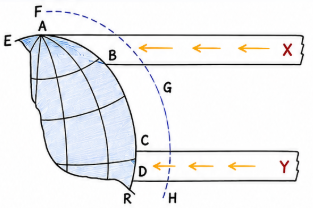
The diagram shows ER as a section of the Earth’s surface receiving two solar beams of equal intensity, X and Y. Beam X strikes the surface at an oblique angle, spreading the same amount of energy over the larger area AB. It also travels through a thicker section of the atmosphere (FGH), where more energy is lost through reflection and scattering before reaching the ground. In contrast, Beam Y reaches the surface almost vertically, concentrating its energy over the smaller area CD while passing through a thinner layer of the atmosphere. As a result, area CD receives more concentrated solar energy and experiences a greater heating effect than area AB.
The Nature of the Earth’s Surface
The type of surface receiving solar radiation also has a major influence on how much heat is absorbed or reflected.
Snow and Ice
Snow and ice have a high reflectivity, meaning they reflect a large proportion of incoming solar radiation. As a result, they absorb relatively little heat and remain much cooler.
Land Surfaces
Dry soil, sand, and bare rock absorb solar energy efficiently. Because heat penetrates only a shallow depth, these surfaces warm quickly during the day and cool rapidly after sunset. This leads to large daily temperature variations.
Ocean Surfaces
Water behaves very differently from land. The sea warms more slowly and cools more gradually because:
- Water has a high heat capacity.
- Solar energy penetrates several metres below the surface.
- Wind mixes warmer surface water with cooler water below.
- A significant amount of energy is used for evaporation.
- Water reflects more sunlight when the Sun is low on the horizon.
These characteristics make the oceans much more stable in temperature than land.
How Surface Heating Affects Air Temperature
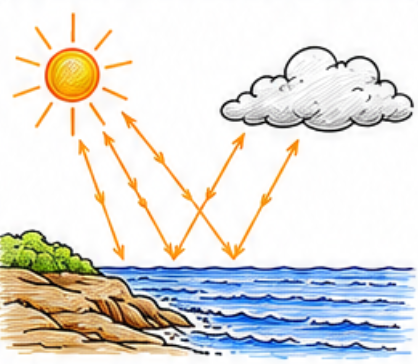
The air closest to the Earth’s surface is heated mainly by contact with the land or sea below it.
Because land heats and cools rapidly, the air above it also experiences larger temperature changes. In contrast, the relatively stable temperature of the ocean helps maintain more moderate air temperatures over the sea.
This is one reason why coastal regions generally experience smaller temperature variations than inland areas.
Other Factors That Influence Air Temperature at Sea
Although solar radiation is the primary source of heating, several additional factors affect air temperature over the oceans:
- Latitude – Areas closer to the Equator receive more direct sunlight and are generally warmer.
- Season – The changing position of the Sun throughout the year alters the amount of solar energy received.
- Proximity to Land – Nearby continents can warm or cool the surrounding air masses.
- Prevailing Winds – Winds transport warm or cold air from other regions.
- Ocean Currents – Warm and cold currents significantly influence coastal and marine temperatures.
- Upwelling – The rise of colder water from deeper layers can lower sea surface temperatures and cool the air above.
Together, these factors create the diverse weather and climate conditions experienced around the world.
Why This Matters to Mariners
Understanding how solar radiation heats the Earth is essential for interpreting marine weather.
Differences in heating influence:
- Air temperature
- Atmospheric pressure
- Wind circulation
- Cloud formation
- Sea breezes and land breezes
- Regional weather patterns
A sound understanding of these principles enables mariners to better interpret weather forecasts and appreciate the atmospheric processes affecting navigation and voyage planning.
Key Takeaways
- Solar heating depends on the angle at which sunlight reaches the Earth’s surface.
- Direct sunlight produces greater heating than oblique sunlight.
- Sunlight passing through a thicker atmosphere loses more energy before reaching the surface.
- Snow and ice reflect much of the incoming radiation, while land absorbs heat quickly.
- Oceans warm and cool more slowly than land due to their physical properties.
- Air temperature near the surface is strongly influenced by the type of surface below.
- Latitude, season, winds, ocean currents, and upwelling all contribute to temperature variations over the sea.
- Understanding these factors helps mariners interpret weather conditions and make informed navigational decisions.