How from code 30 to code 17
Ground for detention
The ship was detained due to the following detainable deficiency:
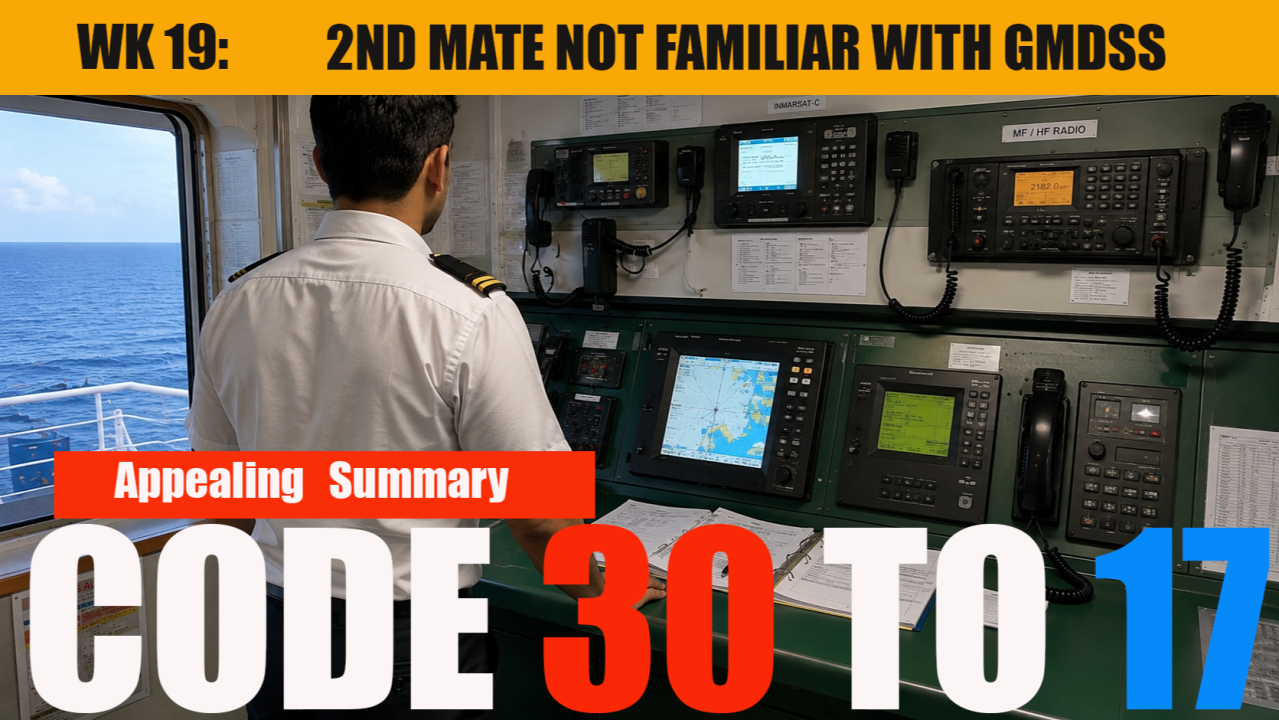
05118 Operation of GMDSS equipment – SECOND OFFICER NOT FAMILIAR WITH THE
OPERATION OF THE GMDSS RADIO
So it was decided to appeal with MOU
Dispute
.1 The Convention reference quoted for the detainable deficiency is SOLAS Chapter IV
Regulation 16, which requires radio personnel to have appropriate qualification and
certification, but, actually, in addition to the second officer, there are three other
officers with the relevant qualification and certificates on board the vessel; therefore it
is considered that the vessel fulfilled the requirements for distress and safety
radiocommunication;
.2 There may be some confusions between PSCOs and the second officer regarding
DSC test call or GMDSS radio; based on ship’s GMDSS logbook, the second officer
demonstrated his ability to carry out DSC test successfully; and
.3 Evidence provided by the Maritime Operations Centre concerned confirmed that test
calls from the vessel during the inspection were successfully transmitted and
received; such indicated that the vessel’s equipment was fully operational at the time
of the inspection and that shipboard personnel were capable of establishing distress
and safety radiocommunications.
Based on the above, the opinion that the detention (code 30) should be reconsidered and downgraded to code 17.
The port State Authority is of the opinion that:
.1 The initial action by the second officer in response to the PSCO’s request for a
GMDSS DSC test call was wrong (i.e.: making a voice call rather than a DSC test);
2. The second officer also failed to provide the reply/acknowledgement from the relevant
coast station for the DSC tests during the inspection; and
3. Based on the muster list, the second officer is the watchkeeping officer in charge of
operation of GMDSS equipment but he failed to demonstrate the required proficiency;
in accordance with procedures set out in paragraph 3.1.1 and subparagraph 3.1.1.4
of Port State Control Procedures 2011 (A.1052(27)), this would be considered for
making the ship substandard.
Based on the above, the detention was correct.
MOU Panel Decision
The panel members reviewed the relevant information and materials received. As the result
of evaluation, panel members reached general opinions as follows:
1. Based on guidance for PSC on GMDSS in the PSC Manual, “insufficient number of
qualified GMDSS operators and the inability of ship’s radio personnel to use ship’s
radio equipment” may warrant detention. But the vessel did have sufficient number of
personnel who could operate the GMDSS equipment correctly as evidenced by the
records and logs on board. This is further substantiated by the radio logs available
from the coast radio stations;
2. There is also no sufficient evidence to suggest that the second officer is so
insufficiently proficient to render the ship unsafe for sea. Moreover the ship is carrying
sufficient radio personnel, even after excluding the second officer, who are qualified;
3. Although at the time of testing, the non-acknowledgement of test calls may give the
impression that the equipment is not operational or the second officer is not proficient,
however after receiving the correspondences from radio station, the Port State should
consider to amend the detention since the ship is not considered to be unsafe;
4. From the information available, it appears that the PSCO had clear grounds to
conduct a more detailed inspection, insofar that the Master or crew (in this case the
second officer) was unable to demonstrate operation of a DSC test call. This was
attributed to the lack of operational knowledge of the second officer by the PSCO. In
this specific case, the presence of 3 PSCOs may have made the second officer
nervous, which would have adversely effected his ability to test the equipment. It
would be prudent that PSCOs would continue the inspection and return later, after
allowing time to test the equipment without the oversight of the PSCO, to ascertain
whether the issue was equipment or personnel related; and
5. The Convention reference (pertaining to the qualification of the radio personnel
(SOLAS Chap. IV/Reg.16)) appeared technically incorrect. The deficiency would
perhaps have been better attributed to an ISM deficiency under familiarization
required under element 6 of the ISM code.
Conclusion
The panel members are of the unanimous opinion that the decision of detention was not
justified. Therefore, the port State Authority would be asked to reconsider the decision of the
detention.