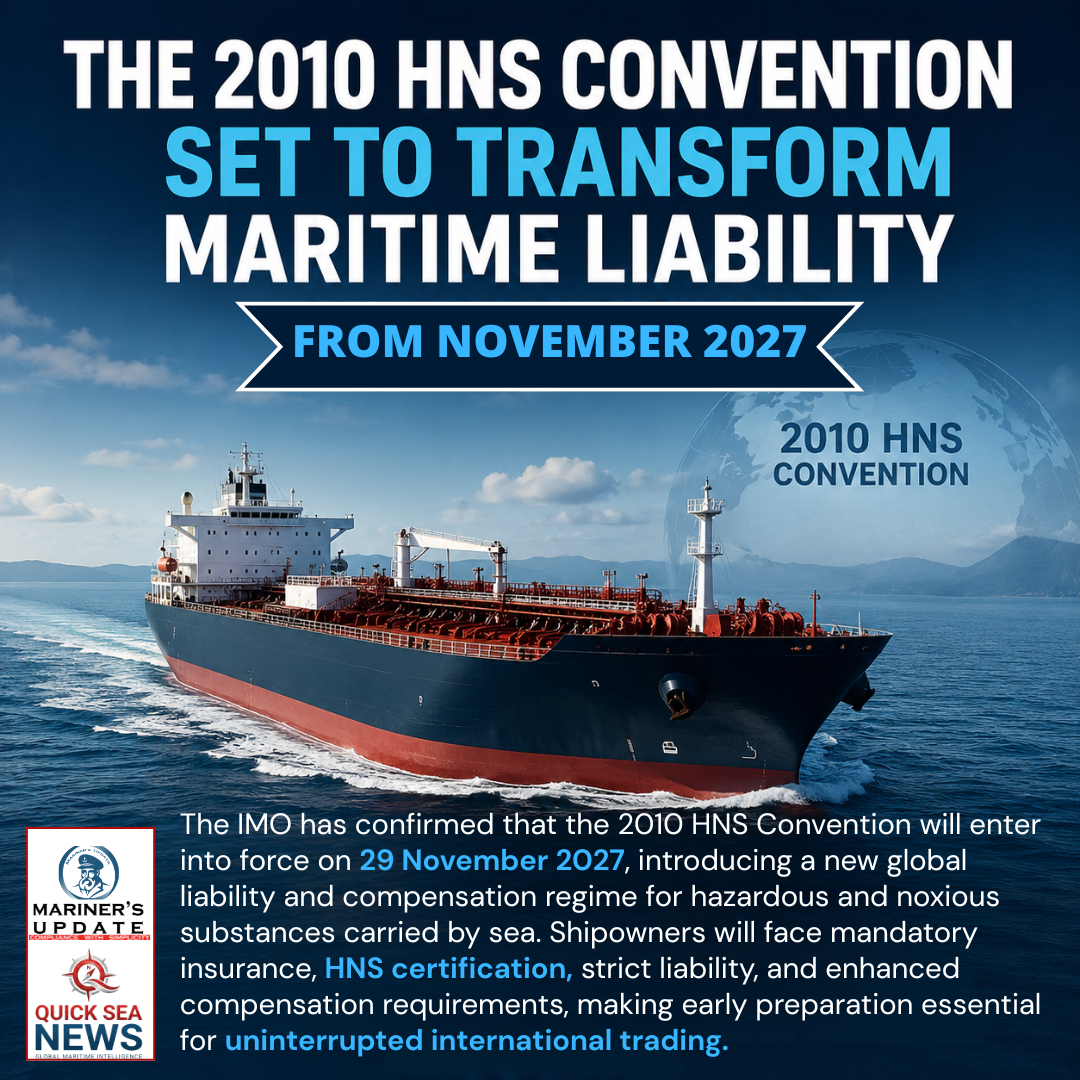
The International Maritime Organization (IMO) has officially confirmed that the 2010 International Convention on Liability and Compensation for Damage in Connection with the Carriage of Hazardous and Noxious Substances by Sea (2010 HNS Convention) will enter into force on 29 November 2027, marking one of the most significant developments in international maritime liability in recent decades.
The Convention’s implementation follows the successful fulfilment of all ratification requirements, including approval by 13 countries, surpassing the minimum requirement of 12 States. The ratifying nations also satisfy the required shipping tonnage and hazardous cargo contribution thresholds necessary for the Convention to become legally effective.
For shipowners, operators, charterers, cargo interests, insurers, flag administrations, and P&I Clubs, the Convention introduces an entirely new global liability and compensation framework governing incidents involving hazardous and noxious substances (HNS) carried by sea. It also establishes compulsory insurance requirements similar to those already applicable under other IMO liability conventions.
A Milestone More Than 30 Years in the Making
The original HNS Convention was adopted in 1996, but it never entered into force due to implementation challenges.
To overcome these issues, IMO adopted the 2010 Protocol, creating what is now known as the 2010 HNS Convention, providing a practical and internationally accepted compensation regime for HNS incidents.
Its primary objective is to ensure prompt, adequate and effective compensation for victims suffering damage arising from hazardous cargoes transported by sea.
Broader Scope Than Existing Oil Pollution Conventions
Unlike the 1992 Civil Liability Convention (CLC), which mainly applies to persistent oil pollution from tankers, the HNS Convention covers a much wider range of incidents.
The Convention applies not only to pollution damage but also to:
• Loss of life
• Personal injury
• Property damage
• Fire and explosion
• Environmental contamination
• Economic losses affecting fisheries and tourism
• Costs of preventive measures
This significantly broadens protection for governments, coastal communities, businesses, and affected industries following maritime accidents involving hazardous cargoes.
Which Countries Have Ratified?
At present, the following countries have ratified the Convention:
Belgium, Canada, Denmark, Estonia, Finland, France, Germany, Kingdom of the Netherlands, Norway, Slovakia, South Africa, Sweden and Türkiye.
Additional ratifications are expected before the Convention enters into force in November 2027.
Which Ships Will Be Covered?
The Convention applies to all seagoing ships carrying hazardous and noxious substances as cargo, regardless of vessel size unless specifically exempted.
Excluded vessels include:
• Warships
• Government-owned non-commercial vessels
• Certain domestic vessels under 200 GT carrying packaged HNS, where exempted by national legislation.
Currently, only Canada and Sweden have adopted this exemption.
Importantly, there is no general minimum gross tonnage threshold, meaning many relatively small cargo vessels will also require compliance.
Ships registered under non-Contracting States will still require HNS Convention Certificates when trading to Contracting States, making early preparation essential.
What Cargoes Are Covered?
The Convention applies to numerous hazardous and noxious substances listed under existing IMO Codes and Conventions, covering both:
• Bulk cargoes
• Packaged dangerous goods
However, it specifically excludes:
• Radioactive materials
• Plastic pellets (nurdles)
The IMO’s HNS Finder Tool will help operators determine whether specific cargoes fall within the Convention.
Geographical Application
The Convention applies to:
• Damage within the territory or territorial sea of a State Party
• Pollution damage within a State Party’s Exclusive Economic Zone (EEZ)
• Certain damage outside territorial waters involving ships registered in Contracting States.
The Convention only applies while HNS cargo is being carried by sea—from loading until discharge.
HNS Used as Fuel Not Covered
An important clarification is that the Convention only applies to HNS carried as cargo.
It does not apply to hazardous alternative fuels used for propulsion, including:
• LNG
• LPG
• Methanol
• Ammonia
Liability for incidents involving these fuels will continue to depend upon domestic legislation until a dedicated international regime is introduced.
Strict Liability for Shipowners
The Convention introduces strict liability for the registered shipowner.
Following an HNS incident, the owner becomes liable regardless of fault unless limited statutory defences apply, including:
• War or civil unrest
• Exceptional natural disasters
• Intentional acts of third parties
• Government negligence relating to navigational aids
• Failure by cargo interests to properly declare hazardous cargo.
Other parties such as Masters, crew, managers, operators and charterers are generally protected from direct liability under the Convention.
Higher Liability Limits
Shipowners retain the right to limit liability based upon vessel gross tonnage.
Maximum limits include:
Bulk HNS
• Up to 100 million SDR
Packaged HNS
• Up to 115 million SDR
These limits can only be broken where intentional or reckless misconduct by the owner is proven—a deliberately high legal threshold.
Creation of the HNS Fund
One of the Convention’s most significant features is the establishment of the HNS Fund.
This creates a second compensation layer when:
• Shipowner liability limits are exceeded
• The shipowner cannot financially satisfy claims.
Combined compensation from the shipowner and the HNS Fund can reach 250 million SDR for a single incident.
Unlike shipowners, the Fund is financed by receivers of specified HNS cargoes in Contracting States, sharing financial responsibility across the maritime supply chain.
Compulsory Insurance Requirements
The Convention introduces mandatory insurance obligations.
Owners carrying HNS cargoes must:
• Maintain approved financial security
• Obtain an HNS Convention Certificate
• Carry evidence of insurance onboard.
Insurance will typically be confirmed through a Blue Card, issued by the insurer, allowing direct legal action against insurers where applicable.
Claim Time Limits
Claims must be filed:
• Within 3 years from when damage became known.
• No later than 10 years after the incident occurred.
Preparing for November 2027
With less than two years before implementation, shipping companies should begin preparations immediately.
Key priorities include:
• Identifying vessels requiring HNS Certificates.
• Reviewing trading routes involving Contracting States.
• Confirming insurance arrangements.
• Coordinating with flag administrations.
• Engaging insurers and financial security providers early.
• Reviewing cargoes carried under HNS definitions.
Early preparation will help avoid certification delays and ensure uninterrupted international trading once the Convention enters into force.
Conclusion
The 2010 HNS Convention represents a landmark shift in global maritime liability. By introducing mandatory insurance, strict shipowner liability, higher compensation limits, and an international HNS Fund, the Convention strengthens protection for victims while creating new compliance responsibilities for the shipping industry.
Shipowners, operators, charterers, insurers, and flag administrations should use the remaining time before 29 November 2027 to review their fleets, insurance arrangements, trading patterns, and certification requirements to ensure full compliance from day one.