
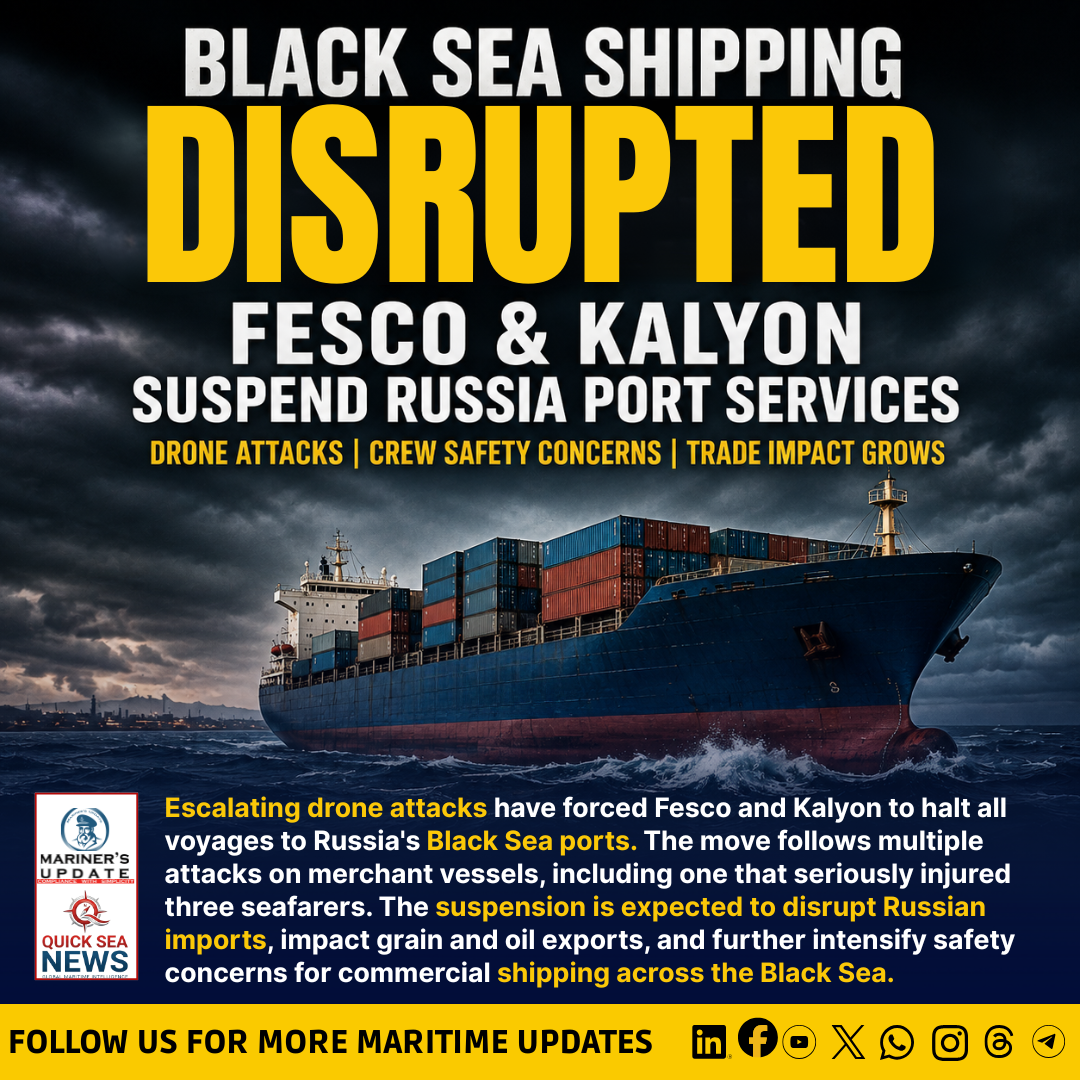
The security situation in the Black Sea has taken another dramatic turn after two major shipping operators—Russia’s state-owned Fesco and Turkish regional carrier Kalyon—announced the suspension of all services to Russia’s Black Sea ports following a series of Ukrainian drone attacks on merchant vessels.
The decision marks a significant disruption to regional maritime trade, affecting cargo movement, supply chains, energy exports, and the safety of commercial shipping operating in one of the world’s most strategically important waterways.
Fesco Suspends Black Sea Operations
Russian state-owned shipping giant Fesco has halted all container services to Russia’s Black Sea ports, including the key gateway of Novorossiysk.
The suspension is expected to severely disrupt Russia’s imports from East Asia, as cargo that would normally arrive through Novorossiysk will now have to be rerouted either:
- Via the Russian Far East using rail transport across the country, or
- Through the Baltic port of St. Petersburg before being distributed inland.
The shift is expected to increase transportation costs, extend transit times, and place additional pressure on Russia’s domestic logistics network.
Series of Attacks Prompt Immediate Action
The suspension follows several recent attacks targeting merchant vessels operating in the region.
Among the major incidents were:
- The reported loss of the Fesco container ship Yanina.
- An attack on the container vessel LDR Yasar.
- A Ukrainian drone strike on the Turkish ro-ro vessel Nadezhda near Novorossiysk.
The attack on Nadezhda struck the vessel’s accommodation block, seriously injuring three crewmembers and once again highlighting the growing dangers faced by civilian seafarers operating in the conflict zone.
Crew Safety Becomes the Primary Concern
Turkish shipping operator Kalyon announced that it has temporarily suspended all voyages serving Russian ports in the Black Sea.
The company stated that protecting the lives of its seafarers remains its highest priority.
According to Kalyon, the worsening security situation has led most of its crews to refuse further assignments on Russian routes due to the escalating risks. As a result, the company stated that maintaining regular operations has become operationally impossible.
The announcement underscores the increasing reluctance among commercial crews to sail through high-risk conflict areas.
Turkey Calls for Protection of Merchant Shipping
Following the recent attacks, Turkey’s Foreign Ministry urged both Russia and Ukraine to refrain from targeting civilian merchant vessels.
The ministry expressed deep concern that the conflict is increasingly spreading into commercial shipping lanes across the Black Sea.
Turkey warned that continued attacks on civilian vessels could have far-reaching consequences beyond regional security, particularly for global food supply chains and international trade.
Officials also cautioned that unless preventive measures are implemented, the escalating maritime conflict could create serious economic and humanitarian consequences.
Ukraine’s Maritime Trade Also Under Heavy Pressure
While Russian shipping is facing increasing disruption, Ukraine’s commercial shipping sector continues to suffer from sustained Russian drone and missile attacks.
Merchant shipping activity around the Odesa region has slowed dramatically as repeated strikes have damaged vessels, terminals, and port infrastructure.
The disruption has significantly affected Ukraine’s exports of grain and steel—two of its most important economic sectors—and has also impacted government revenues needed to support ongoing wartime operations.
Oil Exports Continue to Decline
The maritime conflict is also reshaping regional energy exports.
According to shipping association BIMCO, Ukraine’s continued strikes on Russian tankers have reduced crude oil loadings from Russian ports in the Sea of Azov and the Black Sea by more than 60%.
The association also estimates that exports of Kazakh crude through the Caspian Pipeline Consortium (CPC) have fallen by approximately 60%, illustrating that the conflict is increasingly affecting international energy supply chains beyond Russia and Ukraine.
Growing Risks for Global Shipping
The suspension of services by both Fesco and Kalyon reflects a rapidly deteriorating security environment in the Black Sea.
With commercial vessels increasingly becoming casualties of military operations, shipowners, operators, insurers, and seafarers are facing unprecedented operational and safety challenges.
As attacks continue and shipping services are withdrawn, the Black Sea remains one of the world’s most volatile maritime regions, with consequences extending well beyond regional trade to global supply chains, food security, and energy markets.