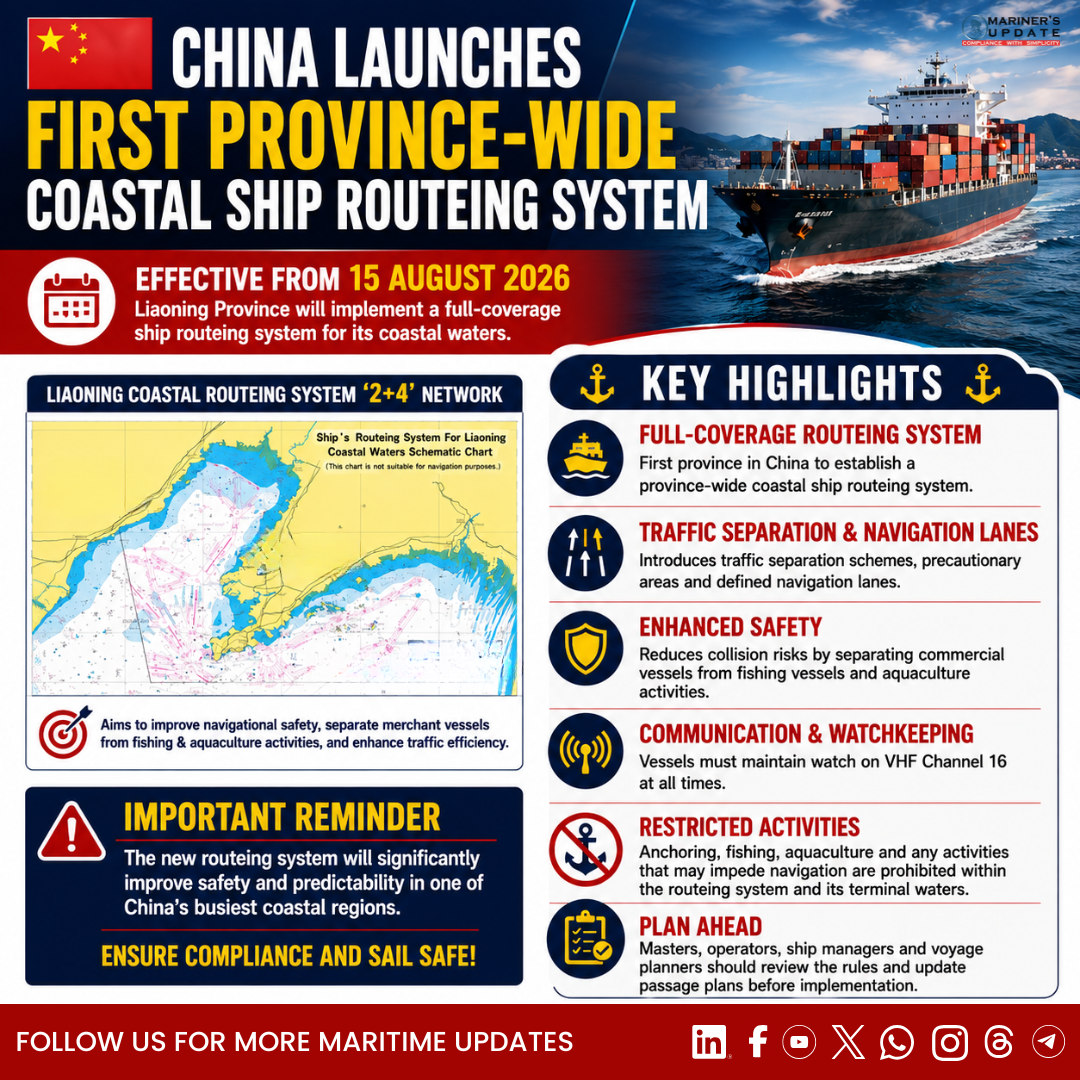
China is set to introduce a major enhancement to coastal navigation safety with the implementation of a full-coverage ship routeing system across Liaoning Province from 15 August 2026.
According to the China Maritime Safety Administration (MSA), Liaoning will become the first province in China to establish a province-wide coastal ship routeing network. The new “2+4” routeing system will cover key maritime areas including the northern Yellow Sea, Laotieshan Channel, and approaches to the Bohai Sea, creating a more structured and predictable traffic management framework.
The initiative aims to improve navigational safety in one of China’s busiest coastal regions by introducing traffic separation schemes, precautionary areas, and clearly defined navigation lanes. A primary objective is to reduce collision risks by separating commercial vessel traffic from fishing vessels and aquaculture operations, which have historically contributed to navigational hazards in the region.
Under the new regulations, vessels are expected to use designated routeing waters whenever applicable. Ships transiting the area must maintain a listening watch on VHF Channel 16, minimize crossing of traffic lanes, and exercise heightened caution within precautionary and connection areas.
The regulations also prohibit anchoring, fishing, aquaculture activities, and any other operations that could obstruct safe navigation within the routeing system and its terminal waters.
Industry experts expect the new framework to enhance traffic predictability, improve port efficiency, strengthen navigational safety, and support smoother vessel movements throughout Liaoning’s coastal waters.
The changes will directly affect vessels calling at major Liaoning ports, including Dalian, Yingkou, Jinzhou, Panjin, Huludao, and surrounding coastal terminals. Ship managers, masters, operators, navigators, and voyage planners are advised to review the official routeing requirements and update passage plans well ahead of the implementation date.
As maritime traffic continues to increase along China’s northern coastline, the new routeing network represents a significant step toward modernizing vessel traffic management and reducing operational risks in strategically important waters.